

Operational leverage is just as important for scaling a self-storage portfolio as capital. For operators looking to grow beyond a single site, the primary constraint is rarely demand—it is the administrative burden of managing that demand.
Consider a common scenario: a prospective tenant visits your rental website, selects a unit, and abandons the checkout. In a manual environment, that lead is effectively lost. In a modern, automated environment, that same prospect is instantly captured, segmented, and re-engaged through an automated lead re-marketing campaign—triggering follow-up emails or SMS messages, re-presenting availability and pricing, and converting demand without adding headcount. Without the right technology stack, expanding your footprint means increasing overhead, which dilutes Net Operating Income (NOI).
Modern self-storage software is the infrastructure that allows a portfolio to scale. Features like automation enable operators to absorb more leads, more tenants, and more facilities without a proportional increase in labor costs. Automated lead follow-ups, standardized communications, and portfolio-wide workflows allow operators to add new assets without needing to add an army of staff. Whether you are stabilizing a recent acquisition, preparing a portfolio for an institutional exit, or simply growing your business, your self-storage management software determines your ability to execute standardized workflows, enforce revenue management strategies, and maintain centralized control.
This guide explores the strategic role of self-storage management software in driving asset value, dissecting the features that enable true scalability, and comparing the top platforms powering the industry today.
Key Takeaways
Self-storage management software is a specialized property management system (PMS) designed to handle the unique operational lifecycle of storage units. Unlike residential or commercial PMS, storage unit software must handle high-volume turnover, short-term leases, delinquency lockouts, and intricate gate access integrations.
For a small business, self-storage software might simply be a tool to automate the collection of rent. But for institutional operators, it is a comprehensive ecosystem that automates:
The market distinguishes between self-storage software for small business—which prioritizes simplicity and low cost—and enterprise platforms like Monument designed for complex, multi-site portfolios. Understanding this distinction is critical: a “simple” tool will cap your growth, while an enterprise solution provides the leverage needed to scale.

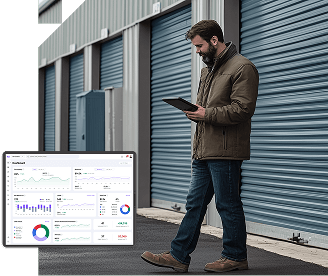
In the high-stakes world of self-storage investment, software is no longer just a utility for tracking rent—it is the primary lever for operational efficiency and asset valuation. The industry has moved beyond the era of “mom-and-pop” management styles; today, the difference between a stagnant portfolio and a high-performing REIT-ready asset often lies in the capabilities of the self-storage management software itself.
For operators aiming at growing the number of facilities they manage, the challenge is not just acquiring more units, but managing them without a corresponding explosion in overhead. True scalability requires a technology stack that disconnects revenue growth from labor costs, ensuring that every dollar of additional revenue flows more efficiently to the bottom line.
The following table outlines how scalable software transforms key operational levers compared to traditional manual approaches:
| Operational Lever (Client Success & Support) |
Manual / Legacy Approach | Scalable Software (Monument’s Approach) | Business Impact |
| Headcount & Labor | Linear growth: Adding a facility means adding staff. Manual processing of delinquency letters and lockouts. | Decoupled growth: Centralized ops manage unlimited units. Smart triggers automate notices and gate access lockouts. | Reduced Payroll % / Higher NOI |
| Rent Increases | Manual, sporadic, and emotionally driven. Managers hesitate to raise rates on long-term tenants. | Automated ECRI (Existing Customer Rent Increase) based on data, tenure, and market demand. | Maximized Revenue Per Square Foot (RPSF) |
| Acquisitions of Additional Facilities | Slow integration; distinct legacy databases and bespoke workflows per site. | “Plug-and-play” integration; rapid data migration and immediate application of standard SOPs. | Rapid Asset Stabilization |
| Financials | Fragmented spreadsheets; cash-basis accounting that requires manual reconciliation. | Centralized, GAAP-compliant, accrual-based accounting with audit trails. | Higher Asset Valuation / Exit Price |
The traditional management model is linear: if you double the number of facilities, you typically double the payroll. This is a trap that caps Net Operating Income (NOI).
Scalable storage facility software breaks this linear relationship. By automating core functions—such as collections, move-ins, and auction processing—enterprise-grade automation allows operators to manage significantly increasing unit counts without a proportional rise in administrative headcount.
Without scalable software, operators are forced to manage facilities as isolated “islands.” A Regional Manager may need to log into separate systems for 15 different facilities to analyze performance or adjust pricing, resulting in wasted time and inconsistent processes. Scalable storage facility management software, such as Monument, resolves this by offering a portfolio-first architecture, allowing leaders to:
To scale profitably, operators must decouple revenue growth from expense growth without sacrificing lead capture or conversion velocity. Enterprise-grade software leverages automation not only to reduce the manual workload on call centers and site managers, but also to systematically increase top-line revenue by ensuring every lead is followed up with speed and consistency. This includes:
Implementing automated or “unmanned” management models can reduce staffing costs by up to 40%, a key lever for profitability, especially in smaller facilities.
Revenue management is the single most effective way to increase the value of a storage asset, yet it is often the most neglected due to fear of tenant churn or lack of data visibility .
As portfolios grow, the financial stakes increase. “Mom and pop” style management, which relies on flat rates or “gut-feel” rent adjustments, leaves significant revenue on the table. Scalable software provides the sophistication usually reserved for Real Estate Investment Trusts (REITs), including:
This systematic approach ensures that your Revenue Per Square Foot (RPSF) keeps pace with inflation and market demand, directly boosting the asset’s capitalization value.
Demand in self-storage is hyper-local and fluctuates weekly. If a specific unit size (e.g., 10×10 climate-controlled) reaches 90% occupancy, your storage unit management software should automatically dynamic-price the remaining units at a premium. Conversely, if occupancy dips, the system should instantly feed data to your self-storage website software to apply a promotion, ensuring the business captures high-intent traffic immediately. Some operators report that ~50% of new customers rent directly through call centers or websites without visiting the office, so optimizing your conversion funnel is definitely worth the time and effort investment.
For property aggregators and investment groups, the speed at which you can stabilize a new asset determines the success of the acquisition. A scalable software architecture enables the seamless integration of new assets into the portfolio.
When you acquire a new facility, inheriting a legacy database or a shoebox of leases is a liability. You need a self-storage management system that allows for rapid data migration and the immediate application of your standard operating procedures (SOPs).
As operators grow, they often need specialized third-party tools for access control, marketing, or pricing. Unlike legacy systems that may restrict integrations, scalable modern platforms utilize an “open ecosystem” approach. This API-first infrastructure allows operators to integrate best-in-class third-party vendors, ensuring their technology stack can evolve alongside their business needs, protecting them from being locked into a single vendor’s ecosystem.
Ultimately, the goal of most operators is to exit or refinance at a favorable cap rate. Institutional investors and REITs do not just buy buildings; they buy income streams verified by data.
A major pain point for growing operators is the inability to get a unified view of business health. Without centralized software, executives spend hours manually aggregating spreadsheets from disparate systems. Scalable solutions offer:
To maximize asset value and achieve a favorable cap rate upon exit, financial reporting must be impeccable. Scalable self-storage reporting software ensures consistent adherence to GAAP (Generally Accepted Accounting Principles). Unlike basic cash-basis tools, enterprise platforms support accrual accounting and private equity-grade accounting that integrates seamlessly with general ledgers. If your accounting software for self-storage business cannot produce a clean, consolidated P&L across multiple entities, you risk devaluing your portfolio during the sale process.

When evaluating software for storage units, look beyond the interface. Interrogate the workflow.
The modern tenant expects an Amazon-like experience. Your self-storage rental software must support:
Cash flow continuity is non-negotiable. Top-tier accounting software for self-storage business integration is vital.
Your software is your inventory ledger. It must track:
This is where the digital meets the physical. Self-storage facility software must sync perfectly with your gate and door systems (e.g., PTI, Nokē, OpenTech).
Collections and marketing rely on communication. Look for self-storage software programs that offer:
Your facility’s website is your highest-performing leasing agent. In an era where 60-70% of rentals begin on a mobile device, it is not enough to have a brochure site; you need transactional self-storage website software that functions as a fully automated sales engine.
You cannot improve what you do not measure. However, data without context is noise. Self-storage reporting software should deliver actionable intelligence, not just data dumps. For institutional operators, reporting is the bridge between operational reality and investor confidence.
Self-storage software technology is shifting from simple management tools to highly integrated, AI-driven ecosystems that enable fully remote and automated operations.

Selecting the best self-storage facility management software depends on your portfolio size, growth strategy, and budget.
The following table provides a high-level comparison of the dominant players in the self-storage software companies market.
| Platform | Best For | Strengths | Considerations |
| Monument | Growing multi-site operators; 3rd Party Managers | Enterprise-grade scalability, portfolio controls, automations, real-time insights & best-in-class client support | Can feel “more than you need” for single-site operators; all-inclusive pricing based on the number of units |
| Sitelink | Broad market / legacy-heavy portfolios | Familiar workflows, wide adoption, lots of “built-in” functionality | Often seen as dated UI / heavier workflows, the ecosystem can feel rigid depending on the stack |
| Storable Edge
(StorEDGE) |
Operators wanting an “all-in-one” experience | Strong tenant management + communications; revenue tools; modern suite feel | Forcing operators to “upgrade” from SiteLink, even though the reporting is much weaker, lacks true multi-facility management capabilities |
| Cubby | Mid-size operators optimizing operations | Operational dashboarding + call-center oriented workflows; streamlined ops | Does not scale well for larger operators; depth of automation; one-size-fits-all approach |
| Tenant Inc. | Operators prioritizing flexibility & integrations | Automations; online rental support | “Closed ecosystem and unintuitive; targeting a broader segment of “independent operators” |
| Self-Storage Manager | Price-sensitive operators / smaller portfolios | Straightforward core management functions; typically positioned as simpler and budget-friendly | Does not scale well for larger operators; may lack enterprise-level automations and revenue optimization |
If you are a single-site operator with 200 units, simple online storage rental software might suffice. However, if you are building a portfolio that will continue to add facilities and provide investors with superior financial performance, you need a management system for self-storage business that offers the audit trails and revenue management sophistication of a platform like Monument.
The era of a storage facility run on a spiral notebook is over. In today’s compressed cap rate environment, your choice of self-storage software is a direct driver of asset value.
Whether you need software for self-storage to automate a single unmanned site or a self-storage management system to control a national portfolio, the goal remains the same: operational leverage. By automating the mundane and surfacing the critical, the right software transforms your facility from a simple warehouse into a high-performance financial asset.
Book a demo with Monument today to discover how our enterprise-grade platform can maximize your portfolio’s potential.


Explore top facility management software systems for self-storage, including key features, benefits, and how these...

Discover how 3rd party self storage management improves operations, revenue, and NOI—and what to look...

Maximize NOI with web-based self-storage software. Discover why modern portfolios require cloud-native management solutions for...