


While the self-storage industry was once run mostly by small business owners with one or two locations, the last decade has seen an unprecedented amount of investment from institutional players. Due to this investment, the self-storage industry is now a $44.3 billion market.
As big investment firms pour more money into self-storage than ever before, the software used to run these businesses must move past old, manual ways of working to handle the complicated needs of large portfolios. Selecting the right facility management platform is an important consideration, as your choice can significantly affect your portfolio’s operational and financial infrastructure. While many operators focus on the upfront license fee, a sophisticated analysis reveals that true self-storage software cost is measured in its impact on Net Operating Income (NOI) and overall asset valuation.
A software platform that fails to optimize revenue or automate complex workflows at scale can act as a silent tax on your business, eroding the cap rate through missed opportunities and operational friction. Conversely, an enterprise-grade system aligned with your growth strategy can transform your management stack from a cost center into a powerful engine for value creation.
This article examines dominant self-storage software pricing in the industry, identifies the hidden costs of legacy “walled garden” systems, and illustrates why a value-based pricing approach is essential for scaling a professional portfolio.
In the capital-intensive world of self-storage, software is no longer a peripheral utility; it is the engine driving NOI and asset valuation. As portfolios scale, the transparency and alignment of a software vendor’s pricing model become as critical as the features themselves.
For sophisticated operators, self-storage software cost should be viewed through the lens of ROI and incentive alignment, rather than merely as a line-item expense. The industry currently operates under three primary pricing frameworks, as summarized in the table below.
| Model | Primary User | Structure | Strategic Impact |
| Flat Monthly Fee | Mom-n-Pop Operators | Fixed cost per month/facility | High predictability; low technological ceiling. |
| The “Trojan Horse” | Legacy Portfolios | Low base fee + high ancillary markups | Hidden costs; vendor-locked ecosystem. |
| Shared Success | Enterprise Portfolios | Percentage of gross revenue. | Direct alignment with revenue growth. |
Each of these frameworks reflects a different philosophy regarding operator partnership and technological sophistication.
Commonly utilized by entry-level providers and smaller competitors, the flat-fee model treats self-storage software as a commodity service. This structure provides a static, predictable expense for single-site operators managing facilities with limited operational complexity. However, these platforms often reach a technological ceiling and lack the enterprise-grade features required for institutional management, such as accurate accrual accounting or portfolio-wide automation rules. In this “you get what you pay for” scenario, the vendor has little incentive to innovate or provide the high-touch support necessary to optimize an asset’s performance
This model is the hallmark of the legacy incumbent, characterized by a low initial entry price that masks the true cost of ownership. Operators are frequently lured by a nominal license cost, only to find that essential functions—such as optimized websites, payment processing, and revenue management tools—are offered as “add-ons” with significant markups. Once all necessary modules are integrated to run a professional self-storage business, the total cost often meets or exceeds premium alternatives, yet lacks the cohesion of a purpose-built system. Furthermore, by controlling these ancillary services, vendors create a closed ecosystem that limits the operator’s ability to integrate with preferred third-party providers, effectively stripping the operator of choice and control.
Monument’s pricing model is built around transparent, tier-based subscriptions—Core, Pro, and Enterprise—designed to match the operational complexity of sophisticated operators. Each tier includes a comprehensive set of capabilities, with no hidden fees, required upsells, or surprise add-ons. What you select is what you get—fully enabled.
Unlike competitors that advertise a lower base price and then layer on fees for essential tools (e.g., rental websites, analytics, automations, revenue management, integrations), Monument’s pricing is structured to reflect the true cost of running a modern, enterprise-grade portfolio. While Monument’s entry price may appear higher at first glance, operators often find that once competitive add-ons are factored in, total per-unit costs are equivalent—or even higher—than Monument’s all-inclusive tiers.
Monument’s per-unit pricing model also creates direct economic alignment between the platform and the operator. Because all revenue in self-storage comes from units, pricing the software on a per-unit basis ensures operators pay in proportion to the revenue potential of their assets. As occupancy grows, rents increase through disciplined ECRI (Existing Customer Revenue Increase) execution, and NOI expands, Monument scales alongside the operator’s success.

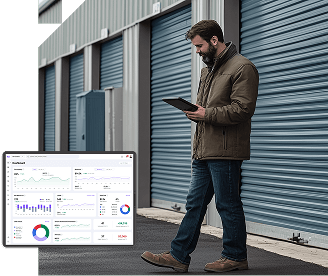

For the institutional operator, the headline self-storage software license pricing is rarely the actual cost of the platform. Legacy systems, often built on outdated architectures, impose a series of hidden taxes that erode NOI through operational friction, limited flexibility, and forced service adoption. Understanding these costs is essential for any executive calculating the actual Total Cost of Ownership (TCO) of their technology stack.
Many legacy incumbents (and even some modern ones) claim to operate open ecosystems, yet in practice, they maintain structural advantages for their preferred or acquired products. A closed ecosystem is not always about refusing integrations outright—it is often about how those integrations are prioritized, structured, and supported.
Legacy software was often designed for single-facility management and later retrofitted for portfolios. This lack of native scalability creates a significant operational drag as the number of assets increases.
A common frustration among operators is the frequency with which legacy providers charge additional fees for functionality that should be considered essential for modern operations.
In a consolidating market, the decision to remain on a good enough legacy platform is often a choice to accept substantial opportunity costs. While the self-storage software cost may appear to be managed, the unseen revenue leakage—stemming from outdated pricing models and underoptimized digital funnels—can significantly depress an asset’s cap rate and overall valuation.
In a consolidating market, the decision to remain on a “good enough” legacy platform is often a choice to accept substantial opportunity costs. While the software expense may appear managed, the unseen revenue leakage from primitive pricing models can significantly depress an asset’s cap rate and overall valuation. Most incumbent software utilizes static pricing rules or flat-rate increases that fail to account for the nuances of local market demand. Operators frequently forfeit an estimated 5% and 15% of potential incremental revenue by failing to implement sophisticated, demand-based ECRI strategies.
Monument provides REIT-level revenue management that allows operators to adjust rates dynamically based on real-time inventory levels and demand triggers. Unlike basic systems, Monument’s tools analyze tenant behavior and churn sensitivity to identify which cohorts are most likely to retain after an increase, ensuring NOI growth without compromising occupancy. Key expanded capabilities include:
A website that merely functions as an online brochure rather than a high-performance e-commerce engine is a primary source of revenue loss. Non-optimized rental sites lead to high drop-off rates and significant friction, particularly during the checkout process. Monument addresses this lead leakage by automatically capturing abandoned carts and converting them into actionable leads for follow-up. By utilizing a mobile-first, white-labeled rental website integrated directly into the backend, Monument ensures that inventory and pricing are reflected in real-time. This infrastructure facilitates a seamless transaction from the first click to the final lease signature, helping operators capture the largest possible basket of goods.
Scaling a portfolio to 20, 50, or 100+ locations without centralized business intelligence is a high-risk strategy that limits an executive’s ability to pivot based on market shifts. Without deep Insights, operators effectively fly blind, lacking visibility into the correlation between marketing spend and actual unit yield. Furthermore, the inability to provide sophisticated, GAAP-compliant accrual reports can stall fundraising efforts or lead to lower valuation multiples during an exit. Monument transforms raw data into actionable knowledge through almost 100 integrated graphs and dashboards. This level of analytical rigor allows owners to provide professional, data-backed reports to ownership and stakeholders with a degree of confidence typically reserved for public REITs.
In the institutional self-storage sector, the most expensive software is rarely the one with the highest license fee; rather, it is the one that fails to maximize the value of the underlying real estate. To properly evaluate a platform, an operator must look beyond the monthly subscription and analyze its impact on NOI (Net Operating Income), asset value, and long-term portfolio scalability.
This is especially true when comparing transparent, enterprise-grade platforms with lower-priced systems that require multiple add-ons to achieve full functionality.
The fundamental metric of self-storage valuation is the relationship between income and asset value. Storage facilities are valued using a capitalization rate:
Value = NOI / Cap Rate
At stabilized institutional self-storage cap rates (typically 5%–6.5%), every $1 of additional NOI translates to approximately $15 to $20 of increased asset value.
That multiplier effect is what makes software selection a capital allocation decision—not an expense management decision.
Consider a mid-sized operator choosing between:
At first glance, a competing platform may appear meaningfully less expensive than Monument. The base license might look lower on paper. But that comparison is rarely apples-to-apples.
Here is what typically happens in practice.
A budget-tier system might quote a lower per-unit fee. However, essential capabilities often sit behind add-ons:
Once those modules are added, the “lower” price begins to climb.
To make this concrete:
Imagine a 10,000-unit portfolio.
If a platform advertises a price that is $0.05 lower per unit per month, that appears attractive. On 10,000 units:
That feels like meaningful savings.
But if advanced pricing, automation, analytics, or website functionality each require separate add-ons, the operator may easily add back $0.04–$0.07 per unit in incremental fees. Suddenly:
More importantly, the real financial impact rarely comes from the fee itself. It comes from what the platform enables—or fails to enable.
If stronger pricing tools increase average rent by just $2 per unit per month, on that same 10,000-unit portfolio:
Even if only a fraction of that is incremental NOI, the upside dwarfs a few thousand dollars in subscription variance.
In other words:
Saving $6,000 in software fees is immaterial if the platform leaves $100,000+ of pricing and automation-driven revenue on the table. This is why serious operators evaluate total economic impact—not just the headline subscription rate.
The difference between “cheap” and “expensive” software is rarely measured in license cost. It is measured in lost pricing power, missed ECRI execution, manual inefficiencies, and suppressed NOI.
When evaluating self-storage software pricing, the focus must remain on total economic impact—not headline subscription rates.
A platform that appears cheaper by a few cents per unit per month can quickly lose its pricing advantage once revenue management, automation, analytics, and website functionality are added back in. And even more critically, small deficiencies in pricing execution or automation can suppress six figures of annual NOI across a mid-sized portfolio.
In a business where:
Software selection is not an operating expense decision. It is a capital allocation decision.
Monument’s Core, Pro, and Enterprise tiers eliminate hidden fees and feature gating. Everything included in the selected tier is fully enabled. Operators are not forced into modular upgrades just to access essential functionality.
More importantly, Monument’s per-unit pricing model aligns directly with how self-storage businesses generate revenue. Because all income is derived from units:
This is not about paying more for software. It is about preventing revenue leakage and protecting enterprise value.
The real question is not “What does this software cost per unit?” It is “What is the opportunity cost of leaving pricing power, automation efficiency, and NOI growth unrealized?”
For operators focused on portfolio scalability, disciplined revenue management, and long-term asset appreciation, transparent tiered pricing with economic alignment is not an expense line item—it is part of the growth strategy.
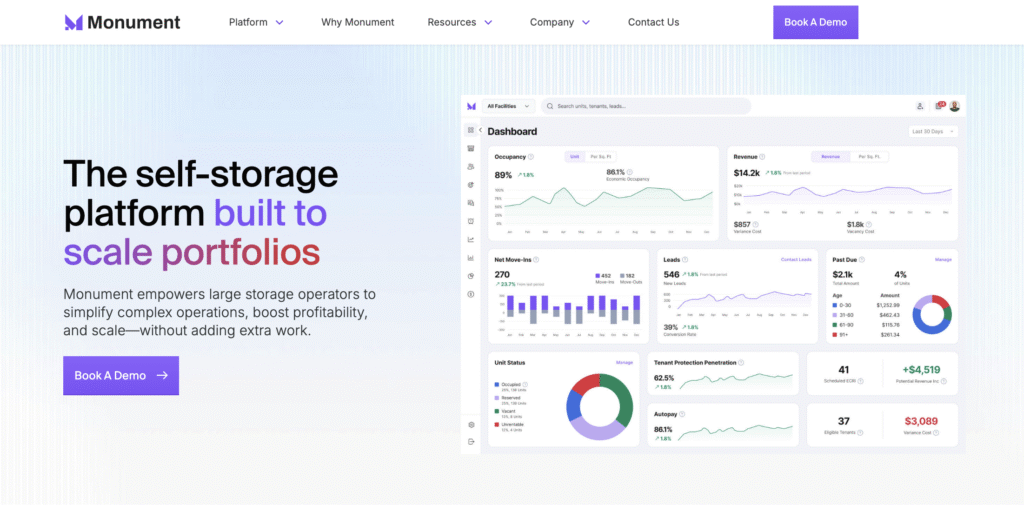
Monument’s pricing structure is designed to eliminate the friction, feature gating, and hidden fees that characterize many legacy systems. Instead of masking true costs behind modular add-ons, Monument offers clearly defined tiers—Core, Pro, and Enterprise—so operators understand exactly what they are purchasing from day one.
For sophisticated operators managing multi-facility portfolios, the value proposition is simple: transparent pricing that scales with portfolio size and operational complexity—without penalizing growth.
Unlike competitors that advertise a low entry price and then add fees for critical functionality, Monument includes everything in the selected tier.
There are:
Core functionality—such as conversion-optimized rental websites, automation engines, portfolio-wide analytics, and revenue management tools—is included in the selected tier.
This ensures operators can execute a high-performance, NOI-focused strategy without renegotiating their contract every time they need a capability that should have been standard from the start.
Monument offers three transparent tiers so operators can align platform capabilities with portfolio complexity and growth strategy.
Designed for operators who require strong multi-facility control and automation, Core includes:
This tier supports disciplined operations without unnecessary complexity.
Pro expands automation and revenue capabilities for growing portfolios and third-party managers, including:
This tier is engineered for operators focused on consistent revenue lift and improved NOI performance.
Enterprise delivers institutional-grade control and modeling capabilities, including:
This tier is designed for large operators, private equity-backed platforms, and institutional portfolios that require full visibility and enterprise scalability.
Monument’s pricing operates on a per-unit model. This creates direct economic alignment with operators because all revenue in self-storage is generated from units.
As portfolios grow:
This is not a flat SaaS fee disconnected from business performance. It is a structure aligned with how storage operators actually generate income.
While Monument’s entry price may appear higher than stripped-down competitors, once those competitors layer in required add-ons for automation, analytics, revenue management, and integrations, the per-unit cost frequently equals—or exceeds—Monument’s transparent tier pricing.
The difference is that Monument’s cost is predictable from the outset.
Monument is built on a genuinely open ecosystem architecture. Operators retain the freedom to integrate with preferred vendors for gates, locks, tenant protection, marketing tools, and other operational systems—without artificial friction or integration penalties.
Rather than forcing operators into a proprietary suite, Monument enables best-of-breed decision-making. This preserves strategic flexibility and prevents vendor lock-in as portfolios scale.
Monument’s philosophy extends beyond software delivery.
The “We Own The Outcome” model reflects a partnership approach supported by a US-based Client Success and Support team. Operators work with professionals who understand the operational, financial, and investor-facing stakes of self-storage management.
To further reduce transition risk, Monument provides a white-glove migration service that includes:
This eliminates revenue disruption and operational friction during platform transitions—protecting both cash flow and NOI stability.
For operators focused on scalable growth, disciplined automation, and long-term asset appreciation, Monument’s transparent tier structure is not simply a pricing model—it is infrastructure designed to support enterprise-level performance.
The self-storage industry has evolved into a sophisticated asset class, yet many operators are still using software built for a bygone era of “mom-n-pop” management. When evaluating self-storage software cost, the focus must remain relentlessly on value creation and portfolio-level control, not just expense reduction. A platform like Monument is not just a tool for tracking units; it is a financial engine designed to standardize operations, maximize NOI, and empower you to scale effortlessly.
Don’t let legacy software be the bottleneck to your portfolio’s next stage of growth. Stop paying hidden taxes to inflexible systems and start treating your software as the strategic asset it is.
Book a demo with Monument today to get started.