


For self-storage third party management firms (“3PMs”), growth often comes at the cost of control. As portfolios expand to include diverse ownership groups and multiple brand identities, the limitations of legacy, site-centric software become a primary operational bottleneck.
The following article examines the critical technical requirements for the modern 3PM, ranging from single-login multi-brand oversight to asset-based financial modeling, and illustrates how a 3PM-native architecture like Monument is essential for scaling institutional-grade management without a linear increase in OpEx.
Key Takeaways
Unlike individual operators, a self-storage third-party management company must balance the distinct identities of multiple ownership groups. Most incumbent self-storage software lacks the sophisticated architecture required to manage these diverse portfolios from a centralized environment.
In traditional self-storage software environments, scaling a portfolio multiplies administrative burdens. Each new owner or brand forces your team to manage unique credentials, fragmented data silos, and disconnected workflows.
Monument redefines this via a single control plane designed for multi-brand oversight. This centralized access transforms operations by:
The inefficiency of legacy systems is most visible in tenant support. In a multi-login environment, a centralized call center agent may be forced to navigate multiple software instances to find a tenant’s record, leading to slow response times and increased staffing costs.
| Operational Feature | Legacy/Incumbent Systems | 3PM-Native Platform (Monument) |
| System Access | Multiple logins are required for different brands/owners. | Single-login control plane for the entire portfolio. |
| Tenant Lookup | Agents must “search and switch” between instances. | Instant, cross-brand tenant search and recognition. |
| Context Switching | High; agents lose 9% of time toggling between apps. | Zero; all brands managed within a single interface. |
| Staffing Impact | Requires higher headcount to manage silos. | Leaner teams can support more units and brands. |
A self-storage third-party management system enables real-time interaction across multiple brands from a single screen. By eliminating context switching, you can significantly reduce the headcount required to support a large portfolio. This allows your team to provide seamless, back-to-back support for disparate brands, ensuring owner standards are met without increasing internal OpEx.
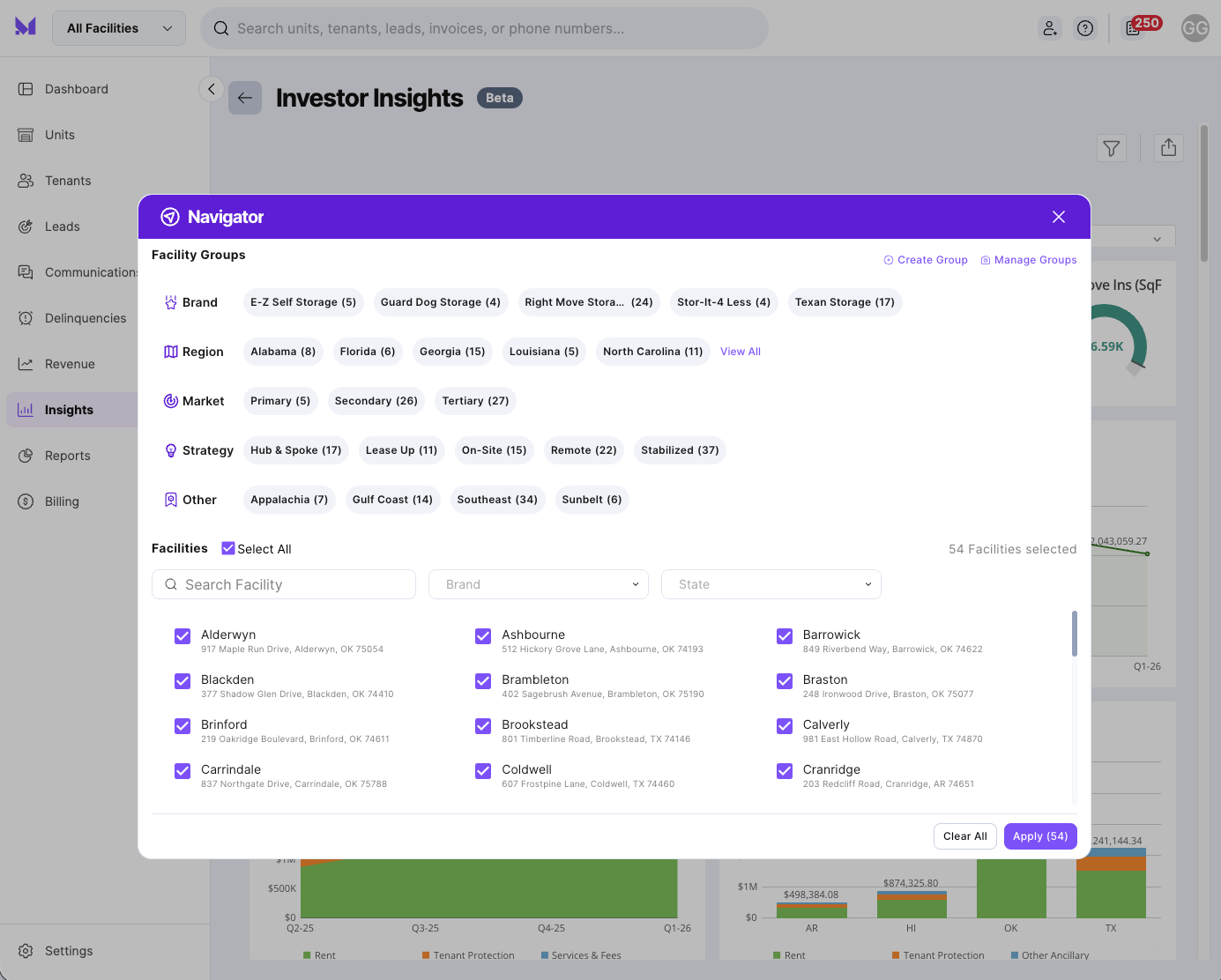
Example of Monument’s Dashboard Navigator for 3PMs
As a self-storage third-party management company, your primary value is your ability to run a portfolio more efficiently than an owner could on their own. This advantage comes from managing your entire operation as a single, cohesive unit rather than a collection of separate sites. Instead of wasting time logging into dozens of individual dashboards to update insurance rules or auction fees, a professional management layer allows you to push those changes across every location with one click. This centralized approach replaces the guesswork of local managers with high-level corporate strategy, ensuring that your institutional standards are met everywhere at once.
True efficiency happens when your team can execute high-stakes moves—like updating pricing or automated collections—across your entire asset base simultaneously. By eliminating the manual click-work required at the facility level, you prevent operational drift and ensure your policies are applied precisely and immediately.

As a self-storage third-party management firm, your ability to scale is often throttled by the manual overhead of your software. When you are forced to manage automation on a per-facility or per-brand basis, you aren’t just losing time; you are introducing significant operational risk.
The primary failure of legacy systems is their site-centric architecture. For a 3PM, this means that every time you want to implement a new collection workflow or communication trigger, you must manually duplicate those rules across every single facility in your portfolio.
This manual configuration becomes unmanageable as your portfolio grows. It leads to:
Monument eliminates this duplication by moving the automation logic from the facility level to the portfolio level. Instead of managing a hundred individual machines, you manage one central engine that powers the entire fleet.

A third-party self-storage management-native platform allows your team to apply automation rules across multiple owners and brands simultaneously. This is not about forcing a “one size fits all” approach; it is about using shared logic to enforce consistency while still allowing for brand-specific variables.
Through Monument’s centralized automation engine, your management team can:
Scalable, cross-brand automation transforms your business from a linear model—where growth requires more headcount—into a compounding efficiency engine. Monument enables this shift by automating high-stakes tasks like delinquency management and rate execution across your entire portfolio.
By removing the burden of repetitive configuration, your team can focus on strategic revenue management and owner relations. This transition directly impacts NOI by reducing labor costs and ensuring revenue-generating activities, such as rent increases and fee collections for each tenant, are executed with institutional consistency.
In legacy systems, your data is often held hostage by rigid hierarchies defined by database structure rather than operational needs. To provide institutional-grade oversight, you must be able to analyze portfolio data beyond simple brand or facility names.
The primary limitation of many self-storage software options is that reporting is often brand-locked or facility-specific. While knowing how “Brand A” is performing compared to “Brand B” has some utility, it often obscures the most meaningful performance insights.
Brand-only insights limit your strategic decision-making because:
Monument provides an alternative to this rigid structure by moving away from brand-locked reporting in favor of a dynamic segmentation model. This is described in more detail in the next two sections.
True 3PM-native software allows you to segment facilities by shared asset characteristics. This enables accurate comparisons that drive real operational value for both the management firm and the self-storage operator.
| Segmentation Category | Shared Characteristics | Strategic Objective |
| Ownership Groups | Assets belonging to specific institutional partners or PE funds. | Monitor cross-brand performance within a single owner’s portfolio. |
| Contract Tiers | Grouped by fee structure (Full-Service vs. Remote-Only). | Analyze profitability and resource allocation of your management business. |
| Regional Economic Zones | Assets within a specific MSA or sub-market tiers. | Benchmark occupancy/rate growth against local market competitors. |
| Acquisition Vintages | Facilities categorized by the year management commenced. | Track the efficacy of “first-year” optimization playbooks. |
The value of sophisticated segmentation is not just better analytics—it is the ability to take faster, more precise action. For example, when you can see that all your “Suburban Growth” assets are lagging in lease-up velocity regardless of brand, you can deploy a coordinated marketing or pricing strategy across that specific segment.
This level of insight translates directly into measurable NOI improvement. By leveraging Monument’s advanced analytics, your management team can:
By breaking free from brand-limited data, you gain the clarity needed to manage complex portfolios with the precision of a much smaller, single-brand operator.
In self-storage third-party management, revenue performance is the primary benchmark. Executing sophisticated pricing and ECRI strategies is inefficient when software restricts management to site-by-site configurations. To maximize NOI, pricing logic must transcend brand boundaries and focus on the fundamental economic characteristics of the assets.
Traditional self-storage property management systems often tie rate plans and ECRI logic to specific software instances or brand configurations. This creates a strategic misalignment for 3PMs managing mixed portfolios.
Brand-based pricing strategies frequently underperform because:
Monument addresses this by making rate-plan architecture asset-driven by design. It allows you to group facilities by attributes—such as market tier, occupancy velocity, or facility type—ensuring your pricing reflects the economic reality of the asset, regardless of the brand it carries.
Manual ECRI execution is a high-risk bottleneck for 3PMs. Managing multiple systems to identify tenants and trigger notices increases human error and leads to rate stagnation when the administrative burden delays necessary increases.
A third-party self-storage management-native platform enables simultaneous rent increase strategies across all qualifying assets. Monument’s centralized engine allows your team to:
A self-storage third-party management company should provide REIT-level revenue management for every owner. But achieving this at scale requires standardized pricing logic that delivers predictable NOI gains without increasing corporate headcount.
Scalable ECRI programs outperform manual, brand-specific efforts through relentless, data-driven execution. By replacing the “gut-feel” decisions of local managers with institutional discipline, Monument enables high-frequency, low-friction rate adjustments that directly impact the bottom line. This technical superiority solidifies your competitive advantage, allowing you to drive higher returns through better technology.

In third-party management, reporting is a critical touchpoint that reinforces your professional identity and commitment to the owner’s brand. To maintain an institutional reputation, your technology must act as an invisible engine that prioritizes the owner’s brand equity over the software provider’s identity.
In the third-party management relationship, you are responsible for the asset’s performance, while the owner is the architect of the brand. Professional presentation is the bridge between the two; using generic, unbranded reports from legacy software can inadvertently dilute the perceived value of your expertise.
White-labeled reporting is essential for three key reasons:
Monument supports this by providing operator-specific, white-labeled capabilities, ensuring a polished and cohesive experience for every owner in your portfolio.
Successful 3PMs centralize management logic while localizing brand identity. Your software must function as a white-label engine that powers multiple brands without imposing a uniform visual mold.
Separating infrastructure from identity is vital for retention. Using Monument’s white-label capabilities, your team can:
A branded, professional interface elevates your role from vendor to strategic partner. Monument provides the flexibility to maintain centralized operational rigor while respecting the unique brand requirements of every owner you serve.
For a 3PM, data is only as valuable as the trust it inspires. When competing for high-value contracts, presenting results through a sophisticated, professional lens is a primary differentiator.
As an institutional manager, you are tasked with safeguarding and growing multi-million dollar assets. If your primary interface with an owner is a collection of generic reports or a dated portal provided by a legacy vendor, you create a credibility gap. Owners may begin to question if your internal processes are as antiquated as the tools you use to report on them.
A professional presentation builds trust by:
For institutional-grade operators, white-labeled dashboards have moved from a “nice-to-have” feature to an absolute requirement. Leading owners and private equity groups expect their management partners to provide a seamless brand experience that aligns with their corporate standards.
Providing a portal that carries the owner’s branding reaffirms that you are an extension of their team. It removes the friction of third-party “noise” and allows the owner to focus entirely on the KPIs that matter. In a competitive RFP environment, the firm that offers a bespoke, branded experience will consistently outperform the firm offering standard branding.
Monument was engineered to meet the exacting standards of the industry’s most sophisticated players. By providing a platform that balances centralized, powerful management with elegant, white-labeled presentation, Monument allows 3PMs to deliver the REIT-like experience that institutional owners now demand.
Positioning your firm with Monument as your backbone ensures that your presentation quality matches your operational excellence. It allows you to enter the boardroom with confidence, knowing that your technology platform is a tool for winning new business and retaining existing clients, rather than a hurdle you must explain away.
In third-party management, portfolio financial structures are rarely uniform, spanning from lean satellite sites to high-touch institutional assets. A primary failure of legacy software is the assumption that every facility should follow identical software pricing and payment logic. To protect margins and offer competitive terms, your platform must support different software pricing models to account for the distinct financial realities of each brand you oversee.
In most legacy systems, billing and processing models are rigid and inflexible. This creates operational friction for 3PMs, who typically pass the cost of facility management software back to the individual brands they manage. Because each ownership group may require a different pricing structure, 3PMs need the ability to allocate software costs on a per-brand basis. Without that flexibility, it becomes difficult to remain competitive—particularly when managers must selectively compress their margins to win new management contracts or expand margins when market conditions allow.
Uniform financial models fail at scale because:
Monument addresses these challenges by moving away from monolithic billing, instead supporting differentiated brand economics that allow you to tailor the financial engine to the specific needs of the asset.
A 3PM-native platform allows your team to configure financial and payment processing rules at the brand level. This level of control enables third-party managers to allocate software costs directly to each brand they manage and apply different pricing structures where necessary—allowing them to tighten margins to remain competitive in new bids or expand margins when market conditions allow.
Through Monument’s configurable financial architecture, your firm can:
In the 3PM world, pricing flexibility is a prerequisite for winning more business. As portfolios scale, the ability to automate complex billing across multiple brands becomes critical. Without it, what should be a profitable management contract can quickly turn into an operational and administrative burden.
By leveraging Monument’s ability to configure brand-specific pricing, you can onboard new clients with varying economic profiles without increasing your back-office headcount. This flexibility ensures that your business model remains resilient and adaptable, allowing you to capture market share across all segments of the self-storage industry while protecting your firm’s bottom line.
Scaling from a regional operator to a large-scale 3PM often results in lost control due to the complexities of multiple brands and fragmented data—challenges legacy systems weren’t built to solve. Professional 3PMs must shift from managing individual sites to commanding a unified portfolio.
The Power of a 3PM-Native Platform
Investing in a platform purpose-built for the 3PM layer enables a higher standard of operational excellence:
Beyond Generic Solutions
Most self-storage software serves individual facilities, creating bottlenecks for growing managers. You need a force multiplier, not a constraint. Monument is the only platform purpose-built to manage complex portfolios at scale. By centralizing multi-brand control and automating across asset classes, Monument turns operational complexity into a competitive advantage.
Take Control of Your Portfolio
Complexity is the inevitable byproduct of success in third-party management, but it does not have to be a burden. With the right platform, you can eliminate the friction of disparate systems and focus on what you do best: driving value for your owners.
Discover how Monument empowers leading 3PM firms to simplify operations and scale effortlessly. Book a demo to see the platform in action.


Explore top self-storage software solutions with key features, comparisons, and tools for facility operations, marketing,...

Explore top facility management software systems for self-storage, including key features, benefits, and how these...

Discover how 3rd party self storage management improves operations, revenue, and NOI—and what to look...