Every step change in software delivery has followed the same pattern: the gain was never really about the new technology; it was about what an operator no longer had to do. Moving off on-premise servers and per-facility installs didn’t just cut hardware costs — it meant a regional director stopped needing to be at (or connect into) each facility’s own machine to see what was happening there, and started getting one login, real-time numbers across every location, and an update that shipped to everyone overnight instead of a disc that shipped to nobody. Agentic AI is the same kind of gain, one layer up: the software stops waiting for someone to notice a problem on a screen and starts flagging or acting on it directly. An FMS that doesn’t build for this isn’t missing a feature — it’s asking its operators to keep doing, by hand, the exact kind of noticing and catching-up work the cloud transition was supposed to have already eliminated.
The cost of skipping this isn’t theoretical, and it’s already showing up in the data from the closest comparable vertical. A 2026 AppFolio benchmark survey of over 1,600 residential property management professionals found that firms who’ve broadly adopted AI are projecting an average 31% portfolio growth in 2026 — nearly triple the 12% growth expected by firms that haven’t — while elevated vacancy squeezing NOI was the single most-cited threat, named by 55% of respondents, which is the exact NOI pressure self-storage operators already track obsessively. That tracks with what analysts are seeing across real estate more broadly: companies that fail to adopt AI risk falling behind competitively, and the gap between early adopters and everyone else is widening rather than narrowing. The mechanism is structural, not hype: operators who build the data and AI capabilities now accumulate an advantage that’s genuinely difficult for a late mover to close a few years out. That’s the real thing an operator misses out on with an FMS that hasn’t invested here — not a missing chatbot, but a compounding gap in how fast a portfolio can spot and act on the things that actually move NOI, while a competitor’s software is already doing it for them.
Every vendor you talk to this year is going to tell you they have AI. What you need to know is (1) how was the AI built (architected), and (2) what are the vendor’s plans for making AI work for you.
On the AI being well architected front, find out whether that AI sits on top of a system that was stretched to cover a portfolio, or on a platform that was built to run AI from day one. That difference decides whether the AI is actually useful, or just a chatbot reading fragmented data.
A system that started out built for a single facility, then got patched together over the years to cover more of them, usually has AI sitting on top the same way everything else does: as an add-on. Ask it a portfolio-wide question and it either can’t answer, or it answers using a slightly different definition of “occupied” or “delinquent” depending on which facility or module you’re asking about, because nobody ever unified how the underlying data was defined in the first place. The chatbot can hold a conversation, but it can’t tell you anything your existing reports couldn’t, because it’s reading the same fragmented data those reports already have.
A platform built to run a portfolio from day one had to solve that unification problem before it could do anything else. Reporting, segmentation, and automation all depend on every facility meaning the same thing by “occupied” or “delinquent.” That’s the same problem an AI tool needs solved before it can be trusted with a question, which is why a vendor that already did this work for other reasons is the one positioned to make AI genuinely useful rather than just conversational.
|
A system stretched to cover a portfolio |
A system built for a portfolio from day one |
| AI access |
A chatbot or rate-suggestion widget sitting on top of the product |
A direct, secure connection so your own AI tool — Claude, ChatGPT, Gemini — can query the data itself |
| Underlying data |
Defined a little differently facility by facility, module by module |
Defined once, consistently, across every facility in the portfolio |
| What the AI can actually tell you |
Roughly what your existing reports already say, just conversational |
Answers your current reports can’t give you, because the data underneath was already unified |
The clearest sign of which kind of vendor you’re looking at is whether you can connect your own AI tool directly to the system and get a straight answer back. That capability runs through a Model Context Protocol (MCP) server, and it’s one of the best tests of AI readiness available to you as a buyer right now.
Underneath a good MCP server sits a semantic layer. Think of it as a translator. When an AI assistant asks for something, the semantic layer turns that plain-language request into the exact data calls needed, using a knowledge base the vendor keeps curated and up to date, instead of leaving the AI to guess at how the underlying system is built. It also gives the vendor control over exactly what comes back: raw data, data that’s already been cleaned up, or a fully packaged insight. Without a semantic layer like this, an AI tool has to be taught the specifics of a vendor’s system from scratch — exactly the kind of unglamorous, unifying work a stretched system usually never got around to doing, because nobody needed a machine to read that data directly until now.
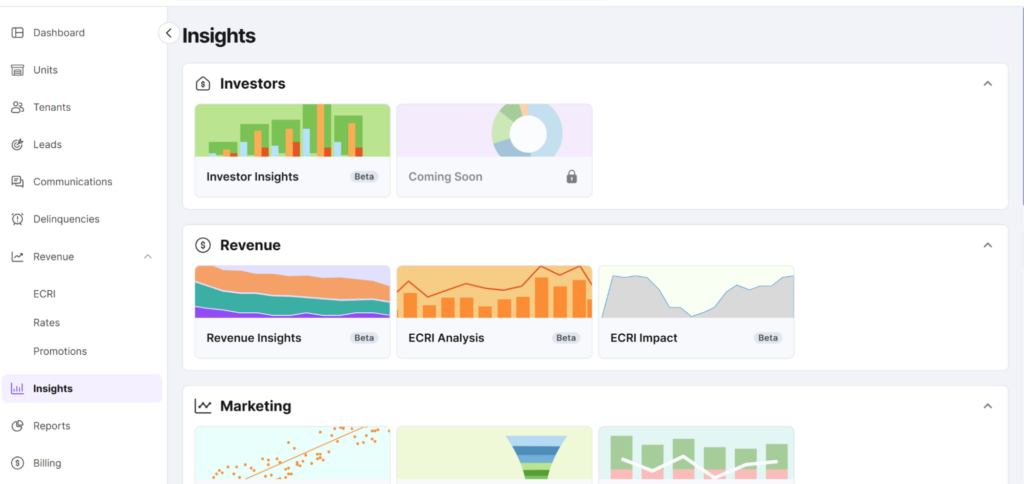
Here’s what it looks like when a vendor actually did that work. Monument’s Insights module, which has close to 100 business graphs and dashboards covering operations, leasing, revenue management, and investor reporting, took more than three years to build. Most of that time went into defining what every key metric actually means, how it’s calculated, for whom, and how it’s rolled up consistently across every facility in a portfolio, not into the dashboards themselves. That’s exactly the work a semantic layer needs underneath it.
A vendor can bolt a chatbot onto old data. It can’t bolt on three years of already having unified that data. Either the work was already done, or it wasn’t.
What This Looks Like in Practice
A concrete example, using Monument’s own implementation as the illustration: Monument’s MCP server gives operators direct, secure access to their own data, so they can ask questions and get answers without waiting on anyone. Instead of requesting a custom report or hiring a developer to build a connection, an operator can simply ask their own AI assistant to pull the data straight from Monument’s MCP server. The AI does the work in minutes, and the operator gets a full picture of what’s happening across the portfolio.
Say a regional manager wants to know which facilities are most likely to see tenants leave after a rent increase. Rather than asking a developer to build a custom report, the manager can type a question like “What would the tenant churn rate be if I increased the rent at my facilities in Texas?” directly to their AI assistant. The assistant pulls the relevant numbers through Monument’s MCP server and puts together an answer in minutes. No spreadsheet, no waiting on IT, no separate tool to buy. The manager gets the answer, the data stays secure, and Monument’s software is what makes the whole thing possible.
A few other things worth checking for in how a real implementation like this should work:
- It translates requests for you. Monument keeps a curated, always up-to-date map of its own system (technical term is “semantic layer”), so when an AI assistant asks for something, the server turns that into the exact data calls needed instead of leaving the AI to guess, and controls whether what comes back is raw data, cleaned-up data, or a fully packaged insight. Most competitors’ MCP servers only hand back report-level data, leaving the AI to do the analysis itself. Because Monument’s Insights analysis is already built into the semantic layer, Monument’s AI assistant starts from an answer that’s already been analyzed, not a spreadsheet it has to make sense of on its own.
- It works with any AI tool. Connect it once, and it works the same way whether the operator is using Claude, ChatGPT, or Gemini.
- Data stays secure. Monument’s login key never gets shared with the AI itself. The server keeps the key hidden and handles sign-in on the operator’s behalf, and operators only ever see their own data, never anyone else’s.
- Only what’s new gets pulled. Rather than downloading the full dataset every time, the AI only pulls what’s changed since the last check, which keeps everything faster and cheaper to run.
- Nothing gets stuck waiting. When the AI runs into something it can’t do yet, it finds a workaround first, then sends a clear request to Monument’s team, so operators aren’t stuck waiting on a fix before they can keep moving.
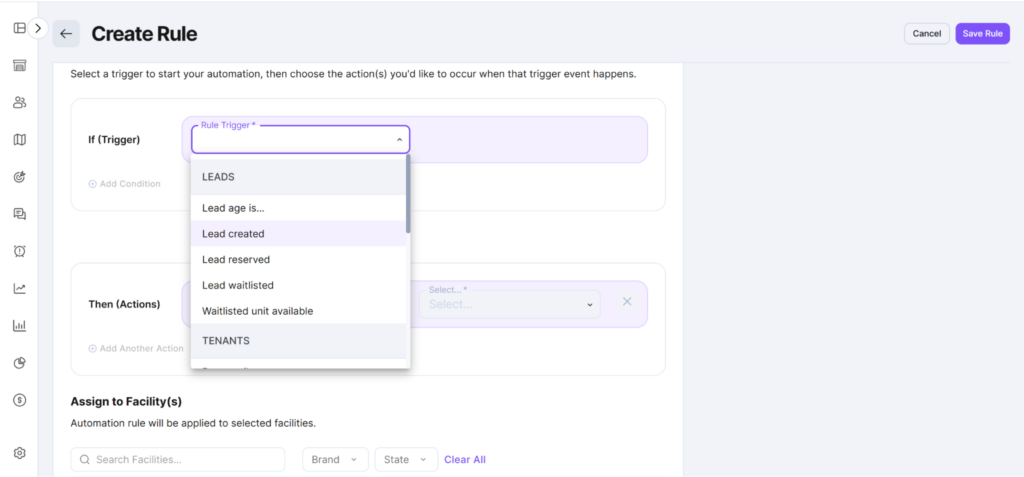
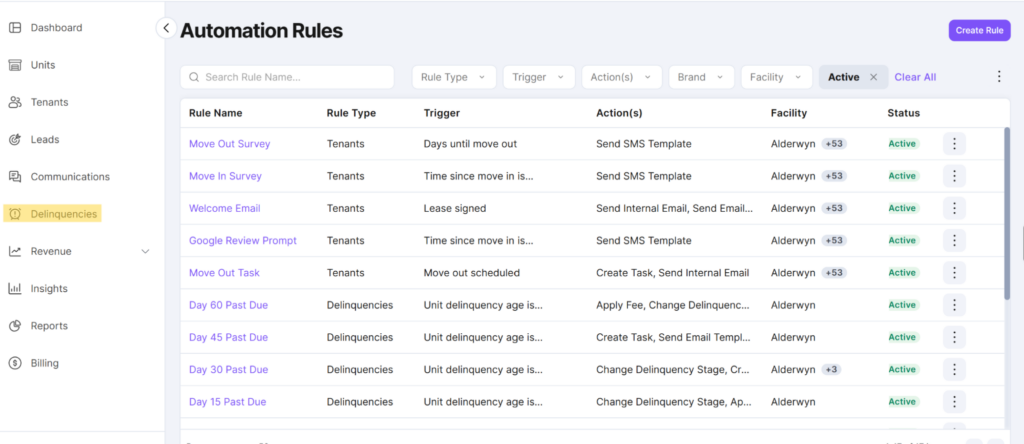
This same infrastructure is what positions Monument for what’s coming next. The trigger-and-action automation rules covered earlier are still operator-defined today, but AI agents are on track to take over more of that work directly — not just answering questions through the MCP server, but eventually running the rules too. Choosing a vendor that’s already built for this, rather than one bolting it on later, is what keeps a portfolio’s tech stack from falling behind.
Skating to Where the Puck Is Heading
There’s an old line about hockey worth borrowing here: skate to where the puck is heading, not to where it has been. Evaluating an FMS vendor’s AI capabilities today, by themselves, only tells you where the puck has already been. The more useful question is where a vendor is skating: whether they have an actual plan for where their AI capabilities go next, or whether “AI” is just a box they’ve checked for this year’s sales calls.
That question matters more than it sounds, because not every vendor makes the jump to the next version of how software works, no matter how good they were at the last one. WordPerfect was the dominant word processor of the DOS era — genuinely dominant, not a close second. When Windows arrived and reset how software was supposed to work, Microsoft rebuilt Word natively for the new platform while WordPerfect was slow to follow. By the time WordPerfect caught up, Word had already taken the category, and it never really got it back.
The FMS an operator chooses today needs to survive that same kind of jump, and the vendors who don’t make it rarely announce it in advance.
Being the best product for the platform that’s ending doesn’t guarantee a seat at the table for the platform that’s starting.
Here’s where Monument is skating. The MCP server and semantic layer described above are the foundation, the part that lets an AI assistant answer a question correctly today. What comes next is turning that same foundation into software that doesn’t just answer questions, but plans and carries out the work itself, inside guardrails an operator sets. That’s an active part of Monument’s product roadmap, organized around four kinds of AI agents:
| Agent type |
What it does |
A self-storage example |
| Copilot |
Assists a user inside an existing workflow |
Answering a regional manager’s question about portfolio performance — this is what Monument’s MCP server already does today |
| Wedge |
Owns one job, end-to-end |
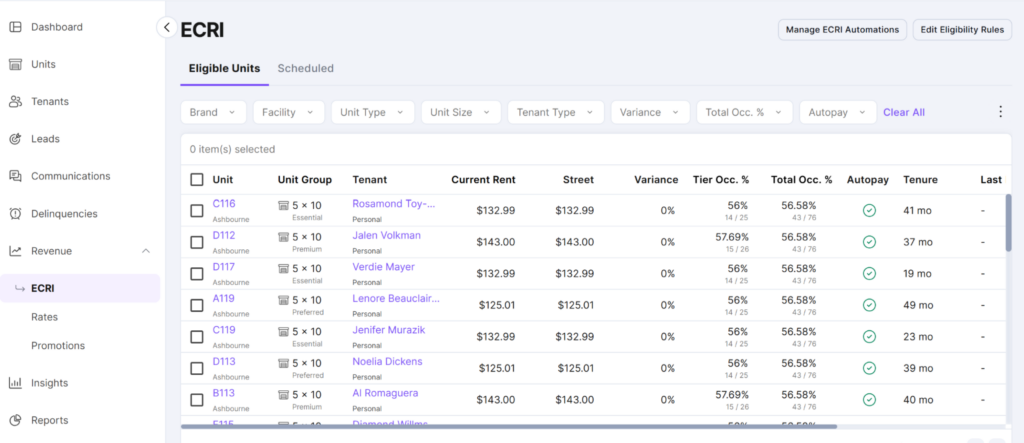
Managing a segment’s ECRI cycle, from eligibility scoring through notice generation |
| Sentinel |
Continuously monitors data and flags issues before they escalate |
Watching delinquency concentration and gate-access patterns and alerting a regional director before either becomes a real loss |
| Orchestrator |
Executes complex, multi-step workflows across systems |
Running the onboarding sequence for a newly acquired facility — GL mapping, gate integration, and rate migration — as one coordinated process |
The Copilot is real today. The other three are what Monument is actively building (not a someday idea) and we’d rather be specific about which is which than let the word “AI” do the work of describing all four at once. When comparing FMS vendors, ask them the same thing: not just what their AI can do this quarter, but where they’re skating. A vendor without an answer to that question has already told you where they’re heading. Nowhere new.
AI’s Role In Your Next FMS Decision
The question worth asking a vendor isn’t “do you have AI?” Every vendor will say yes to that question by the end of this year. The more useful questions are about the layers underneath.
| Question to ask your FMS vendor |
A reassuring answer |
A red flag |
| “Do you expose a documented, standards-based connection — like MCP — for AI assistants to query your data?” |
Yes, shipped today, with secure, read-scoped access |
“We’re evaluating options,” or no stated roadmap |
| “Is there a semantic layer defining how key metrics are calculated across your platform?” |
Yes — definitions are built once and applied consistently everywhere |
Every report is calculated a little differently, module by module |
| “How was that semantic layer actually built, and how much of your platform’s business logic does it cover?” |
Built over years, alongside the reporting and automation already shipped; it covers the core KPIs and compliance rules that drive the business, and gets extended every time something new ships |
It’s new — a handful of endpoints were mapped last quarter to have something to say about MCP |
| “Who owns the automation engine that will ultimately carry out an agent’s actions — is it built and maintained by you, or licensed from a third party you don’t fully control?” |
“It’s native. We built it, we maintain it, we’ve run it in production for years.” |
“It’s licensed from a partner we work with” — a dependency the vendor doesn’t fully control |
| “What happens to your product if a general-purpose AI agent can query a competitor’s data just as easily as yours?” |
A specific answer about proprietary data, domain rules, and compliance depth (see examples below) |
A pivot back to talking about the interface |

Self-storage software built for
high-performance operators