
The “build it, and they will come” era of self-storage is over. Today, the sector is dominated by institutional capital and data-driven operators, making operational efficiency the primary driver of asset value. In this competitive market, the quality of your management strategy is the difference between a stagnant asset and one that consistently outperforms market cap rates.
3rd-party self-storage management has evolved from simple staffing to a holistic operational strategy. For independent operators and private equity firms, outsourcing to a professional firm has become both a convenient and strategic move to access institutional-grade platforms, sophisticated revenue management, and scalable infrastructure that drives Net Operating Income (NOI).
Key Takeaways:

- Revenue Management Drives Valuation: Effective management moves beyond flat rates to dynamic pricing and automated Existing Customer Rent Increases (ECRI), capable of lifting NOI by 10–20% annually.
- The “Tech Stack” Differentiator: Modern management firms are defined by their technology—leveraging enterprise-grade software for automated collections, integrated e-commerce, and real-time data transparency.
- Operational Standardization: 3rd-party managers provide critical infrastructure, including compliance playbooks, centralized call centers, and standardized move-in processes, to ensure consistent performance across diverse locations.
- Strategic Scalability: Operators typically hire 3rd-party firms to navigate high-stakes scenarios such as new construction lease-ups, expansion into new regions, or the rapid alignment of acquired portfolios.
- Purpose-Built Software Matters: Leading management firms utilize platforms like Monument, which are designed specifically for multi-facility operations, offering centralized control and automation that legacy single-site software cannot match
Self-storage software built for
high-performance operators
Why Operators Typically Hire a Third-Party Self-Storage Management Company

The decision to hire a self-storage 3rd party management firm is often triggered by a specific lifecycle event or pain point.
1. New Construction Lease-Up Phases
Filling a brand-new facility (going from 0% to 85% occupancy) is a cash-flow-negative sprint. It requires aggressive marketing and dynamic pricing that shifts weekly to capture market share. Operators hire professionals to shorten this “lease-up” timeline and reduce the carry cost of the development loan.
2. Operators Expanding Into New States or Regions
A successful operator in Texas may struggle to manage a new acquisition in Colorado due to a lack of local vendors and knowledge of local lien laws. Third-party managers provide instant infrastructure in new markets, ensuring compliance and operational continuity without the operator needing to build a local team from scratch.
3. Operators Whose Software Cannot Scale With New Facilities
Many operators reach a point where their manual spreadsheets and legacy software become ineffective. When a portfolio grows from 3 to 10 sites, the complexity compounds. Third-party managers bring enterprise software stacks—like Monument—that are built for scale, preventing operational bottlenecks.
4. Operators Lacking Centralized Infrastructure
Building a call center, a marketing department, and an accounting team is expensive. Outsourcing allows an operator to rent this centralized infrastructure for a management fee (the industry standard is typically 5-7% of Gross Revenue) rather than building it with the associated massive overhead.
5. Portfolios Acquired Through Roll-Ups
Private equity firms often buy “mom-and-pop” facilities to roll them into a portfolio. These assets usually have messy data and no systems. A third-party manager can “onboard” these chaotic assets into a unified system in 30-60 days, instantly stabilizing the portfolio and ensuring rapid operational alignment.
Technology-Enabled Third-Party Management: The Emerging Standard
For third-party self-storage management companies, technology is no longer an internal efficiency tool—it is the core product being sold to operators. The distinction between a “management firm” and a “technology platform” has effectively collapsed. Operators are not hiring headcount; they are hiring a scalable operating system. As a result, third-party managers competing on legacy, facility-centric software are structurally disadvantaged against firms built on cloud-native, portfolio-first platforms.
Today’s operators evaluate third-party managers through a technology lens first. They assess whether a manager can deliver institutional-grade revenue management, execute ECRI programs with precision, operate hybrid or unmanned facilities through automation, produce real-time, GAAP-compliant reporting, and integrate seamlessly with best-in-class vendor ecosystems. These capabilities are no longer “nice to have”—they are table stakes for winning and retaining management contracts in a capital-constrained, margin-sensitive environment.
This technology directly determines a third-party manager’s cost structure and scalability. Labor remains the largest controllable expense in self-storage operations, and the difference between a legacy stack and an enterprise-grade platform is measurable. A technology-enabled third-party manager can operate a facility at approximately 1.5 full-time employees (FTEs), versus 2.5 FTEs under traditional management models. That delta compounds across a portfolio, flowing directly into higher NOI for operators—and higher margin, more defensible economics for the management company itself.
What 3rd Party Self-Storage Management Companies Should Consider When Selecting Software
Not all operator relationships are structured the same way, and for third-party self-storage management companies, this distinction is critical. The level of involvement an operator expects—ranging from fully delegated control to hands-on oversight—directly impacts how a management firm must operate, report, and ultimately which software platform can support those expectations at scale.
Full-Service Third-Party Management vs. Hybrid Support Models
The industry is increasingly bifurcating into two dominant engagement models. For third-party managers, understanding where an operator falls on this spectrum is essential to selecting technology that enables—not constrains—the relationship.
From a management company’s perspective, these models impose very different software requirements:
| Dimension |
Full-Service Management (Operator Delegates Control) |
Hybrid Support Model (Operator Retains Control) |
| Operational Control |
The management firm has autonomy over daily operations, pricing, staffing, and enforcement. |
The management firm supports execution, but the operator retains final decision-making authority. |
| Staffing Model |
The manager hires, trains, and manages staff across the portfolio, requiring centralized workflows and labor optimization tools. |
The operator hires staff; the manager provides systems, guardrails, and training frameworks. |
| Financial Oversight |
The manager runs AP/AR, collections, and banking workflows, demanding GAAP-grade accounting and audit-ready reporting. |
The operator maintains banking relationships; the manager needs transparent reporting and advisory visibility without full financial control. |
| Revenue Management |
Pricing, ECRI execution, and promotions are fully automated and standardized by the manager. |
Revenue strategy is co-managed; software must support scenario modeling, approvals, and visibility rather than unilateral execution. |
| Brand Structure |
Assets are often re-flagged under the manager’s brand, requiring consistent brand-level reporting and portfolio segmentation. |
Properties retain the operator’s brand, requiring clean brand separation, operator-specific dashboards, and flexible configuration. |
| Economic Structure |
Higher management fees (typically 5–7% of gross revenue) justified by full operational delegation. |
Lower percentage or flat-fee structures, where efficiency and transparency are critical to profitability. |
| Best Fit (Operator Profile) |
Passive investors, institutional capital, and REIT-backed operators seeking a “set-it-and-forget-it” experience. |
Active operators who want modern systems and expertise but retain strategic control. |
Why this matters for software selection:
A third-party management company supporting both full-service and hybrid operators cannot rely on rigid, one-size-fits-all systems. The platform must flex between full operational control and collaborative oversight—supporting delegated automation in one relationship and permission-based visibility in another. Software that assumes a single operating model forces managers to either over-control hybrid operators or under-deliver for full-service mandates.
In practice:
- Full-service relationships require deep automation, centralized pricing, standardized workflows, and enterprise-grade accounting.
- Hybrid relationships require configurable permissions, operator-facing reporting, approval workflows, and brand-level segmentation—without fragmenting data or duplicating effort.
Management firms that scale successfully are those whose technology stack adapts to the operator’s governance model, not the other way around.
Regional Operators vs National Third-Party Management Firms
- National firms bring deep expertise but can be rigid or expensive: The “big guys” (REITs) have massive data advantages. Still, they often require you to adopt their brand, and they may be less flexible with unique property constraints. You become a small fish in a massive pond.
- Regional operators may provide more hands-on support: A regional manager (e.g., one managing 50 stores in the Southeast) often provides more personalized attention. They know the specific micro-market dynamics better than a national analyst in a remote headquarters.
- Boutique firms may specialize in distressed assets, new builds, or secondary markets: Some firms specialize in turnarounds—taking a failing asset and fixing it. These boutique firms are often more aggressive and creative than large national chains.
Core Software Capabilities 3rd-Party Managers Must Prioritize
Beyond engagement models, third-party managers must evaluate software through the lens of portfolio complexity and long-term scalability. Several capabilities are non-negotiable.
1. Multi-Facility Management and Centralization
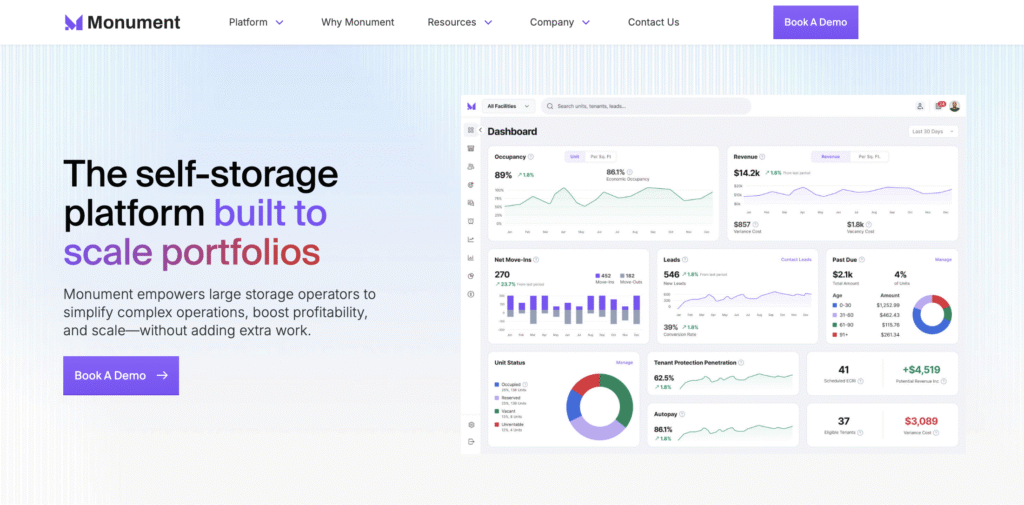
- Unified dashboard: Software must allow managers to oversee all locations from a single platform, enabling regional teams to move between facilities without logging in and out of separate databases.
- Consolidated reporting: The system should generate portfolio-level reports (occupancy, revenue, delinquency, NOI drivers) alongside site-level and owner-specific reports to support transparency and trust.
- Role-based access controls: The ability to define granular roles—regional manager, asset manager, site manager, ownership view—ensures the right data is visible to the right stakeholders without compromising control.
2. Integration Capabilities and Open Architecture
- Open API philosophy: Third-party managers should prioritize platforms with open, API-first architectures that integrate with best-in-class vendors rather than forcing adoption of a closed, proprietary ecosystem.
- Access control integrations: Native connections to gates, smart locks, cameras, kiosks, and call centers allow managers to automate move-ins, move-outs, and security workflows across the portfolio.
3. Automation and Operational Efficiency
- Automated marketing and leasing: Built-in online rentals, digital lease execution, abandoned-cart recovery, and automated follow-ups reduce labor dependency and improve conversion rates.
- Dynamic pricing and revenue optimization: Software must support demand-based pricing, ECRI execution, and market benchmarking to maximize revenue without manual intervention.
- Delinquency management automation: Automated reminders, late fees, overlocks, and workflow escalation reduce bad debt while ensuring consistent enforcement across owners and brands.
4. Data Ownership and Security
- Data control: Third-party managers must retain ownership of their data and be able to extract it cleanly if an owner contract ends or a platform change becomes necessary.
- Security standards: Enterprise-grade security—including PCI compliance, encrypted cloud storage, strong authentication, and audit controls—is mandatory for protecting tenant and owner data.
5. Scalability and Support
- Scalable architecture: The platform must support rapid portfolio growth—new locations, additional units, and increased user volume—without reimplementation or system redesign.
- Support and training: Reliable, responsive support and structured training programs are essential for minimizing downtime and ensuring consistent adoption across teams.
6. User Experience for Staff and Tenants
- Intuitive interface: Software should be easy to use, minimizing training time and reducing friction for on-site and regional teams.
- Mobile accessibility: Managers and staff must be able to monitor operations, review reports, and manage exceptions remotely from mobile devices.
Common Pitfalls to Avoid
- Choosing software based on price alone: Low-cost, generic solutions often lack the automation, analytics, and integration depth required for professional third-party management—leading to higher operational costs over time.
- Ignoring future scale: Selecting software that cannot support growth forces expensive, high-risk migrations later, often at the exact moment a portfolio is expanding.
How Monument Supports 3rd-Party Self-Storage Management Companies
For third-party management firms, the software they choose is the foundation of their value proposition. These operators must deliver consistent NOI growth, operational discipline, and investor-grade reporting across portfolios they do not own. Monument was built specifically for this model—unlike legacy systems designed for single-site operators and later retrofitted for scale.
Two strong examples of this are Right Move Storage and The Storage Mall. Both organizations operate in environments where performance, standardization, and scalability are non-negotiable. They require a platform that can enforce consistent workflows, support sophisticated revenue management strategies, and provide portfolio-wide visibility without increasing overhead.
Monument serves as the technological backbone for operators like Right Move Storage and The Storage Mall, enabling them to centralize operations, automate revenue-critical processes, and deliver repeatable, high-yield outcomes for operators. By combining enterprise-grade automation, data-driven ECRI execution, and portfolio-level analytics, Monument allows third-party managers to scale their businesses while protecting margins and maintaining institutional standards across every asset they manage.
Self-storage software built for
high-performance operators
1. Built Specifically for Third-Party Operators and Large Portfolios
Legacy software often struggles with “portfolio-level” actions. Monument was purpose-built to solve this.
- Purpose-built for multi-facility operations: Traditional software often requires logging in and out of separate databases for each facility. Monument provides a unified “Single pane of glass” view, allowing a District Manager to oversee 20 sites simultaneously.
- Designed to centralize operations, reporting, and pricing: With Monument, a change in pricing strategy or a new marketing email template can be pushed to 50 locations with one click. This centralization is critical for maintaining quality control across a third-party manager’s portfolio.
- Brand categorization and segmentation at scale: Monument allows third-party managers to group facilities by entity, brand, market, asset class, or operational phase (e.g., lease-up vs. stabilized). This enables brand-specific pricing strategies, reporting packages, automations, and operator-facing dashboards—without duplicating workflows or fragmenting data. For managers overseeing multiple brands on a single platform, this is critical to preserving brand integrity while operating efficiently.
- Open ecosystem—integrates with any vendor: Monument believes in an open API. Except for payment processors (due to strict security and reconciliation controls), Monument integrates with your preferred access control, call center, or accounting software, giving managers the flexibility to build their “best of breed” tech stack.
2. White-Glove Implementation and the “We Own The Outcome” Support Model
For third-party self-storage management companies, switching core systems can pose significant operational and financial risks. Monument was designed to remove that risk entirely by treating implementation and support as outcome-driven services, not ticket-based add-ons.
- White-glove, risk-free migration managed end to end: Monument’s implementation team handles the full migration of historical tenant data, financial records, and—critically—credit card payment tokens. This ensures tenants remain on autopay without interruption, eliminating the temporary delinquency spikes and cash-flow leakage that commonly occur during platform transitions. Third-party managers retain continuity across collections, reporting, and operator statements from day one.
- Dedicated Client Success team accountable for outcomes: Monument assigns a U.S.-based Client Success team responsible for onboarding, configuration, and ongoing performance through structured check-ins and Quarterly Business Reviews (QBRs). Their mandate is not limited to system training—they are accountable for ensuring automation rules, revenue workflows, reporting structures, and portfolio segmentation are implemented correctly to deliver the NOI and efficiency outcomes promised during the sales process.
- U.S.-based Client Support that understands portfolio operations: Monument’s support organization is staffed domestically and embedded in the self-storage operating model. Support is not limited to reactive ticket resolution; the team actively assists with operational workflows, automation troubleshooting, reporting logic, and edge cases that arise in multi-operator, multi-brand third-party portfolios. This reduces escalation cycles and prevents operational bottlenecks that impact operators and on-site teams.
- Training designed for scale, not single-site use: Monument’s Training function ensures that regional managers, call centers, and on-site teams are equipped to use the platform consistently across dozens of facilities. This includes role-based training, best-practice automation guidance, and ongoing enablement as new features and analytics are released—critical for maintaining process discipline in a third-party management environment.
- Ongoing partnership, not a helpdesk relationship: The “We Own The Outcome” philosophy means Monument does not disappear after go-live. Bi-weekly platform enhancements, proactive optimization guidance, and continuous collaboration ensure third-party managers can scale portfolios, onboard new operators, and standardize operations without re-implementing or retraining from scratch.
3. Automations That Scale Across Every Managed Property
Efficiency is born from automation. Monument allows managers to script their operations.
- Trigger-based automation for leads, tenants, and delinquencies: Managers can set “if-this-then-that” rules. If a tenant is 5 days late, send an SMS, lock the gate, and add a $20 fee. This happens without human intervention, ensuring 100% compliance with company policy.
- Fully automated collection workflows that reduce manual work: By automating the collections cadence, managers reduce their accounts receivable (AR) days significantly. This frees up staff to focus on leasing and customer service rather than chasing bad debt.
- Standardizes operations and eliminates site-level inconsistencies: For a third-party manager accountable to multiple clients, consistency is key. Monument enables standardization, ensuring that every facility in the portfolio adheres to the same operational rigor.
4. REIT-Level Revenue Management for Third-Party Management Firms
Monument expands access to the sophisticated revenue tools previously reserved for public REITs.
- ECRI tools that customize rent increases: The platform’s ECRI workflow allows managers to segment tenants based on behavior. You can apply a different increase percentage to a tenant who moved in 6 months ago versus one who has been there for 3 years.
- Churn sensitivity insights: Monument provides data on “churn sensitivity,” helping managers understand the elasticity of their tenant base. This prevents aggressive rate hikes that might trigger a mass exodus, balancing yield growth with occupancy retention.
- Real-time impact reporting: Managers can generate reports showing exactly how much incremental revenue was generated by rate increases, providing a clear “ROI” metric to present to operators.
5. Upgraded Rental Experience Built to Maximize Conversion and NOI
For third-party management companies, the rental flow is a revenue engine. Monument focuses on materially improving conversion economics and average ticket value at the point of lease execution, without adding operational overhead.
- Abandoned cart capture paired with automated outreach: Monument detects when a prospect begins but does not complete a rental and automatically converts that session into a lead. Automated follow-up sequences—via SMS, email, or tasks—re-engage the prospect in real time, recovering demand that would otherwise be lost and improving portfolio-wide look-to-lease ratios.
- Value-based upsells embedded directly into the rental flow: Monument supports Good-Better-Best unit group pricing, protection plan tiers, and optional services within the checkout experience. These upsells are presented dynamically at the point of decision, increasing average revenue per move-in without requiring staff intervention or post-lease follow-ups.
- $0 authorization payment validation during e-lease execution: Monument performs a $0 authorization check on the tenant’s payment method while the e-lease is being generated. This validates the card without triggering a charge, reducing failed move-ins, preventing downstream delinquency, and ensuring cleaner accounts receivable from day one.
- Unified rental logic tied directly to automation and reporting: Because the rental experience is natively connected to Monument’s automation engine and analytics layer, every interaction—from abandoned carts to accepted upsells—is measurable, actionable, and continuously optimized across the portfolio.
6. Analytics & Insights: The Manager’s Competitive Advantage
Data is only useful if it is accessible.
- Nearly 100 analytics dashboards: From marketing funnel visualization to delinquency aging and revenue lift from ECRIs, Monument covers every metric a manager needs.
- Ability to generate investor-level presentations: Managers can generate professional, white-labeled performance reports for their investor clients at the press of a button, saving hours of manual Excel work every month.
- AI-ready data infrastructure: Monument’s multi-year investment in Business Intelligence (BI) has structured its data to be “AI-ready,” paving the way for the industry’s first true AI knowledge base for operators.
Conclusion
The self-storage industry has moved beyond the phase of passive holding; it is now an active operational business where the quality of management dictates the return on investment. Whether you are a private operator looking to retire from daily operations or an institutional investor building a portfolio, partnering with a third-party self-storage management company is often the most direct path to maximizing NOI.
However, the partner you choose matters less than the tools they use. In an era of margin compression, you must align with managers who leverage enterprise-grade technology to automate operations, optimize revenue, and deliver transparent financial insights.
Next Steps:
If you are a third-party management firm or a multi-facility operator ready to upgrade your operational infrastructure, book a demo with Monument today.
Discover how our purpose-built platform can help you scale your portfolio, automate your workflows, and deliver REIT-level results for your assets.
Self-storage software built for
high-performance operators