


Self-storage operators are investing in automation at a rapid pace—but most of the industry still defines automation too narrowly. Smart gates, locks, kiosks, and cameras matter, yet they are not entirely what makes a portfolio operationally scalable. The real determinant of performance is operational automation: the software-driven workflows that standardize leasing, collections, revenue management, and reporting across every asset in the portfolio.
For operators with large portfolios, automation is not a convenience feature for their self-storage software, it is a valuation strategy. When you reduce OpEx through workflow automation, increase revenue through data-driven pricing, and enforce consistent execution across dozens of facilities, you protect margins and improve NOI—often with a measurable impact on cap rate and portfolio value.
Automation allows operators to thoroughly execute with great detail at scale, enabling many points of contact with prospects and customers at just the right time and without human intervention. These multiple just-in-time contacts converts more leads, drive more tenants to pay their late fees, prevents or automates delinquencies
Key Takeaways
Storage facility automation is the most durable lever operators have to protect NOI while scaling, because it reduces labor dependency and enforces consistent execution across every asset.
At an enterprise level, self-storage automation is fundamentally a financial decision. Automation improves valuation through two primary channels:
For portfolios evaluated on income, automation does not just make teams faster. It changes how the P&L behaves under scale, which is the foundation of enterprise-grade operations.
| NOI lever | What manual operations create | What automation changes | Business outcome |
| Collections & delinquency | Inconsistent outreach, late interventions, uneven lien execution | Standardized sequencing, triggers, templated notices, automated tasks | Faster cash recovery; fewer delinquencies, which reduces bad debt and staff labor |
| Leasing velocity | Slow lead response; missed follow-ups; higher vacancy days | Automated lead routing, follow-ups, digital leasing using personalized SMS and email messaging. | Higher conversion; reduced vacancy loss |
| Street Rate Optimization | Static street rates; inconsistent promos; slow reaction to demand | Dynamic rate plans, rules-based promotions | Higher realized rent; better yield |
| ECRI execution | Ad hoc increases; uncertainty around churn impact | Data-driven ECRI workflows + churn sensitivity analysis | Higher revenue with controlled churn |
| Reporting & visibility | Spreadsheet consolidation; delayed insights | Portfolio dashboards and automated reporting | Faster decisions; reduced overhead |
Automation is not a one-time efficiency project. It is a structural lever that directly moves NOI in two ways: by maximizing revenue capture and by minimizing operational leakage.
On the revenue side, automation ensures consistent execution of pricing strategy, rent increases, and abandoned cart recovery—capturing income that would otherwise be missed. On the cost side, it reduces labor inefficiency, bad debt exposure, and unauthorized credits by standardizing collections, delinquency workflows, and approval controls.
As portfolios grow, these automated workflows must scale across the full asset base without requiring proportional increases in headcount. The operators who automate these levers outperform not because they work harder, but because their platform executes consistently—every time, across every facility.
The defining operational risk in multi-facility portfolios is not a lack of effort; it is operational inconsistency. At scale, operational inconsistency becomes the primary driver of NOI erosion.
Inconsistent execution forces District Managers into reactive situations. Automation shifts them from firefighting to strategic oversight. When each facility becomes an “island,” outcomes become dependent on local habits and individual managers:
A centralized, automated self-storage system solves this by creating a single source of truth and enforcing standardized workflows across the enterprise. Instead of managing locations, you manage a portfolio operating model.
Yes—but “fully automated” can mean two very different things. The distinction is not about technology presence. It is about where automation is applied and what problem it is solving.
The unmanned model is a real estate design strategy.
In this approach, a facility is intentionally built or retrofitted to operate with little or no on-site staff. It relies heavily on:
The objective is physical labor elimination at the property level.
This model requires:
It works best for newer facilities or assets specifically engineered for remote operation. However, it is capital-intensive and not universally applicable across older, mixed-use, or stabilized portfolios.
This is automation at the facility infrastructure level.
The second model is fundamentally different. It is not about removing staff from buildings. It is about removing repetitive work from people.
This is an operating model strategy, not a real estate strategy.
Under this approach:
Staff are still present. But they are not:
Instead, the system executes the standard workflows, and humans manage exceptions, customer relationships, and oversight.
This is automation at the business logic and portfolio governance level.
The unmanned model attempts to remove people from buildings. The automated operations model removes manual repetition from people’s roles.
One is a physical infrastructure strategy. The other is an operating leverage strategy.
For sophisticated operators managing mixed portfolios—lease-up, stabilized, secondary markets, acquired assets—the second model is more flexible and scalable. It does not require retrofitting every facility into a kiosk environment. It works across any asset class and enables growth without proportional payroll expansion.
The operators who outperform at scale are not necessarily the ones with the fewest staff on-site. They are the ones whose systems execute consistently across the entire portfolio—without depending on human repetition to enforce policy.
Monument’s view is that automation is about precision and scalability, not simply the absence of people. Our high-performing operators still differentiate through service—especially for commercial tenants, high-LTV renters, and complex requests. The objective is to automate what should be automated so teams can deliver “white glove” outcomes where it actually matters.
To reach the level of a fully automated self-storage facility, operators need a synchronized, open ecosystem—not a closed “walled garden.” The core system must function as the central hub, integrating best-in-class tools without restricting vendor choice.
A scalable stack typically includes:
A key point: these components are only considered automation if they work together. When the stack is fragmented, teams spend time reconciling systems—reintroducing manual work through the back door.

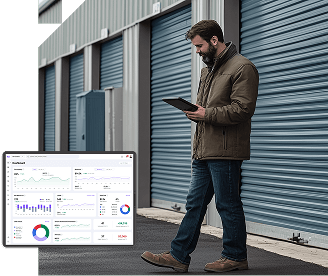
Revenue management is where automated self-storage systems create the most reliable NOI lift, because pricing and ECRI discipline compound across every unit, every month.
Automation in modern storage facility management should be evaluated by how well it drives predictable, repeatable financial outcomes—not by how impressive the software looks.
| Automation capability | What gets automated | Primary KPI impact | NOI impact pathway | Common failure mode (manual/legacy) |
| Digital leasing + online move-ins | End-to-end rental flow, ID capture, e-sign, payment setup, access credential creation | Conversion rate, time-to-lease, vacancy days | Faster lease-up reduces vacancy loss; fewer admin hours per move-in | Staff-dependent follow-up; incomplete reservations; delayed move-ins |
| Autopay, payment tokenization, auto-card updater | Stored payment credentials, recurring billing, retry logic | Autopay penetration, collections efficiency | Higher on-time payments; lower delinquency labor and write-offs | Tenants fall off autopay during migrations; manual reminders |
| Delinquency workflow automation | Trigger-based notices, tasks, fee application, lien sequencing | Delinquency rate, DSO, cost-to-collect | Faster cash recovery; fewer bad-debt losses; reduced labor per delinquent tenant | Inconsistent timelines; missed notices; delayed escalation |
| Dynamic pricing (real-time) | Rules-based or algorithmic rate updates by unit group and demand | Realized rent, occupancy mix | Higher revenue per occupied unit; improved yield without added headcount | Static rate cards; slow response to demand shifts |
| ECRI automation | Scheduled increases with policy controls and segmentation | ECRI adoption, churn rate, realized rent | Compounding revenue lift across stabilized occupancy | “Set-and-forget” or avoided increases due to churn fear |
| Promotion governance | Portfolio-wide promo rules, guardrails, automatic start/stop thresholds | Discount rate, net effective rent | Reduced revenue leakage; tighter control over concessions | Promo drift by site; discounts persist after demand returns |
| Tenant communication automation | Lead nurturing, abandoned cart recovery, notices, operational updates | Lead-to-lease, response time, CSAT proxy | More leases from existing traffic; fewer inbound calls for routine issues | Leads go cold; inconsistent messaging by location |
| Remote operations + task routing | Centralized queues, exception handling, standardized SOP tasks | Labor hours per facility, response SLAs | Lower staffing requirements per site; more scalable org design; brand consistency accross all fronts | Manager “heroics” drive outcomes; no repeatable process |
| Portfolio reporting + exception dashboards | Automated roll-ups, anomaly detection, unit-group performance views | Decision velocity, reporting cycle time | Faster corrective actions; fewer hidden losses | Spreadsheet consolidation; month-end surprises |
| GAAP-ready accounting workflows | Accrual-ready reporting, revenue recognition controls, audit trails | Close time, reporting integrity | Reduced reconciliation overhead; improved lender/investor reporting confidence | Manual adjustments; disconnected systems; audit complexity |
Monument’s Insights platform captures and correlates all of the data generated by these automation layers. Every automated workflow—whether related to pricing, ECRI execution, delinquency management, abandoned cart recovery, or payment processing—feeds directly into interactive dashboards that quantify performance impact across markets. Operators are not asked to assume ROI; they can see it. By linking automation activity to realized rent, churn sensitivity, collections efficiency, and labor metrics, Monument makes the financial gains measurable at the portfolio, region, and facility level. Increased NOI is not anecdotal—it is traceable.
Automated self-storage units generate more revenue when pricing is treated as a system that continuously adjusts to supply, demand, and tenant behavior without manual intervention. rather than a static rate card.
Dynamic pricing enables algorithmic street-rate adjustments based on demand signals such as occupancy by unit group, competitor positioning, seasonality, and velocity of move-ins. The objective is not volatility, it’s disciplined yield management.
ECRI is often the single highest-ROI automation lever in stabilized portfolios, frequently representing 15–25% of annual revenue growth when executed consistently. Yet it is also where manual execution most commonly breaks down:
Automating ECRI addresses these issues directly by standardizing cadence, applying data-driven logic, and integrating churn analysis so you can increase revenue without triggering avoidable move-outs.
Churn analysis becomes the control system: you are not guessing which tenants will absorb an increase. Through Monument’s Insights platform, operators can see the data driving the decision—length of stay, payment behavior, unit scarcity, competitive pricing gaps, and historical response to prior increases. Instead of applying blanket adjustments, you use tenant behavior and demand signals to distinguish “elastic” from “inelastic” customers and adjust strategy accordingly. This turns pricing from intuition into a measurable, data-backed discipline.
Promotions are often treated as marketing tactics, but in a modern portfolio, they are revenue tools. Automated self-storage pricing should allow you to set rules such as:
This is where portfolio-first systems matter: a pricing strategy is only as strong as its enforcement. Rules-based rate plans and promotion governance ensure that pricing guardrails are in place so manual discounts cannot erode street-rate integrity or reset customer price expectations. By standardizing how and when promotions are applied—and automatically starting or stopping them based on defined thresholds—the portfolio maintains consistent financial discipline across every site.

A fully automated self-storage facility is not just about efficiency. It is about improving three measurable outcomes:
Automation reduces friction in the leasing process, increases the amount each tenant generates, and strengthens retention through structured communication and payment continuity.
If those three metrics do not improve, the automation is not working.
If your move-in experience does not match modern e-commerce expectations, you are leaking conversion rate before pricing strategy even begins.
A high-performing digital leasing flow improves conversion rate by reducing abandonment and increasing completion speed:
Every step is designed to remove friction and protect conversion rate. The objective is not to eliminate people—it is to ensure that every qualified prospect can become a tenant without delay, inconsistency, or manual bottlenecks. A higher conversion rate increases occupancy. Higher occupancy supports pricing power. Pricing power expands revenue per tenant.
The leasing moment is the highest-leverage opportunity to increase revenue per tenant. When upsells are embedded directly into the checkout flow, margin expands without additional marketing spend.
Structured automation increases revenue per tenant by consistently presenting:
These gains do not require more traffic. They increase revenue per tenant from the same inbound lead.
Over time, higher revenue per tenant compounds across stabilized occupancy, directly increasing lifetime value and overall NOI. Automation here is not about efficiency. It is about systematically increasing the economic output of every lease.
Even strong leasing funnels lose prospects. The question is whether your system recaptures them and protects conversion rate.
Automated abandoned cart workflows directly increase conversion rate by re-engaging high-intent prospects:
For operators investing in digital marketing, abandoned cart recovery protects acquisition spend and increases lead-to-lease conversion.
A higher conversion rate leads to more tenants. More tenants, combined with structured upsells and disciplined pricing, increase revenue per tenant. Sustained autopay enrollment and communication automation extend lifetime value.
Automation creates enterprise-grade scalability only when it is paired with strong controls—especially around customer experience, data integrity, and financial reporting.
Automation is powerful, but it can amplify problems if governance is weak. High-performing operators treat automated self-storage as an operating model that requires oversight.
Even in a fully automated self-storage environment, people remain strategically important.
Automation should handle:
People should focus on:
Tailored, direct customer service continues to be an important differentiator for vendors. Each self-storage business should have an individualized approach to automation rather than trying to paint everyone with the same brush, assuming that every enterprise self-storage business is going to have the exact same needs. Being able to determine where and when manual review is needed is just as important as the automation itself.
Automation is dangerous without accurate data. If your tenant ledger, rent rules, fee policies, and reporting are not structurally consistent, automation can produce confident-looking outputs that are financially wrong.
This is where accounting maturity matters. For sophisticated operators—especially investor-backed portfolios—GAAP-compliant accrual accounting is not optional. It is the reporting standard that lenders and institutional stakeholders expect.
In many legacy environments, finance teams still rely on exports, manual adjustments, and external systems to produce accrual-ready reporting at portfolio scale. That process introduces lag and reconciliation friction—exactly the opposite of what “automation” is supposed to achieve. Automation without accounting rigor creates speed without control. True enterprise systems deliver both.

Transitioning to automated self-storage units is less about turning on features and more about de-risking a portfolio-wide operating model change. Operators that execute well treat implementation as a disciplined program with clear financial guardrails: protect collections, preserve occupancy momentum, maintain tenant access continuity, and ensure reporting integrity from day one.
Automation should not introduce volatility. It should eliminate it. A modern storage facility automation rollout should be engineered around four non-negotiables:
If your implementation plan cannot explicitly defend these four outcomes, automation will create short-term chaos that offsets ROI.
For multi-site operators, successful implementation is phased and controlled—not a “big bang” portfolio-wide launch.
Start portfolio-first, not site-first. Document how the business actually runs and where inconsistency creates risk:
Deliverable: A portfolio operating blueprint the system will enforce.
Automation is only as strong as the integrity of its data model. The goal is not just tenant balances—it is clean data that supports automation on day one.
Migration scope should include:
Deliverable: A validated migration map with field-level rules and exception handling.
Automation fails when systems are loosely connected. Validate critical integrations before training begins:
Deliverable: Integration test scripts with defined pass/fail criteria—not just confirmation that systems “connect.”
A strong cutover plan is operationally specific. It defines the exact moment systems switch, what is frozen, and how you reconcile accuracy.
Operational cutover essentials
If you are scaling across dozens of facilities, the cutover should be treated like a controlled deployment—not an IT event.
Automation is only enterprise-grade if it strengthens financial control.
A modern implementation should explicitly address:
A practical best practice is a finance validation pack that includes:
The most overlooked “implementation task” is eliminating parallel manual processes.
To ensure automation delivers ROI:
If staff keeps doing work the old way in spreadsheets, email threads, and side logs, automation becomes additive complexity instead of a replacement.
| Area | What “ready” looks like | Why it matters to NOI |
| Autopay continuity | Tokens migrated; retry rules tested; no tenant action required | Prevents collections dip and churn risk |
| Access continuity | Gate/lock permissions validated for active tenants | Avoids service failures and reputational risk |
| Pricing governance | Rate plan rules and override permissions set portfolio-wide | Protects yield discipline and reduces leakage |
| ECRI automation | Cadence, segmentation, and guardrails configured | Enables compounding rent growth with controlled churn |
| Delinquency automation | Notice sequencing and lien workflows validated | Reduces cost-to-collect and delinquency duration |
| Reporting integrity | Finance reconciliation pack completed | Maintains confidence with lenders/investors |
Automation should be managed against a defined KPI scorecard, typically tracked weekly for the first 60–90 days:
The practical objective is not “feature usage.” It is measurable operating leverage: better NOI performance with less manual effort and more consistency across the portfolio.
A disciplined implementation program prevents these outcomes and accelerates time-to-value—so storage facility automation delivers scalable performance, not operational turbulence.
Automated self storage is not a hardware trend. It is an operating strategy that turns scale into an advantage instead of a burden. When your automated self-storage system standardizes execution, strengthens revenue management discipline, and produces investor-grade reporting, you are no longer managing facilities. You are running a portfolio with REIT-level precision—driving higher NOI and protecting asset value through operational consistency.
If you are evaluating fully automated self-storage solutions, the most important question is whether the platform automates the work that actually drives performance: leasing conversion, collections, pricing, ECRI, and portfolio-wide visibility.
Monument is purpose-built for high-growth operators who need automation that scales across dozens of assets without adding extra work.
Does your current platform automate the work that actually drives performance? If you want to see what enterprise-grade operational automation looks like in practice, book a demo and evaluate the system against your portfolio’s real constraints.


Explore top self-storage software solutions with key features, comparisons, and tools for facility operations, marketing,...

Explore top facility management software systems for self-storage, including key features, benefits, and how these...

Discover how 3rd party self storage management improves operations, revenue, and NOI—and what to look...