


The self-storage industry has undergone a radical structural shift. What was once an industry that mainly consisted of small, local operators has evolved into a new type of industry that is dominated by institutional capital and high-performance REITs. The legacy on-premise systems that once served a single facility are no longer just insufficient—they are a liability.
As an operator scales, the complexity of managing different sites increases exponentially, requiring a fundamental change in how technology is utilized. This article analyzes why cloud-native, open-ecosystem web-based self-storage software is the only viable foundation for the next stage of institutional-grade growth.
Key Takeaways
Web-based self-storage software is a cloud-delivered platform that centralizes leasing, tenant lifecycle workflows, payments, pricing, reporting, and integrations in a browser-based system. Unlike on-premise or desktop-heavy tools, cloud-based self-storage management software is designed for continuous updates, real-time portfolio visibility, and Open API connectivity—so operators can integrate smart locks, dynamic pricing, and marketing channels without rebuilding workflows for every asset.
The API economy matters because modern operations are no longer monolithic. Your competitive advantage comes from combining best-of-breed capabilities—access control, analytics, revenue engines, call center tooling, tenant protection, and marketing—into a coherent, scalable operating model. Your software for self-storage should be the hub, not the bottleneck.
A useful way to answer the “what is self-storage software” question is to take a closer look at the two different approaches that developers take to building the software itself: an open ecosystem or a walled-garden (closed ecosystem).
This distinction becomes decisive at scale. The Director of Ops needs consistency across regions and property sets; the CFO needs investor reporting confidence and predictable systems risk. Large, growth-oriented operators (20–100+ facilities) cannot scale effectively without centralized automation, sophisticated analytics, and a modern, contactless rental process. This is where Monument comes in.

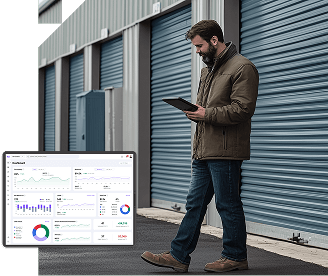

Selecting management software for self-storage is not a UI decision. It is a control-system decision: how quickly you can deploy changes, how reliably you can report, and how much NOI you can protect and expand through automation.
Automation should not be narrowly defined. It includes the ability to standardize tenant communication, automate responses to leads, structure delinquency management workflows, and enforce consistent pricing and revenue policies across the portfolio. These systems directly influence revenue capture, bad debt exposure, and labor efficiency.
In multi-facility environments, software selection becomes a valuation decision disguised as an IT decision. The platform determines whether execution is consistent across assets or dependent on individual manager habits.
Below is a practical framework you can use when choosing storage facility management software—especially if you are evaluating options through an enterprise lens.
| Evaluation area | “User Buyer” (Director of Ops / Regional) | “Executive Buyer” (Owner / CFO) |
| Portfolio controls | Batch operations for policy changes (fees, delinquency rules, messaging) across a portfolio, region, or custom property set | Controls that reduce operating risk and support consistent compliance across assets |
| Automation depth | Rule-based workflows that eliminate repetitive staff work (collections, notices, lead follow-up) | Payroll scalability: grow units under management without linear headcount growth |
| Reporting and visibility | Real-time dashboards that show occupancy, leads, delinquency, and exceptions without exports | Investor-grade reporting, audit readiness, and confidence in the numbers |
| Analytics | Clickable dashboards that allow drill-down from portfolio metrics directly to tenant-level detail; fast identification of outliers and operational issues | Data-backed revenue forecasting, cohort performance analysis (lease-up vs stabilized), churn sensitivity insights, and asset-level valuation support |
| Integrations | Open API and straightforward connectivity to locks, gates, tenant protection, marketing tools | Reduced vendor lock-in; ability to adopt best-in-breed tooling over time |
| Migration | Minimal disruption to site teams during transition | White-glove migration; low risk of data loss; strong support model |
A practical way to run this evaluation is to convert it into an implementation “stress test”:
The myth of “low-base-price” self-storage software persists because subscription fees are easy to compare—and opportunity cost is harder to measure. But at scale, the biggest loss is not the license fee. It is the foregone NOI.
An operator may save $200 per month on a software subscription. That feels prudent. But if the platform fails to support disciplined pricing execution, consistent rent increases, abandoned cart recovery, and structured delinquency management, the portfolio may quietly forgo $20,000 per month in incremental NOI.
That is not a software savings. It is a valuation drag.
The hidden costs become measurable:
But even those are secondary to the core issue: suppressed pricing power.
In a 10,000-unit portfolio, a $2 average rent lift equals $20,000 per month. If the system cannot consistently execute rent increases or automate follow-up on leads, that income may never materialize.
Modern industry comparisons increasingly focus on automation, portfolio dashboards, integrations, and structured communication systems because these are the levers that directly move NOI—not just reduce overhead.
If “cheap” software requires manual workarounds and inconsistent execution, it can become the most expensive system in your stack. Saving $200 per month while foregoing $20,000 in NOI is not cost control—it is lost equity.

Revenue management is the most direct, repeatable lever available to improve NOI without adding new assets. The problem is that many self-storage management solutions still treat pricing of self-storage units as a static field—an operator sets a rate, checks competitors occasionally, and makes sporadic adjustments. That approach underperforms in a competitive, multi-channel environment. Revenue management is a discipline, not a feature toggle.
Flat-rate unit pricing strategy fails for one simple reason: the “same” unit is not actually the same unit.
Web-based self-storage software can operationalize this reality by managing unit groups, attributes, and rules, ensuring consistent pricing changes—without managers improvising at each site.
Existing Customer Rent Increase (ECRI) is the second part of the revenue science stack: raising rents for existing tenants is often the highest-margin revenue move available, but it must be executed with discipline to protect occupancy and avoid churn. Cloud-based self-storage management software can support ECRI workflows by measuring tenant sensitivity and churn risk before notices go out, turning a subjective “should we raise rents?” debate into a repeatable, data-driven process.
Top self-storage software recognizes that pricing is not one number; it is a strategy across channels and contexts:
| Pricing approach | What it looks like in practice | Operational impact on NOI |
| Flat pricing (“set it and forget it”) | Same price across similar unit types; occasional manual adjustments | Consistent underpricing of high-value inventory; slow reaction to demand shifts |
| Attribute-based, value pricing | Premiums/discounts based on convenience, access, and unit attributes | Higher yield on top-performing units; fewer “regret discounts” |
| Channel-aware (“street” vs. “web”) | Pricing rules that reflect acquisition channel dynamics | Better conversion without eroding in-store margin opportunity |
| ECRI discipline | Structured rent increases with churn-aware guardrails | Predictable, compounding NOI lift with controlled churn risk |
Modern operator guidance increasingly points to conversion flow quality, reporting, and pricing agility as primary differentiators because they directly influence occupancy and revenue velocity.
Automation is not about eliminating busy work. It is about creating scalability and measurable performance gains. In multi-facility portfolios, the real risk is not staff effort—it is inconsistent execution. When pricing, delinquency management, and tenant communication vary by location, revenue leaks and risk compounds. Automation standardizes execution across every facility, every tenant, and every lead.
More importantly, automation multiplies impact. For every new lead or tenant, there are dozens of potential connection points: follow-up messages, pricing logic, payment retries, delinquency escalation, review requests, renewal notices, and more. When those touchpoints are automated and triggered systematically, conversion improves and revenue capture increases. When they are manual, outcomes depend on individual attention and timing.
The legacy assumption is simple: more facilities require more staff. That assumption is built on manual workflows.
Modern self-storage software changes the math.
When collections, lead follow-up, rent increases, and policy enforcement are automated, operators can manage more properties without proportionally increasing payroll. Instead of adding a manager for every 8–10 stores, the system absorbs repetitive execution across the portfolio.
Automation creates leverage in two measurable ways:
For operators managing 20+ facilities, automation is not optional. It is the only way to scale without chaos. A 30-facility portfolio cannot rely on memory, spreadsheets, or local habits to enforce pricing, collections, and communication standards.
A simple framework for prioritizing automation:
The operators who outperform at scale do not necessarily work harder. Their platform executes more consistently, across more properties, at more connection points per tenant and per lead. That consistency is what drives both scalability and NOI expansion.
A responsive storage facility rental software experience—your website and online rental flow—should be treated as your most efficient leasing agent. It works 24/7, does not call in sick, and does not forget to follow up. Done properly, it handles the entire end-to-end transaction: select, sign, pay, and access in real time.
Modern “best platform” roundups consistently highlight contactless reservations, automated billing, and integrated communications because they reduce overhead and improve tenant experience at the same time.
If you are evaluating a web-based self-storage software solution, do not treat mobile-friendly as a low priority. Mobile-friendly self-storage software is operationally meaningful when:

Once you operate at portfolio scale, you stop asking, “What happened last month?” and start asking, “What is changing right now, and what should we do next?” That is the difference between reporting and intelligence. Interactive storage management facility dashboards turn raw data into decision velocity—one of the most underappreciated drivers of NOI.
Most legacy systems can export data. That is not the standard anymore. CFOs and operators need:
This becomes especially important for regional managers juggling 15 facilities, each on its own island, where time is lost switching contexts and rebuilding the same analyses repeatedly.
The GAAP gap is where “good enough” becomes disqualifying for institutional operators. Sophisticated investors demand accrual accounting, audit-ready financials, and true General Ledger (GL) integration—because that is how they evaluate performance, manage risk, and underwrite future growth.
In the self-storage industry, this matters because prepaid rent, promotions, and timing differences between cash receipt and service delivery create deferrals (unearned revenue) that must be handled correctly in accrual reporting. Unearned revenue is typically recorded as a liability until it is earned, then recognized into income as the service period occurs.
If your self-storage manager software cannot support accrual workflows cleanly, finance teams end up “fixing” the books outside the platform—introducing delay, inconsistency, and audit friction. For investor-backed portfolios, GAAP-ready accounting is not optional; it is the baseline for credibility.
Visualizing the portfolio is not a BI vanity project; it is how leaders manage execution across geography. The best systems make it straightforward to view:
This is the operating reality for Monument’s target segment: large operators who cannot report to investors without sophisticated analytics and who cannot scale without centralized automation.
The market has already made the direction clear: the “top self-storage software” category is increasingly defined by platform architecture, automation depth, revenue science, and investor-grade financial rigor—not by basic facility workflows. In the API economy, web-based self-storage software must be a scalable hub that supports integrations, decision intelligence, and repeatable execution across the portfolio.
If you are still evaluating software for self-storage management with a single-site mindset, you will eventually hit a ceiling where the system cannot keep up with the business. The executive question becomes: do you want a tool that records activity, or a platform that measurably improves NOI, reduces operational drag, and protects valuation?
For large, growth-oriented operators, Monument is built around that portfolio reality: automation that scales, analytics that drive decision velocity, and enterprise-grade financial foundations—plus an open ecosystem model designed to integrate with best-in-breed tooling.
If you are preparing to scale (or already operating at 20–100+ facilities), book a demo with Monument to see how portfolio-first automation, revenue management, and enterprise-grade reporting can drive NOI—without doubling payroll.


Explore top self-storage software solutions with key features, comparisons, and tools for facility operations, marketing,...

Explore top facility management software systems for self-storage, including key features, benefits, and how these...

Discover how 3rd party self storage management improves operations, revenue, and NOI—and what to look...