


Most software evaluations start with the wrong question. Operators compare feature lists, sit through demos, and ask vendors to walk through their dashboards. What they rarely do is pressure-test a platform against the actual demands of running a portfolio of 20, 50, or 100-plus locations. At that scale, a misconfigured automation rule affects every site at once, and the inability to produce GAAP-compliant investor reports becomes a liability.
The self-storage software market has grown quickly, but product depth hasn’t kept pace. Many platforms have bolted multi-site features onto single-facility foundations, and the cracks show. Pricing decisions get made one facility at a time. Automation rules have to be rebuilt site by site. Analytics surface raw numbers instead of actionable intelligence.
This guide offers a practical evaluation framework for Directors of Operations, Regional Managers, Portfolio Owners, and Executives managing 10 or more locations, focused on what actually determines whether a platform can support your next stage of growth.
Key Takeaways
When looking for the best self-storage management software solution, you should focus on:
There’s a meaningful difference between a platform that reports data and one that processes it into actionable intelligence. A dashboard that shows occupancy is useful. One that correlates occupancy trends with tenant acquisition funnel performance, Existing Customer Revenue Increase (ECRI) sensitivity, and market benchmarking tells you what to do about it. As your portfolio grows, the volume of raw operational data grows with it, and the gap between operators who can extract meaning from that data and those who can’t becomes a direct competitive disadvantage. Evaluate any platform on whether its analytics layer produces intelligence, not just reports.
For multi-facility operators, the automation layer separates a basic facility management system from a platform that can handle multiple facilities. The volume of delinquency notices, payment follow-ups, lease communications, and collections outreach that must be coordinated daily is simply incompatible with manual execution at scale. The question is whether your platform can automate across your entire portfolio from a single rule set, or whether it requires you to replicate configuration by facility.
When evaluating any platform’s automation capabilities, focus on three key factors:
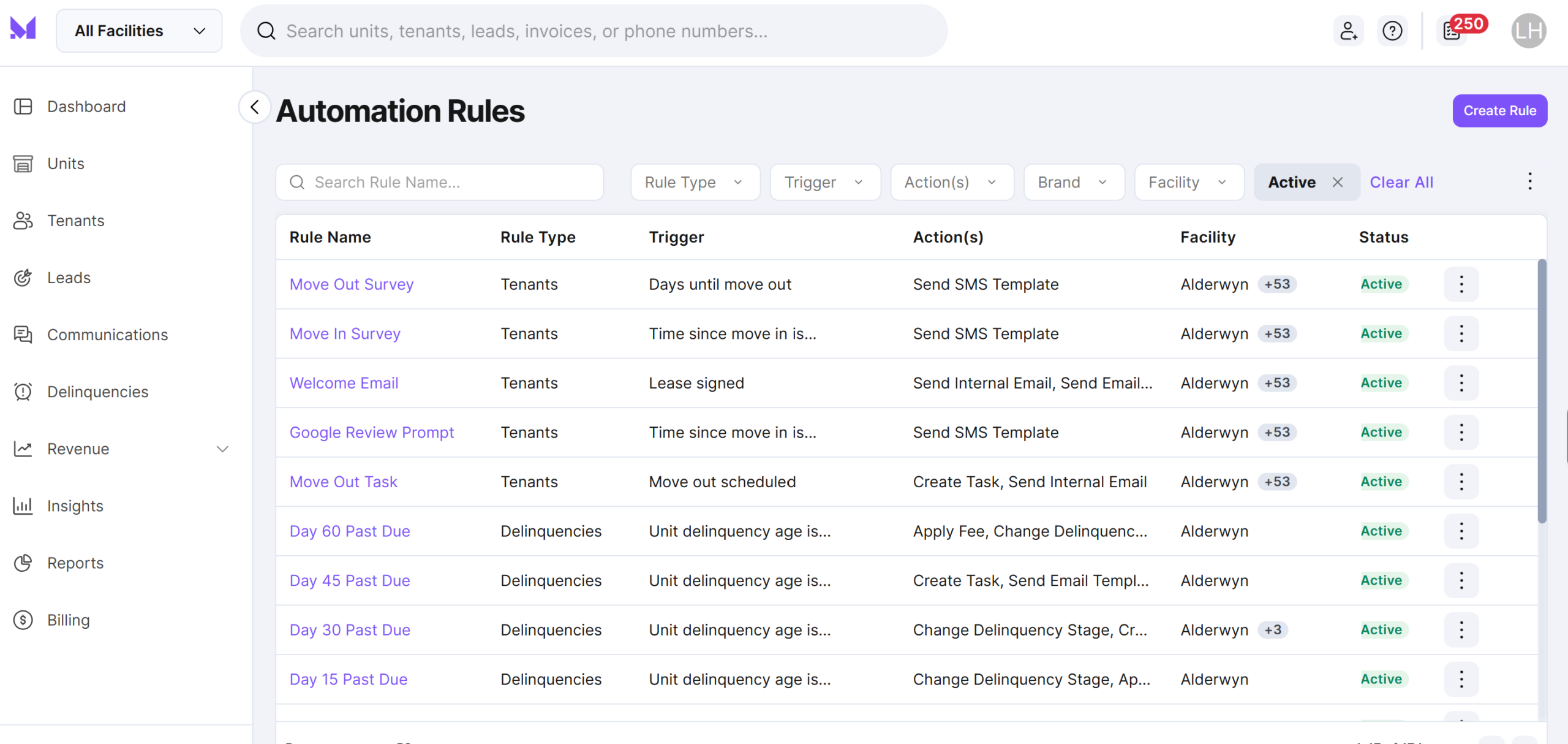
Sample of Monument’s delinquency management automation rules dashboard.

Sophisticated operators treat revenue management as a primary NOI lever. At portfolio scale, the difference between data-driven pricing and gut-feel rent increases can represent millions of dollars in annual revenue and asset values. The best self-storage management software provides a complete revenue management suite with the analytical infrastructure to make those changes defensible and systematic.
Evaluate any platform on the following capabilities:
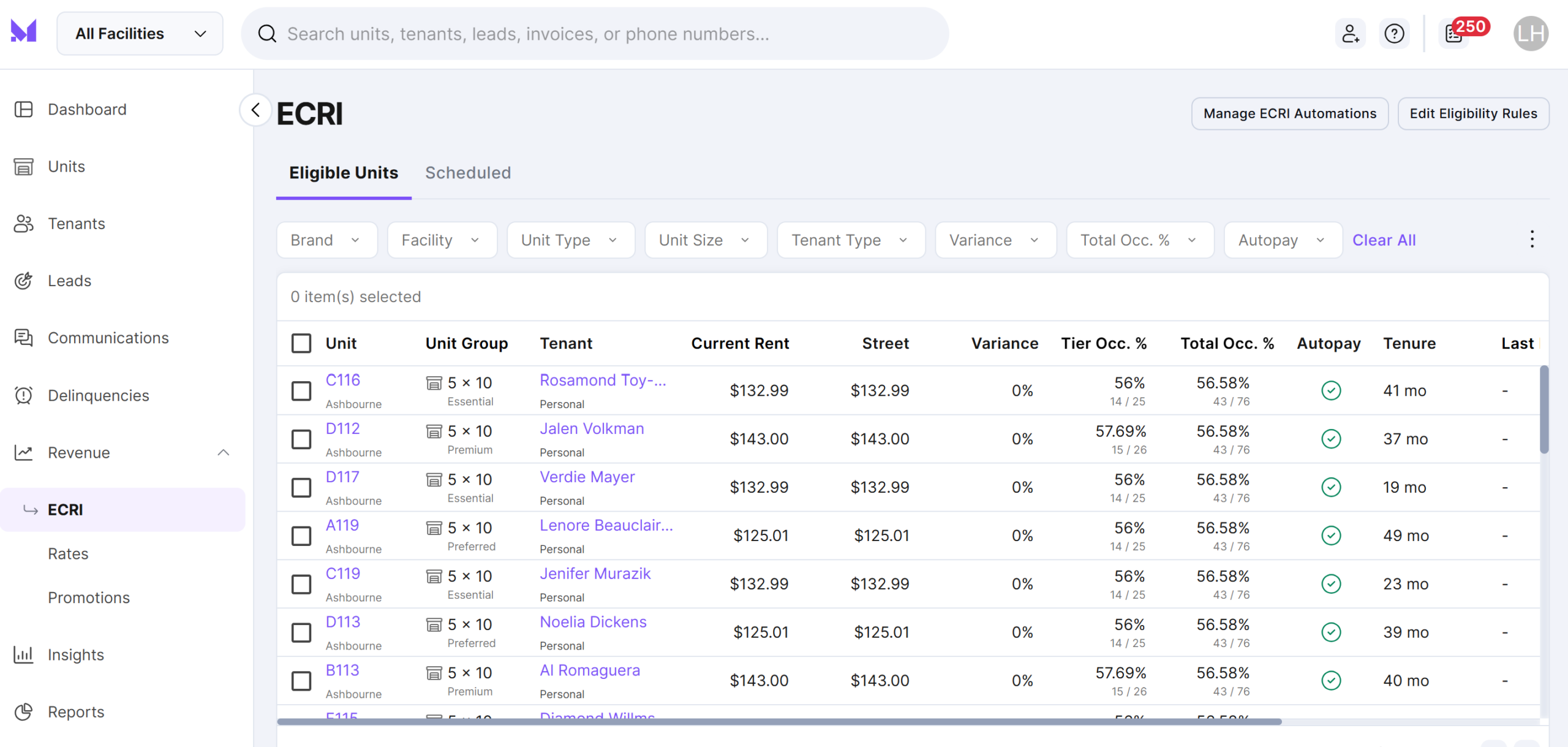
Sample of Monument’s ECRI workflow.
Operators who report to private equity sponsors, institutional lenders, or ownership groups cannot rely on cash accounting. GAAP-compliant accrual accounting requires lease-level precision, automated journal entries, and clean general ledger integration. Operators on legacy platforms that only support cash accounting often spend significant time manually converting figures, introducing errors and delaying investor reporting. For portfolios pursuing capital events, REIT-level exits, or any financing arrangement requiring auditable financials, native accrual support is a non-negotiable requirement.
Key accounting capabilities to evaluate include the following:

Sample of Monument’s revenue insights dashboard.
The best self-storage software doesn’t just report data. It converts raw operational metrics into actionable business intelligence. Regional Managers and Portfolio Executives shouldn’t be spending hours assembling spreadsheets before every investor update. The platform should do that work automatically.
Evaluate the quality of insight the analytics layer generates, not just the number of reports available. There is a meaningful difference between a dashboard that shows occupancy and one that correlates occupancy trends with tenant acquisition funnel performance, ECRI sensitivity, and market benchmarking. The first gives you data. The second gives you intelligence.
| KPI Metric | What It Measures | Why It Matters at Portfolio Scale |
| Economic Occupancy | Revenue collected vs. total possible revenue | Reveals true income performance beyond physical unit fill rates |
| Revenue per Square Foot | NOI efficiency relative to rentable area | Benchmarks asset productivity across dissimilar facility types and markets |
| Tenant Acquisition Cost | Marketing and leasing cost per new tenant | Identifies where direct bookings vs. third-party channels are over- or under-performing |
| ECRI Acceptance Rate | Percentage of tenants who retain after a rent increase | Validates pricing strategy and informs future churn sensitivity modeling |
| Accounts Receivable Aging | Delinquent balances segmented by days past due | Exposes collections risk across the portfolio at a glance |
| Autopay Enrollment Rate | Percentage of active tenants on autopay | Predictive indicator of cash flow stability and collection effort required |
| Conversion Rate | Leads converted to signed leases | Measures leasing website and follow-up process effectiveness |
Investor reporting capabilities deserve specific scrutiny. The ability to generate professional, accurate investor presentations on demand, segmented by fund, asset type, debt status, or geographic region, is a meaningful competitive differentiator when raising capital or managing existing LP relationships.
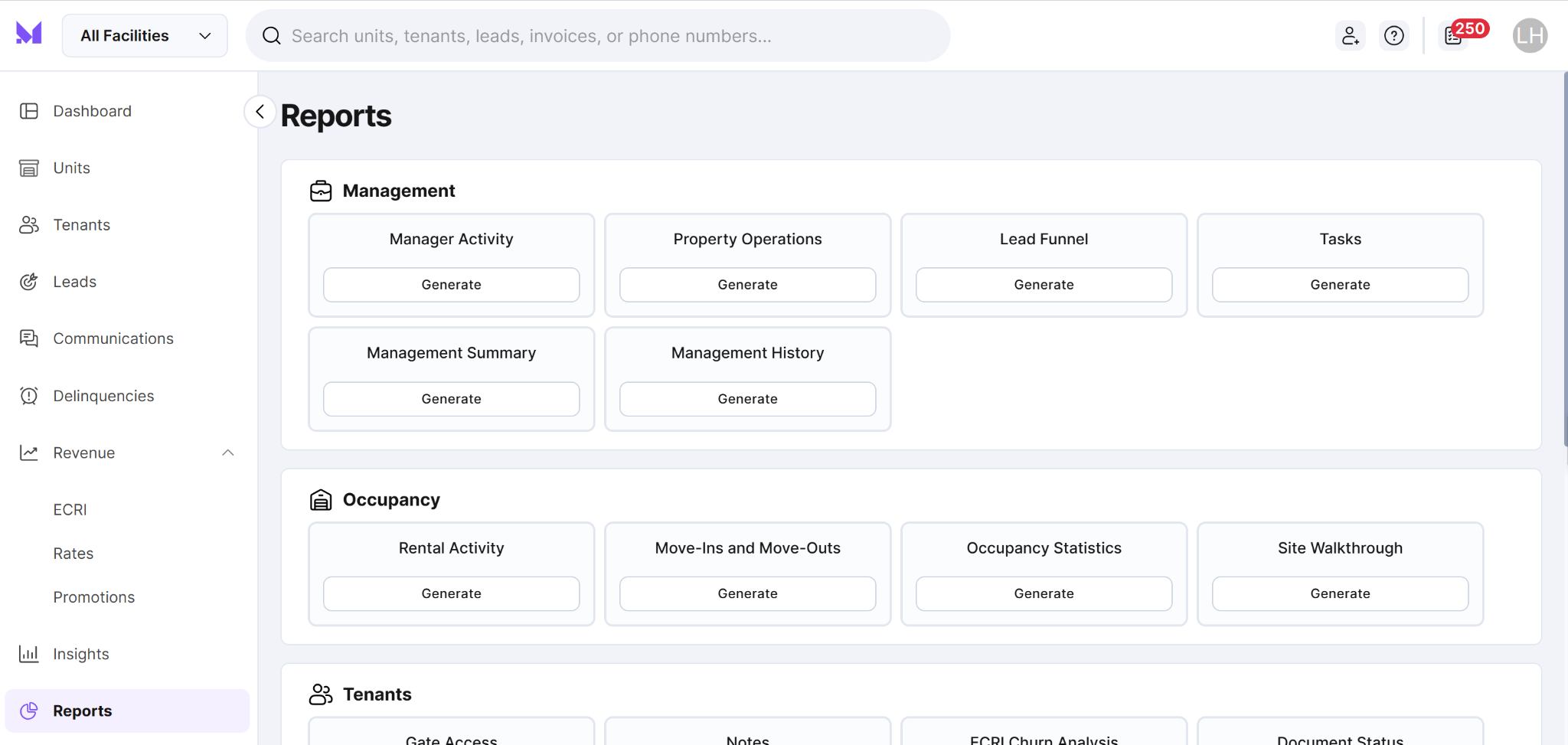
Sample of Monument’s reporting dashboard.
A conversion-optimized rental website is a direct revenue driver, not a marketing expense. Operators whose leasing infrastructure relies on outdated websites, third-party iframe solutions, or platforms that redirect prospective tenants off-site are losing direct bookings, often at a premium price point that marketplaces won’t match.
Evaluate the leasing layer on its ability to maximize both conversion rate and average basket value, not just generate traffic. The leasing experience should be engineered end-to-end: from SEO-optimized landing pages that capture direct search intent, through a frictionless checkout flow, to an upsell architecture that increases average transaction value at the point of lease signing.
Specific capabilities to assess:
For large operators, the migration process is consistently the most underweighted factor in software evaluations, and the one that causes the most operational disruption when it goes wrong. Before committing to any platform, understand exactly who owns the migration process, what data will be preserved, how payment tokens will be transferred, who will train your team and when that training occurs, how third-party integrations will be configured and tested before go-live, and what a realistic timeline to full operational stability looks like.
A vendor that treats implementation as a self-service exercise is not built for enterprise transitions. For operators managing many facilities, migration poses a higher operational risk. The platform’s ability to transfer autopay tokens without disrupting active payment relationships is often the single most critical capability in this evaluation. Loss of autopay enrollment means re-engaging tenants manually, increasing collections friction, and creating accounts receivable risk at exactly the moment you need to demonstrate operational continuity.
Evaluate the vendor’s migration methodology on the following:
The operators who will have a meaningful advantage in three to five years are the ones whose platform is positioned to leverage AI today. That means a system built on clean, structured, portfolio-wide data, the kind that an AI engine can actually use to surface anomalies, generate recommendations, and automate decisions that currently require human judgment. Selecting a platform that isn’t architected for AI integration isn’t a neutral choice. It’s a decision to retrofit later, at significantly higher cost and disruption. When evaluating platforms, ask where AI is on the product roadmap, and what the underlying data architecture looks like.
Self-storage management software is typically marketed with a straightforward per-unit or per-facility price. That number is easy to compare. What’s harder to compare, and far more consequential, is total cost of ownership: the license fee, add-on modules, integration costs, implementation overhead, and the operational drag created by a platform that doesn’t fit your portfolio.
At portfolio scale, the most significant financial risk is the NOI lost to a platform that can’t execute disciplined revenue management, structured ECRI workflows, and automated collections across every site.
Per-unit pricing creates economic alignment between the platform and the operator. Your software cost scales proportionally with the portfolio’s revenue potential, and budgeting is predictable as you acquire new assets. Per-facility base rate models appear more affordable initially, but the true cost emerges once you layer in the modules required to run a functional enterprise operation. Payment processing fees, advanced reporting, open API access, and automation toolkits are frequently billed separately. The all-in cost of a modular platform routinely converges with, or exceeds, an all-inclusive per-unit rate.
Operators at the Pro and Enterprise level need the full suite from day one: advanced analytics, ECRI automation, open API access, GAAP-compliant reporting, and investor dashboards. A platform with a low entry price that gates these capabilities behind premium tiers is structured to grow with your frustration, not your portfolio. Ask every vendor explicitly what is excluded from the base license. The answers will reveal more about their true positioning than any feature demo.
The most underreported cost in any platform evaluation is the labor absorbed by software that doesn’t automate what it should. Manual reconciliation, spreadsheet-based investor reporting, and per-site rule configuration all carry a dollar value that rarely appears in a software cost comparison. For a portfolio of 30 facilities, even five hours per week of avoidable manual work represents a significant annual labor cost. The question isn’t whether the better platform costs more. It’s whether the operational drag of the cheaper one costs more than the difference.
Monument was purpose-built for the multi-facility operator, not as a retrofit of a single-site platform, but as an enterprise-grade portfolio management system designed from inception to handle dozens or hundreds of locations from a single point of control. All-inclusive subscription tiers with no hidden add-ons mean operators can model their cost accurately before signing.
Two capabilities distinguish Monument at the implementation stage specifically:
| Question to Ask | What You’re Really Testing | Red Flag Answer |
| How do you handle payment token transfer during migration? | Migration risk and operational continuity | “Tenants will need to re-enter their payment information.” |
| Does your accounting module support both cash and accrual natively? | Financial reporting capability and GAAP compliance | “We integrate with a third-party tool for accrual.” |
| Can I deploy automation rules across my entire portfolio simultaneously? | True portfolio-level architecture vs. per-facility configuration | “You’ll configure rules at the facility level.” |
| What third-party integrations do you support, and what does custom API development cost? | Ecosystem openness and total cost of ownership | “We don’t support that vendor” or “Custom APIs are billed separately.” |
| How is post-implementation support structured, and where is your support team based? | Accountability, responsiveness, and client success model | “You can submit a ticket and our team will respond within 48 hours.” |
| What is excluded from the base license price? | True all-in cost vs. modular pricing with hidden fees | A long list of add-on modules required for full functionality. |
| How often do you update your platform? | Vendor investment in continuous innovation and product roadmap velocity | “We release updates when they’re needed” or a vague, uncommitted answer about release cadence. |
| Where does AI fit into your product roadmap, and what does your underlying data architecture look like? | Whether the platform is positioned to deliver AI-driven insights or will require a costly rebuild to get there | “We’re exploring AI” with no specifics, or a data model that can’t support portfolio-wide pattern recognition and recommendations. |

Operators who are actively acquiring facilities need a platform that can absorb new assets without requiring significant reconfiguration with every onboarding. But platform longevity goes beyond technical scalability. It’s about whether the vendor is investing in the right capabilities, at the right pace, to remain a competitive advantage rather than becoming a constraint.
A vendor’s update frequency is one of the most reliable signals of its long-term product investment. Enterprise platforms that ship meaningful updates on a bi-weekly cycle are structurally different from legacy vendors that release major versions annually or charge implementation fees to access new functionality. In a market where AI-assisted analytics, dynamic pricing models, and automated investor reporting are becoming baseline expectations, the gap between a vendor investing aggressively in its roadmap and one maintaining a static product widens every quarter.
Ask any vendor you’re evaluating: How frequently do you release new features? Are updates applied automatically across all customers, or do they require local installation? What does your product roadmap look like for the next 12 months, and what capabilities are in active development?
The next meaningful frontier in self-storage management software is the conversion of raw operational data into AI-assisted business intelligence. That means natural language insights that surface actionable recommendations without requiring manual analysis. Platforms that are building this capability now, against real customer datasets, are creating a compounding advantage that will be difficult to replicate.
This includes AI-powered rent increase recommendations calibrated to tenant churn sensitivity, automated competitive benchmarking that flags rate positioning risks before they affect occupancy, and investor narrative generation that transforms portfolio-level data into presentation-ready summaries. For operators managing 50-plus locations, the labor displacement from these capabilities alone represents a material reduction in management overhead.
Every software migration carries operational risk and transition cost. Operators who select a platform that reaches its architectural ceiling within two or three acquisition cycles face a compounding penalty: the direct cost of a second migration, the opportunity cost of the transition period, and the disruption to teams who have built workflows around the outgoing platform.
Selecting an enterprise-grade platform that can scale to your ten-year portfolio target, not just your current footprint, eliminates that penalty. Evaluate vendors on their largest current customer and the operational complexity that customer manages. A platform proven at 90 or 100 locations provides materially more confidence for an operator at 25 than one whose reference customers top out at 15.
Automation and AI are no longer emerging capabilities for forward-thinking operators to consider. They are operational necessities for any portfolio competing in the current demand environment. With tenant demand softening in many markets, operators cannot afford to leave revenue management, collections efficiency, or lead conversion to manual processes. The margin for error has narrowed, and the competitive advantage available to operators with sophisticated automation infrastructure has correspondingly increased.
Automation functions as a direct NOI lever across four critical operational domains: collections, delinquency management, ECRI execution, and lead follow-up. Each of these domains, managed manually at portfolio scale, consumes disproportionate team capacity and produces inconsistent results.
Well-designed automation rules handle the full delinquency workflow, including notices, overlock instructions, payment follow-ups, and late fee applications, without human intervention. This dramatically reduces inbound call volume and frees regional management capacity for higher-value activities. The same infrastructure drives lead nurturing sequences for abandoned cart contacts, improving conversion rates without adding headcount.
AI-assisted insights extend this capability further. The next frontier for enterprise-grade platforms is the ability to convert raw operational data, including occupancy trends, tenant behavior, rate sensitivity patterns, and market benchmarking data, into natural language insights that surface actionable recommendations without requiring manual analysis. Platforms investing in this capability now are building the infrastructure for AI-powered benchmarking, automated rent increase recommendations, and investor narrative generation.
Operators who delay automation adoption are compounding a competitive disadvantage that grows harder to close over time. The gap between a portfolio operating with portfolio-wide automation rules and one relying on site-level manual processes widens with every acquisition. The cost to catch up isn’t just financial. It’s operational, in the form of accumulated inefficiency that has become embedded in team workflows and institutional habits.
Automation is not a feature to evaluate in isolation. It is the connective tissue of a scalable operation. The right platform treats automation as core architecture, not an add-on module, with configurable rules that reduce call center volume, headcount requirements, and the manual burden that constrains your team’s ability to focus on growth.
The right self-storage management software for a multi-facility operator isn’t the one with the longest feature list. It’s the one purpose-built for the specific complexity of managing a portfolio. Operators who have outgrown their current system aren’t facing a software problem. They’re facing a scalability problem. The platform they select next will either solve that problem or perpetuate it.
Migration risk remains the most underweighted factor in most evaluations. A poorly managed migration can disrupt active payment relationships, lose historical data, and destabilize operations at exactly the moment you need to demonstrate continuity to investors and lenders. The vendor’s implementation methodology deserves as much scrutiny as the platform’s feature set.
The operators who extract the most value from an enterprise-grade platform are the ones who approach the selection process with the same rigor they’d apply to any major capital decision. The returns, in NOI, operational efficiency, investor confidence, and acquisition scalability, are proportional to the quality of that decision.
Book a personalized demo today to see how Monument addresses your portfolio’s specific challenges.


Explore top self-storage software solutions with key features, comparisons, and tools for facility operations, marketing,...

Explore top facility management software systems for self-storage, including key features, benefits, and how these...

Discover how 3rd party self storage management improves operations, revenue, and NOI—and what to look...