


Transitioning from a single-facility operation to a multi-site self-storage portfolio is not merely about doing the same job at a higher volume; it’s a fundamental operational shift. When an operator expands from managing one or two locations to overseeing a complex portfolio of facilities spanning different municipal jurisdictions and states, pretty much everything that goes into operations often changes completely. With a single facility, you only had to worry about ensuring that operations were consistent across the one location, and could easily get away with manual processes. Even if you had two or three facilities, it’s still absolutely doable to standardize processes. But as soon as that number balloons to even just 10 or 20 facilities, store-to-store habits and other inconsistencies become a serious issue. And sitting at the heart of that issue is your self-storage software that wasn’t designed to handle scale at this level.
This is what is called a complexity ceiling, and if you’re at this point in your business, you probably already know that you need to change your approach to self-storage management.
This comprehensive guide breaks down the core operational disciplines that’ll take you from barely treading water to swimming like an Olympian. We’ll explore how portfolio-level operators leverage centralized governance, advanced revenue optimization, and enterprise-grade infrastructure to maintain total control over their assets, eliminate operational leakage, and aggressively drive Net Operating Income (NOI).
Key Takeaways
Delinquency management is one of the most volatile areas within multi-facility operations. It’s where process inconsistency directly damages cash flow, escalates labor costs, and more. When individual site managers are left to handle overdue accounts according to their own timelines, preferences, or personal relationships with tenants, the result is highly unpredictable revenue recovery and a fractured portfolio. Standardizing this process across all facilities ensures consistent collections and strict adherence to statutory requirements.
Operators lose sleep over delinquency because it hits NOI directly, and it hits it fast. Every day an overdue account sits unresolved, cash flow tightens, collections labor climbs, and the portfolio’s revenue picture gets murkier. Standardizing delinquency workflows gives operators a predictable, defensible process that protects revenue and reduces legal exposure, no matter which site or manager is handling the account.
To mitigate risk and stabilize cash flow, executive leadership must establish a uniform, rule-driven delinquency sequence that executes automatically based on specific lease milestones. This sequence must not depend on the site manager’s memory or manual intervention. Enterprise-grade automation ensures that every account follows an identical escalation pathway, eliminating human error and protecting the organization from wrongful sale lawsuits.
Here’s an example of an escalation pathway:
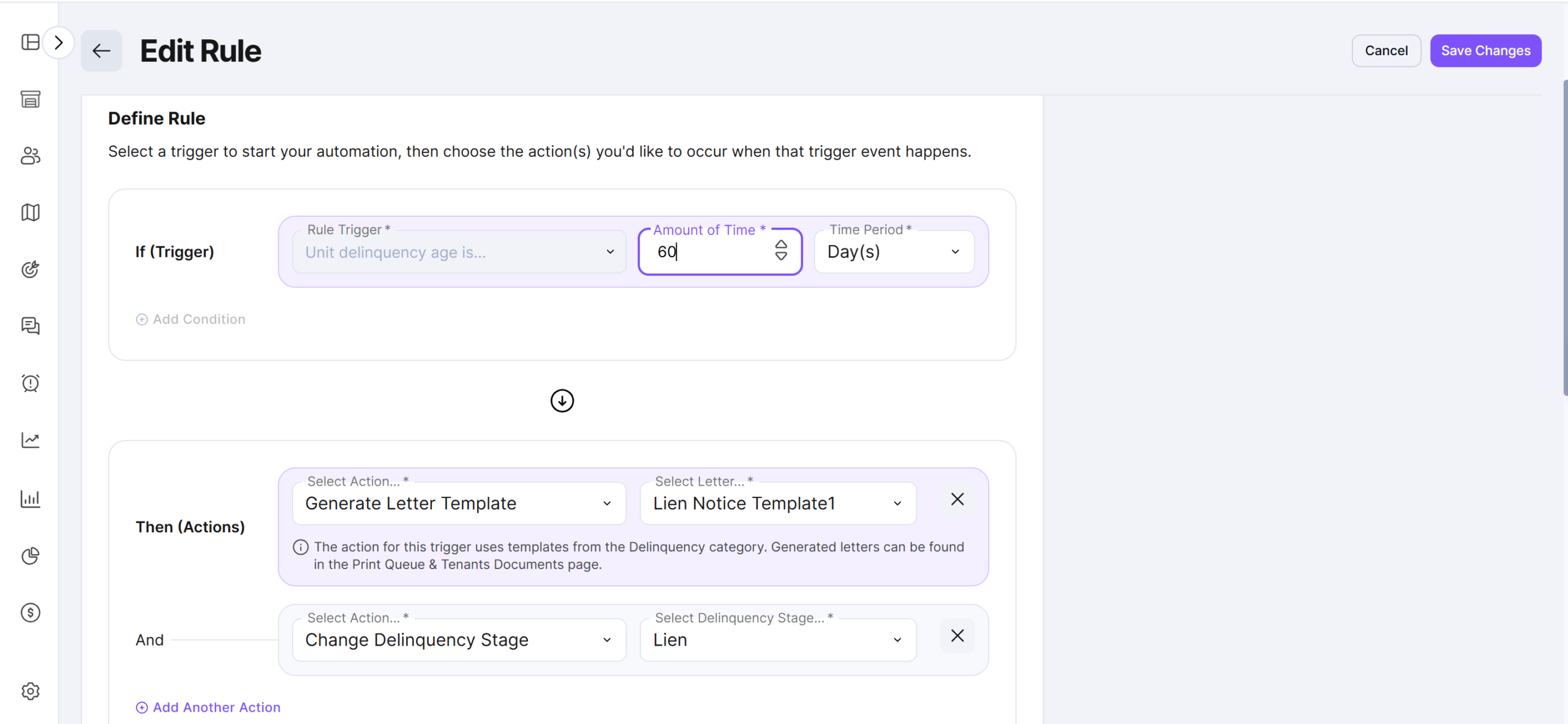
Example of an automated task that would send a lien letter to a tenant who is 60 days overdue on payment.
While execution must be automated, oversight must be centralized for effective self-storage unit management. Collections performance naturally varies by market, asset class, and demographic profile, making it essential to compare facility performance at the portfolio level. Executive teams must have real-time visibility into past-due balances, written-off bad debt, and collection cycle times across all assets.
By leveraging advanced business intelligence and dedicated Insights dashboards, operators can immediately isolate underperforming sites where delinquency metrics are diverging from the portfolio mean. This data allows regional managers to pinpoint operational bottlenecks, such as failing to follow up on returned mail or issues with local hardware integrations, before bad operational habits negatively impact the asset’s overall cap rate.
| Stage | Trigger | Recommended Timeframe | Action |
| Grace Period | Due Date Missed | Day 1 – Day 5 | Initiate automated SMS and email payment reminders; suspend online account modification privileges. |
| Late Status | Threshold Reached | Day 6 | Automatically apply primary late fee; issue official notice; communicate with access control to overlock unit. |
| Pre-Lien Status | Extended Non-Payment | Day 16 – Day 20 | Assess secondary late fee; generate pre-lien notification; initiate automated outbound collection sequences. |
| Lien & Auction | Statutory Delinquency | Day 31+ | Generate formal Lien Notice via verified/certified mail; lock unit with institutional security; schedule auction date. |

Autopay is a payment method that automatically charges a tenant’s card or bank account each month, without the tenant needing to log in or take any action. For operators, it is the difference between revenue that arrives predictably and revenue that has to be chased. The higher the autopay enrollment across a portfolio, the fewer manual collection calls, the fewer late payments, and the more stable the cash flow.
In many organizations, autopay enrollment is viewed simply as a convenience feature for the consumer. In high-performance portfolios, however, it is managed as a critical financial lever that directly influences cash flow predictability, minimizes collection expenses, and reduces tenant churn. A portfolio with a high concentration of automated payments experiences substantially less revenue leakage and operates with superior efficiency.
Effective self-storage unit management means not treating autopay adoption as a passive outcome of customer onboarding, but rather managing it as a hard financial KPI to protect Net Operating Income (NOI) and systematically eliminate collection drag. Executive leadership must establish explicit, portfolio-wide, and facility-specific autopay targets, utilizing a baseline of 75% or higher across all active leases as the institutional standard.
To break through the complexity ceiling and reliably hit these performance targets, operators cannot rely on manual site-level execution; the workflow must be programmatically embedded into the platform architecture across every consumer touchpoint:
By transforming automated collections from a site-level convenience into a centralized enterprise discipline, multi-facility operators establish total portfolio control, stabilize cash flow predictability, and maximize long-term asset valuation.
A major source of friction in traditional self-storage management is managing the administrative burden of soft credit card declines. When a recurring transaction fails due to temporary insufficient funds, cardholder spending limits, or brief network timeouts, legacy software platforms typically trigger an immediate decline status. This forces site managers to spend valuable hours making manual collection calls, sending letters, and handling administrative minutiae.
To eliminate this operational drag, Monument utilizes sophisticated automated card retry logic that executes silently in the background. When a card soft-declines, the system implements an optimized, multi-day transaction retry cascade. This automated recovery occurs over subsequent days before any late fees are formally assessed or delinquency notices are generated. By resolving a significant percentage of failed transactions without human intervention, operators preserve the customer relationship, maintain steady cash flow, and free up field teams to focus on revenue-generating activities.

One of the most common operational traps in self-storage management is the over-reliance on physical occupancy as the primary measure of a facility’s health. Running a property at 95% physical occupancy sounds impressive, but it often masks severe financial underperformance. True asset optimization requires looking past vanity metrics to separate physical occupancy from economic reality. Managing a high-yield portfolio requires tracking both physical occupancy and Revenue Per Available Foot (RevPAF) as entirely distinct metrics.
Physical occupancy measures the total square footage under lease, while economic occupancy measures the actual revenue collected as a percentage of the asset’s gross potential rent at current market rates. The gap between these two metrics represents lost revenue potential, frequently driven by unmanaged concessions, long-tenured tenants sitting on severely depressed legacy rates, and unoptimized street pricing.
Gross Potential Rent (Current Market Rates)
[-] Actual Collected Revenue
============================================
[=] Revenue Leakage (The Occupancy Gap)
Closing this gap requires an aggressive, data-driven Existing Customer Rent Increase (ECRI) strategy. High-performance operators don’t implement blanket rent increases across a facility. Instead, they deploy nuanced revenue management algorithms that evaluate tenant tenure, price sensitivity, unit-size demand, and current market conditions. By systematically adjusting legacy rates toward current market rates, operators can drive substantial increases in NOI and cap rates, even if physical occupancy dips slightly.
Learn more about the execution mechanics of economic vs. physical occupancy in our revenue management article.
A portfolio-wide view of unit-mix data can easily obscure localized demand shocks. A specific size profile, such as a 10×10 climate-controlled unit, might show balanced occupancy when averaged across an entire state, while simultaneously being entirely sold out at one location and completely stagnant at another
To avoid misallocating marketing spend or missing pricing opportunities, operators must analyze unit-mix performance at the individual facility level. Rather than requiring analysts to painfully compile separate spreadsheets for dozens of locations, Monument’s Navigator module enables operators to instantly segment and contrast unit-mix performance across custom, dynamically defined property groups. This rapid visibility allows asset managers to immediately identify where hyper-local demand curves warrant a street-rate increase and where promotions should be selectively dialed back to protect rate integrity.
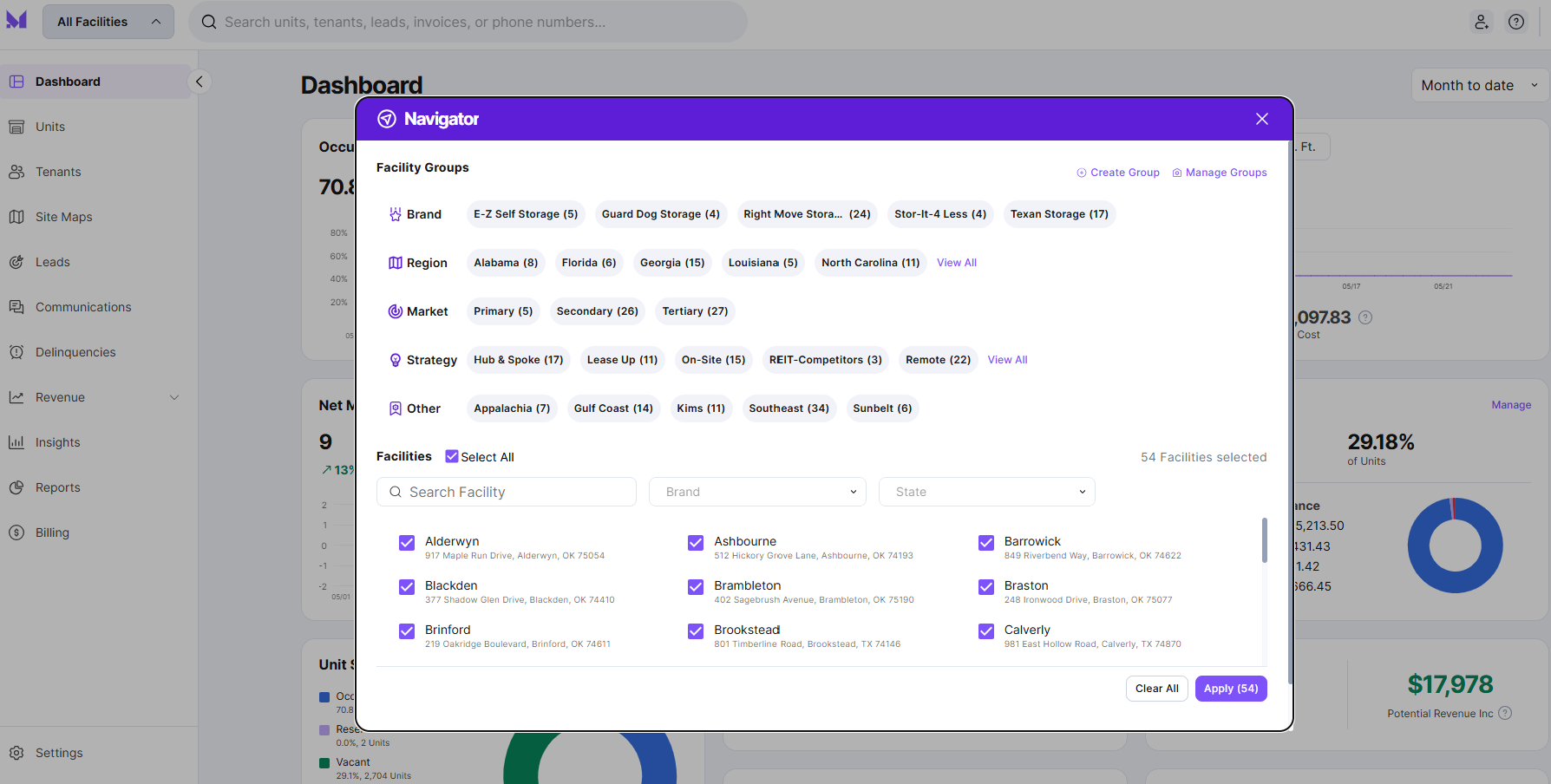
Monument’s Navigator.
| Metric | What It Measures | What Action It Should Drive | Warning Threshold |
| Physical Occupancy | Percentage of total rentable square feet currently leased to paying or promotional tenants. | Triggers adjustments to localized marketing spend, paid acquisition, and street rate baselines. | Drops below 85% in a stabilized sub-market or asset class. |
| Economic Occupancy | Actual gross revenue collected divided by total gross potential revenue at current street rates. | Mandates immediate deployment of targeted ECRI campaigns and audit of active tenant discounts. | Variance exceeds 15% relative to baseline physical occupancy. |
| RevPAF (Revenue Per Available Foot) | Total annualized facility revenue divided by the total rentable square footage of the property. | Drives capital allocation decisions, portfolio monetization strategies, and expansion feasibility studies. | Trends downward for two consecutive fiscal quarters. |
| Unit Group Velocity | The lease-up speed and move-out rate of specific dimensions (e.g., 5×10, 10×20 CC). | Directs dynamic tier pricing adjustments and controls real-time web-concession availability. | Net absorption shifts negative over a rolling 30-day window. |
As a portfolio expands, process drift becomes an inevitable challenge in self-storage management. Without centralized guardrails, a business can easily devolve into a loose collective of independently operated properties, each running on its own ad-hoc workflows. Operational consistency across a scaling portfolio is achieved by centralizing your core workflows, removing local variance, and standardizing execution. This standard of control is especially critical for portfolios embracing modern operational models.
Every message sent to a customer, whether it is a welcome email, an automated payment reminder, an ECRI announcement, or a legal delinquency notice, represents a critical brand touchpoint and a potential compliance vulnerability. Allowing individual store managers to draft custom emails or send ad hoc text messages introduces significant brand inconsistency and regulatory risk.
The solution is to define and lock global communication templates at the corporate level. These templates are then mapped to specific, system-wide triggers. Utilizing Monument’s advanced Automation Rules, these tailored sequences execute uniformly across the entire portfolio based on real-time lease milestones. Because the system handles delivery programmatically (depending on the criteria in automated rules), executive leadership can rest assured that every tenant receives precise, brand-compliant, and legally vetted correspondence, completely independent of local store staffing levels or manual oversight.
One of the fastest ways to erode portfolio profitability is to grant unchecked pricing and discount authority to site-level employees. When a manager is under pressure to hit a raw occupancy target, they will frequently rely on heavy discounting or extended promotional periods to secure a lease. Over time, this habitual discounting destroys rate integrity and significantly lowers the asset’s long-term valuation and cap rate.
However, completely removing local insight can leave a facility unresponsive to sudden competitive moves in the local market. The functional answer is centralized rate plans with controlled override permissions that strike an intentional balance between corporate oversight and local flexibility:
This framework effectively protects portfolio-wide yield and stabilizes baseline revenue while maintaining the tactical agility required to respond to immediate field dynamics.

For Regional Managers and Vice Presidents of Operations overseeing large portfolios, time allocation is a constant challenge. Without clear, data-driven segmentation, management attention is typically absorbed by the facilities that complain the loudest or present the most immediate administrative issues. Programmatic portfolio segmentation shifts your self-storage management culture from a reactive posture to proactive asset optimization.
Grouping properties purely by physical geography is a legacy approach that fails to reflect operational realities. A mature, stabilized facility in Florida faces completely different operational needs than a newly constructed facility in the same market that is in the middle of a heavy lease-up phase. High-performance operators segment their assets by life-cycle classification:
By using Monument’s Navigator module, executive teams can easily build dynamic property sets based on any combination of performance metrics, asset types, or lifecycles. This capability allows operations teams to deploy tailored automation rules, run targeted performance dashboards, and issue unified operational playbooks across specific property groups simultaneously.
Internal benchmarking is an exceptionally valuable tool for identifying hidden operational efficiencies. Comparing a 50,000-square-foot rural facility against a 120,000-square-foot multi-story urban asset yields little actionable insight. However, benchmarking that rural facility against five other rural properties of similar scale and demographic profile within the portfolio immediately highlights meaningful performance gaps.
If one location is maintaining a 12% higher autopay rate or a significantly lower average delinquency timeline than its demographic peers, management can quickly isolate the specific operational behaviors driving that success. Utilizing Monument’s Insights module, these multi-facility comparisons are available in real time without requiring manual data compilation, enabling operators to rapidly replicate winning strategies across their entire footprint.
The property management platform serves as the foundation of your entire operational infrastructure. Every workflow, revenue strategy, and internal control covered in this article is either accelerated or limited by the capabilities of your core software. Operating a complex, multi-site portfolio on software designed for single-facility operations forces your team to manage against the grain of their own systems. To scale past the complexity ceiling, operators must transition to an enterprise-grade platform built specifically for portfolio operations.
A true enterprise platform is fundamentally different from a collection of single-site systems that have been modified to handle multiple locations. When auditing your operational technology stack, ensure your platform delivers these five critical enterprise capabilities:
The most common reason operators choose to remain on restrictive, legacy management systems is the perceived risk of data migration. The fear of dropped customer credit card tokens, corrupted historical ledgers, extended system downtime, and chaotic software transitions frequently causes organizations to tolerate operational stagnation.
At Monument, we address this challenge directly with a clear commitment to our clients: “We Own The Outcome With You.” We don’t simply hand over a software login and expect your internal team to manage a complex migration. Our US-based implementation experts provide a fully managed, white-glove onboarding experience. We handle the entire data migration process end-to-end, including the secure transfer of encrypted payment tokens, ensuring your tenants remain seamlessly on autopay without requiring manual re-entry or disrupting your collections cycle. Our team manages the technical complexity so your staff can remain focused on driving performance.
Scaling a self-storage business past the complexity ceiling requires a deliberate transition from localized, reactive store operations to a centralized, institutional-grade management strategy. By standardizing your workflows, managing autopay as a hard KPI, tracking advanced revenue metrics, and leveraging intelligent portfolio segmentation, you protect your assets from operational leakage and position your business to maximize yield.
Monument is purpose-built to provide the control, clarity, and enterprise-grade infrastructure required to drive your portfolio’s next stage of growth. Our platform eliminates the operational chaos of scale, allowing you to run your business with institutional sophistication while maintaining complete flexibility.


Explore top self-storage software solutions with key features, comparisons, and tools for facility operations, marketing,...

Explore top facility management software systems for self-storage, including key features, benefits, and how these...

Discover how 3rd party self storage management improves operations, revenue, and NOI—and what to look...