


Operators managing 20 or more self-storage facilities are not shopping for the same product as an owner with a single location, but the self-storage property management system (PMS) (sometimes referred to as the facility management system (FMS)) market doesn’t always reflect that difference. Most platform comparisons treat “self storage property management software” as a single category, benchmarking features against one another without accounting for the operational reality that separates a 5-facility portfolio from a 50-facility one.
At portfolio scale, the property management system becomes the connective infrastructure between physical assets and financial performance. The right platform centralizes and automates operations across your entire portfolio from one login, eliminates manual reporting, and drives NOI through intelligent revenue management. The wrong one replicates the siloed, facility-by-facility workflow you already have, just with a subscription fee attached.
This guide is built for operators who have outgrown general-purpose solutions and need a framework for evaluating what a self-storage PMS must do at scale.
Key Takeaways
| Pillar | Problem It Solves | Key Vendor Question |
| Portfolio-Level Architecture | Siloed, facility-by-facility management | Can I act across a custom portfolio segment from one login? |
| Automation Depth | Manual workflow execution at scale | What steps happen without staff intervention in a delinquency case? |
| Revenue Management | Gut-feel pricing across 20+ locations | How does your platform model churn sensitivity before an ECRI? |
| GAAP-Compliant Accounting | Manual cash-to-accrual conversion | Do you produce accrual financials natively? |
| Analytics & Investor Reporting | Disconnected data, spreadsheet-built reports | Can I produce an investor-ready portfolio report without exporting? |
| Open Ecosystem | Vendor lock-in on the full tech stack | What happens if I want to keep my existing rental website? |
The standard software comparison grid treats every operator the same. A feature earns a checkmark if it handles a single facility or 90. “Reporting” is a checkmark whether it produces a single-site PDF or a real-time, investor-grade portfolio dashboard. “Automation” is a checkmark whether it sends a payment reminder or runs a full delinquency workflow across every facility simultaneously.
For the operator managing one or two locations, simple reporting and automations are often enough. For the operator managing 40 or 50, you need more nuanced features, because a delinquency workflow that requires a manager to advance each step manually doesn’t scale across a regional team. A reporting module that only produces facility-level exports doesn’t meet the requirements for an investor presentation. A rate management tool that requires a login per location is not effective revenue management. With per-facility-focused tools, you’re left to manually fill in the gaps, which can not only be time-consuming but also almost impossible if you can’t track down the right data.
The evaluation framework for a multi-facility operator has to start with a different question: Does this platform treat the portfolio as the unit of operation, or does it treat each facility as an isolated instance? That distinction shapes every capability that follows, and it’s the lens through which the rest of this guide examines what a self-storage property management system needs to deliver.
Most platforms in the self-storage facility management space were built for a single location and later adapted to handle more. The seams from that retrofit consequently show up everywhere: separate logins per facility, reports that need to be exported and stitched together manually, and pricing or promotion changes repeated location by location. None of this is a dealbreaker for an operator with two or three sites, but at 20, 50, or 100 facilities, it becomes the primary source of operational drag.
A platform that’s built with a portfolio-first approach works differently from day one. Every facility lives inside a single system of record, and the operator’s view into that system can be sliced however the business actually operates, not however the software happens to organize data.
Monument’s Navigator is the clearest example of what this looks like in practice. Navigator lets operators define custom sets of properties: all properties in a region, all stabilized assets, all locations under a specific brand, all facilities offering RV parking, or any other grouping that matches how the business is managed. Once that set is defined, the operator can pull a dashboard, run a report, build a delinquency rule, launch a promotion, or adjust pricing across the entire set at once. The portfolio segment becomes the unit of action, not the individual facility.
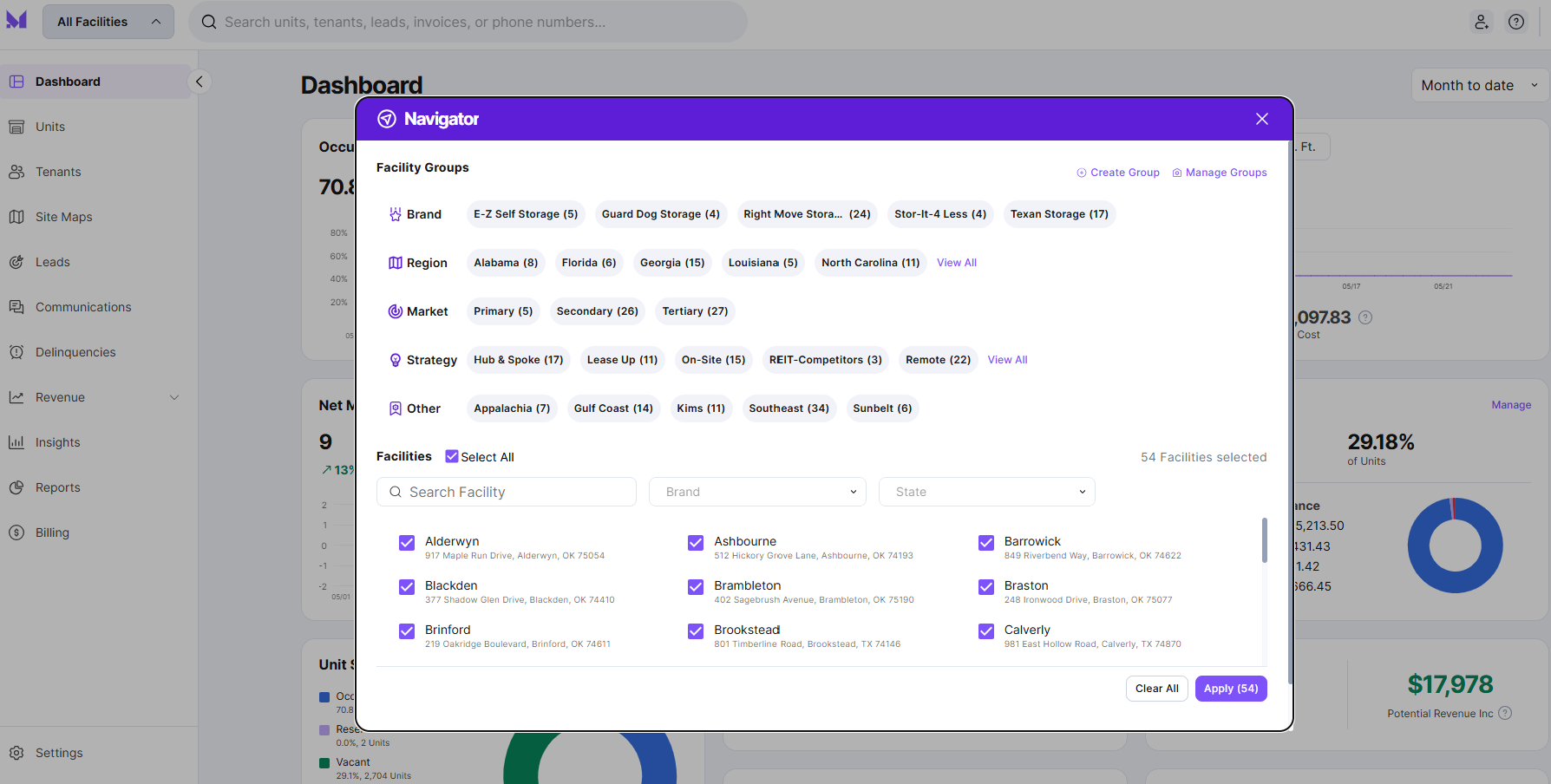
Monument’s Navigator.
The cost of not having this is rarely visible on a single day, but it adds up. A regional manager checking occupancy across 30 facilities by logging into 30 separate dashboards loses hours every week to navigation alone, before any analysis happens. A pricing change entered 30 times instead of once is 30 opportunities for inconsistency. Fragmented reporting means nobody has a single accurate view of the portfolio without building it manually first.

What to ask a vendor:
Automation is one of the most overused terms in self-storage property management software marketing, and one of the least standardized. For a single-facility operator, automation might mean an email reminder that a payment is overdue. For an operator managing dozens of facilities, that is not automation. It is a notification system that still requires a person to act on every alert, at every facility, every day.
The difference that matters at scale is whether the platform executes a complete workflow or simply prompts a person to start one. Delinquency management is the clearest test case, because it touches collections, compliance, and tenant communication at once, and because it happens continuously across every facility in the portfolio.
A platform with real automation depth runs the full delinquency sequence without a manual handoff: the trigger fires when an invoice goes past due, escalation notices generate and send on schedule, overlock tasks get assigned automatically when a unit crosses the delinquency threshold, and collections outreach continues on a defined cadence. A platform without that depth requires a manager or call center agent to read an alert, decide on next steps, and manually move each tenant through each stage. Multiply that by hundreds of delinquent accounts across dozens of facilities, and the staffing requirement scales with the portfolio. With true workflow automation, it doesn’t.
This is not theoretical. One of Monument’s largest customers transitioned its full portfolio onto automated delinquency workflows and saw call center volume drop sharply within the first billing cycle. The team had braced for a six-month transition; collections activity reached parity with pre-transition levels within roughly two billing cycles, and call volume on what had historically been the highest-volume day of the month returned to normal almost immediately. That outcome reflects what full workflow automation looks like when it is actually running, not just configured.
What to ask a vendor:
Multi-facility operators aren’t just competing against the self-storage operator down the street. In most markets, they compete with REITs and institutionally backed portfolios that run sophisticated, data-driven pricing strategies as a matter of course. An operator still setting rates by gut feel, facility by facility, is leaving revenue on the table against competitors who are not.
The core mechanism here is the Existing Customer Rent Increase, or ECRI, workflow. A manual ECRI process means someone reviewing tenant accounts, deciding which units are due for an increase, applying that increase, and hoping the resulting churn does not offset the revenue gain. At one facility, this is manageable. Across 30 or 50 facilities, it isn’t a process anyone can run consistently, and inconsistent ECRI execution is one of the most common sources of underperformance in multi-facility portfolios.
A revenue management toolset built for portfolio scale automates the mechanics of ECRI while preserving the judgment that makes it effective. That includes setting dynamic rate plans by facility, unit group, or tenant type, so pricing reflects local market demand and occupancy rather than a single blanket rule. It includes churn sensitivity analysis, which models which tenants are most likely to retain after a rate increase and which are at higher risk of vacating, so increases can be applied with that risk already factored in. And it includes occupancy-based rate triggers that adjust pricing dynamically as units fill or empty, rather than waiting for a quarterly review cycle.
Monument’s revenue management capabilities are built specifically for this kind of portfolio-wide execution. Rate plans, ECRI workflows, and churn modeling operate across the full portfolio or any Navigator-defined segment of it, which means a multi-facility operator can execute a consistent, data-backed pricing strategy with the same effort a single-facility operator spends on one location.
What to ask a vendor:

Accounting is where the gap between single-facility software and portfolio-grade software becomes most consequential, and least visible until it causes a problem. Most legacy facility management systems were built around cash accounting, which works fine when the only audience for the financials is the owner-operator running day-to-day operations.
That stops working the moment a portfolio has institutional ownership, outside investors, a bank covenant tied to financial reporting, or a planned capital event such as a refinance or sale. All of those situations require GAAP-compliant accrual accounting, and converting cash-basis records into accruals after the fact is slow, manual, and prone to error. For an operator managing one facility, this conversion might be an annual exercise handled by an outside accountant. For an operator managing 30 or 50 facilities, it becomes a recurring project that consumes the finance team’s capacity every reporting period, with no guarantee that the conversion is correct.
A self-storage property management system built for this audience needs to produce accrual-based financials natively, not as an add-on conversion step. That means automated daily journal entries generated as transactions occur, lease-level accuracy that holds up under audit, and integration with the operator’s general ledger so the data flows into existing financial systems rather than requiring a separate reconciliation process. Monument’s accounting infrastructure is built directly around this requirement, with daily journal entries generated automatically, accrual and cash reporting supported, and the resulting data structured to meet the standards of private equity-grade reporting and REIT-level exits.
For an operator preparing for a refinance, a new investor, or a portfolio sale, the difference between a platform that produces this reporting natively and one that requires manual conversion is not a convenience question, but rather a question of whether the financials are ready when the business needs them.
What to ask a vendor:
There is a meaningful difference between a reporting module and a business intelligence platform, and it matters more as portfolio size grows. A reporting module produces static exports: an occupancy report, a delinquency aging report, and a revenue summary, each generated separately and each requiring someone to pull them together into something usable. A business intelligence platform correlates those data streams against each other and surfaces what the combination means, not just what each number is individually.
For a multi-facility operator, the practical questions are rarely answerable from a single export. Is the increase in delinquency aging in one region connected to a recent rate increase there? Is the tenant acquisition funnel underperforming in markets where occupancy is also soft, and is that a marketing problem or a pricing problem? Which facilities are driving portfolio-wide ECRI impact, and which are dragging on it? Answering these questions from disconnected reports means building a spreadsheet first and analyzing it second. A platform with true analytics built in answers them directly.
Monument’s Insights module is built around this premise, with close to 100 business graphs organized into easy-to-understand dashboards covering marketing, operations, revenue management, and investor reporting. These dashboards aggregate KPIs across the full portfolio in real time and update as the underlying data changes, so the same view a regional manager uses to monitor day-to-day performance can also be the source an executive uses to brief investors. The Investor Insights dashboard specifically is designed to produce the kind of portfolio-level reporting that institutional ownership groups expect, without a separate reporting process running in parallel.
This matters because the operators in this audience are frequently asked to justify their performance to investors, lenders, or ownership groups, and the credibility of that case depends on the data being current, accurate, and presentable without weeks of preparation.
What to ask a vendor:
One of the most common frustrations among operators evaluating a new self-storage property management system is discovering that switching platforms means switching everything. Closed-ecosystem platforms bundle their own rental website, pricing tools, gate and access control integrations, and tenant protection products, and make it difficult or impossible to use anything else. A single vendor decision made years ago can end up dictating tool choices today, long after better options exist.
This becomes a compounding problem at portfolio scale. Consider the investments most operators at this scale have already made:
None of that should have to be rebuilt just to adopt a PMS with better core operations, revenue management, or accounting. But in a closed ecosystem, that is exactly the tradeoff.
An open, API-first architecture removes it. Monument’s platform is built on this model: the API is documented and accessible, and operators can connect their preferred tools directly into the platform rather than being forced into Monument’s own versions of each. If a needed integration does not already exist, it gets built before go-live at no additional cost — in direct contrast to platforms where every third-party connection is either unavailable or comes with its own upsell.
For operators evaluating platforms, this question deserves more weight than it typically gets in a feature comparison. A platform that wins on operations, revenue management, and accounting but locks the operator into its own rental website and pricing tools is asking them to trade best-in-class core infrastructure for the specialized tools already working for their business. An open ecosystem means that tradeoff doesn’t have to be made.
What to ask a vendor:
Most software evaluations follow a familiar pattern: a sales call, a slide deck, a features list, and a demo that walks through the same features in a slightly more interactive format. For a multi-facility operator, this process tells you almost nothing about how the platform will perform once it is running your portfolio.
The better approach is to treat the demo as a workflow demonstration rather than a feature presentation. Instead of asking a vendor to show you what the automation tab looks like, ask them to run an actual delinquency case from start to finish and show you every step that happens without manual intervention. Instead of asking whether portfolio-level reporting exists, ask them to build a report for a custom segment of facilities in real time and show you the result.
A demo built around these requirements should be able to:
A vendor who can complete these demonstrations clearly, in the platform itself, without pivoting to a slide deck or a “this is on our roadmap” explanation, is a vendor who understands what multi-facility operators actually need from a self-storage PMS. A vendor who cannot is telling you, indirectly, how the platform will perform once you are relying on it.

The cost of an underperforming self-storage PMS is rarely reflected as a single line item. It shows up as smaller costs spread across operations, revenue, and finance, each individually tolerable but collectively significant once a portfolio reaches 30, 40, or 50 facilities.
| Cost Category | Source | Symptom | NOI Impact |
| Reporting Overhead | Manual data aggregation across logins | Hours per week per regional manager lost to admin | Reduced capacity for revenue-driving activity |
| Rate Management Lag | Manual pricing review cycles | Delayed rent increases across facilities | Incremental revenue gap compounds per quarter |
| Collections Inefficiency | Staff-gated delinquency workflows | Uncollected balances accumulate between interventions | AR aging grows; write-offs increase |
| Migration Cost Amplification | Extended time on underperforming platform | Larger, more complex eventual migration | Higher switching cost; delayed performance gains |
None of these costs are abstract. At 40 or 50 facilities, each one is measurable, and each one compounds. The longer an operator runs a portfolio on a platform that was not built for it, the wider the gap between the NOI they’re generating and the NOI the portfolio is capable of producing. The right self-storage PMS does not just eliminate those costs. It converts the capacity they were consuming into performance.


Explore top self-storage software solutions with key features, comparisons, and tools for facility operations, marketing,...

Explore top facility management software systems for self-storage, including key features, benefits, and how these...

Discover how 3rd party self storage management improves operations, revenue, and NOI—and what to look...