


You didn’t notice the first few signs. A call center is busier than it should be. A reporting package that took two days to assemble. A rate increase that went out flat across every location because there wasn’t time to do it any other way. Individually, each felt like an operational inconvenience. Collectively, they’re a financial signal: your self-storage property management software has stopped working for your portfolio and is now working against it.
This article is about how to read the operational signals that indicate your infrastructure is already costing you, and what a platform built for portfolio scale actually does differently at the level of daily execution.
The distinction matters because not all self-storage property management software is built on the same architectural assumptions. Some platforms were designed for a single facility and scaled outward by adding logins and aggregating reporting. Others were built from the start around the portfolio as the primary unit, with automation, revenue management, and reporting designed to operate across 20, 50, or 100 locations without multiplying overhead. That gap doesn’t show up on a feature comparison matrix. It shows up in your NOI.
Key Takeaways
The critical distinction is between a system of record (software that logs what happened) and a system of action (software that determines what happens next, automatically, across every facility).
Most operators have a working definition of their facility management software: it’s where tenant records live, where payments post, and where unit statuses update. That definition isn’t wrong, it’s just incomplete in a way that becomes increasingly expensive as a portfolio grows.
The deeper question isn’t what your self storage property management software stores, it’s what it does. The difference between a platform that records activity and a platform that drives outcomes is the most consequential architectural difference in the category.
Think about a standard day across a 30-facility portfolio. Leases lapse into delinquency. Prospects start online rentals and abandon them. Tenants who haven’t received a rate increase in 14 months sit in units that the market would bear at 18 percent higher. None of these situations requires a human decision. They require a system with enough operational intelligence to recognize the trigger condition and execute the correct response automatically, consistently, and at scale.
That is the difference between a system of record and a system of action. And understanding that difference is the first step toward diagnosing whether your current platform is keeping pace with your portfolio’s growth or quietly becoming the ceiling on it.
A system of record stores what happened. A system of action determines what happens next.
Legacy platforms were designed to capture data accurately. They do that reasonably well. But capturing data and acting on it intelligently are two different engineering problems, and platforms built to solve the first are poorly equipped to solve the second.
The distinction shows up in specific operational gaps:
Across 30, 50, or 100 locations, these gaps aren’t rounding errors. Every delinquency notice that goes out late is lost recovery probability. Every abandoned cart without automated follow-up is a lease that went to a competitor. That’s a structural drag on NOI that shows up in your returns whether or not you can attribute it to the software.
Some self-storage property management software platforms were built for one location and retrofitted for many. The friction is consistent: rules rebuilt per site, reporting that requires logging into multiple interfaces, and delinquency handling that varies by location because each site runs its own configuration.
This isn’t a configuration problem, it’s an architectural one. The underlying data model was designed around a single facility as the primary unit. Multi-site access was added on top, typically through logins that aggregate across sites rather than a unified data structure that treats the portfolio as the primary unit.
The consequences are predictable. A Director of Operations managing 25 locations on a single-facility platform isn’t managing from a unified command center. They’re managing 25 separate systems that share a login. Every automation rule that should apply portfolio-wide gets configured 25 times. Every portfolio report gets pulled from 25 instances and reconciled manually. Every pricing decision gets made without cross-portfolio demand signals.
At 10 locations, this is manageable. At 30, it constrains the team. At 50 or beyond, it’s an active impediment to growth.

Automation is not a differentiator in the self-storage software category anymore. Every platform claims it. The meaningful question you should be asking is: “which workflows are automated, to what degree, and what does the revenue recovery look like when those workflows run without human intervention?”
The answer is not uniform across operational domains. Some workflows are well-automated across most platforms. Others remain surprisingly manual at operators who consider themselves technologically sophisticated. The three areas where the gap between automated and manual execution is largest, and where the dollar losses are most concentrated, are collections and delinquency management, ECRI execution, and lead follow-up.
| Operational Workflow | Manual Execution Cost at Scale | What Automation Recovers |
| Delinquency notice sequencing | Delayed notices extend delinquency cycles; inconsistent enforcement reduces recovery rates | Faster resolution, reduced call center volume, lower write-off rates |
| ECRI execution | Flat or infrequent increases leave revenue on the table; high-churn increases on rate-sensitive tenants create unnecessary vacancy | Higher revenue per unit without excess turnover |
| Abandoned cart / lead follow-up | Lost lease opportunities with known unit preferences go uncontacted | Incremental lease conversion without headcount addition |
| Late fee application | Manual review creates inconsistency; tenant disputes increase | Consistent enforcement, reduced dispute volume |
| Payment retry logic | Failed payments that aren’t retried on an intelligent schedule result in avoidable write-offs | Higher payment recovery rate on failed initial transactions |
| Autopay enrollment | Low autopay penetration increases payment failure rates and collections workload | Reduced collections volume, improved cash flow predictability |
| Tenant Protection Self-Insured Inspection | Tenants that provided expired or bogus proof of self-insurance are not included in system protection programs | operator-sponsor participation rates for tenant protection increases |
If your inbound call volume spikes in the first week of every month, that spike is diagnostic information. It tells you that a meaningful portion of your tenant base is calling to ask about charges, fees, overlocks, or account status, questions that a fully automated delinquency workflow would have already answered through structured outbound communication.
A properly automated delinquency sequence looks like this:
At each stage, the tenant has received a communication that explains exactly where they stand and what happens next. The call center queue is not populated with tenants asking questions that the system should have already answered.
What this removes from operations is significant:
Remember, delinquency cycles that extend because a notice wasn’t sent on day one take longer to resolve and generate lower recovery rates.
The platform-level implication is equally important. A portfolio of 40 facilities where delinquency management runs on automated, consistent logic is operationally different from one where 40 facility managers are applying the policy at their own pace. One produces uniform outcomes. The other produces 40 different outcomes that average out to something worse than the best-case scenario.
Existing Customer Rate Increases are the single highest-leverage revenue management tool available to a self-storage operator. They’re also, in many portfolios, the most under-optimized, not because operators don’t understand their importance, but because the execution infrastructure to do them precisely doesn’t exist in their current platform.
The problem with flat-percentage ECRI is that it treats a 60-month tenant in a high-demand 10×20 the same as a 4-month tenant in an oversupplied climate-controlled unit. A purpose-built revenue management workflow generates recommendations based on a layered set of inputs:
The output isn’t a blanket percentage. It’s a recommendation set in which some tenants receive a 12% increase because their tenure, unit type, and demand profile support it, while others receive 6% or are flagged for a hold because the churn risk outweighs the incremental revenue.
At 5 locations, a sophisticated revenue manager can approximate this manually. At 50, it’s computationally impossible without software that automates the analysis. Operators applying flat increases across a portfolio that size aren’t executing a revenue management strategy. They’re executing a guess, leaving a measurable gap between actual and achievable revenue per unit every month.
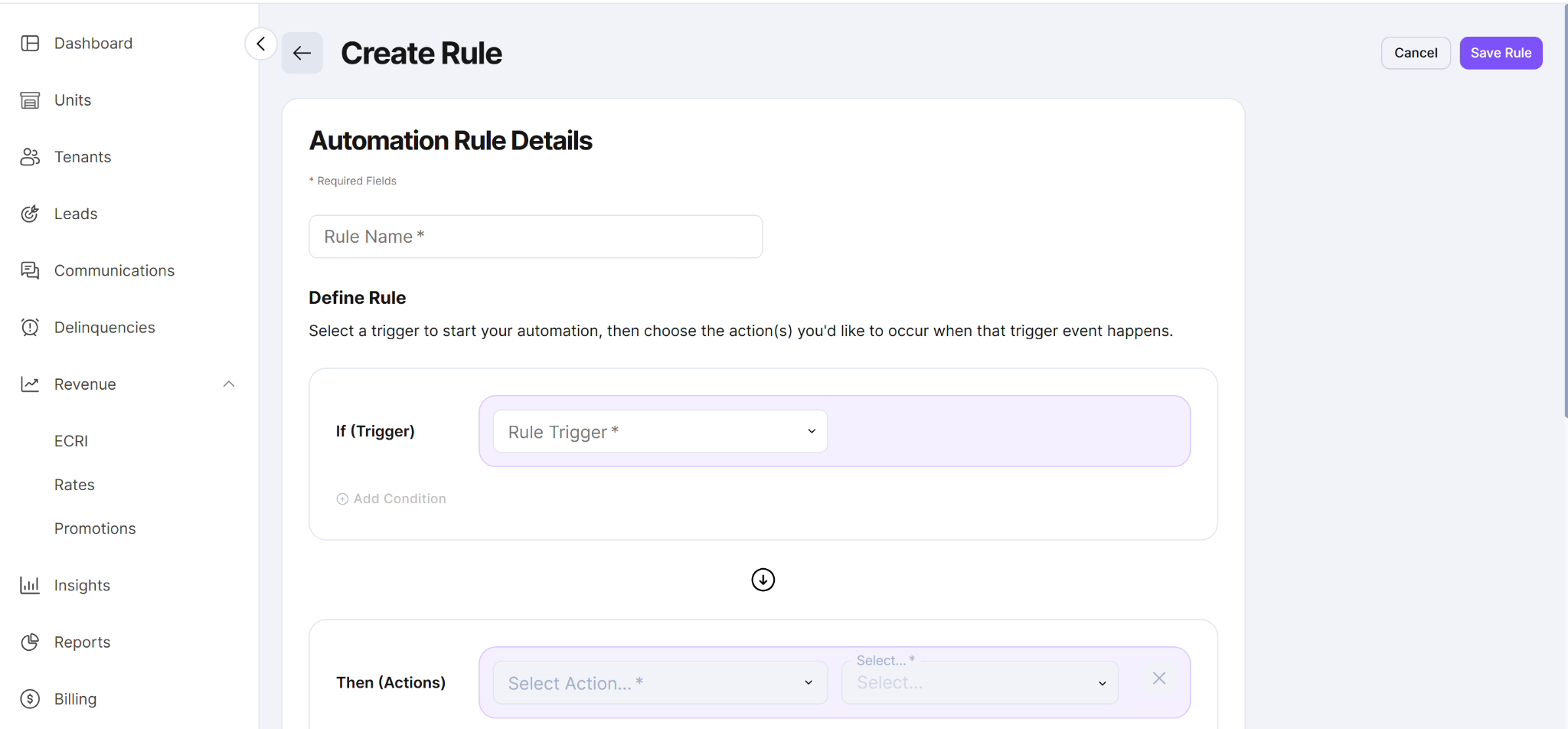
Every prospect who initiates an online rental and doesn’t complete it represents a known unit preference, a demonstrated intent signal, and a contact who has already done the research. They didn’t leave because they changed their mind about needing storage. They left because something interrupted them, such as a phone call, a child, a moment of friction in the rental flow, and they haven’t come back yet.
Without an automated follow-up workflow, that contact goes cold. With one, it doesn’t. A properly configured abandoned cart recovery sequence captures the contact at the moment of exit, enrolls them in a structured outreach sequence, and re-presents the specific unit they were evaluating with a frictionless path back to completion. The conversion rate on this contact is materially higher than on a cold lead, because the intent signal is already there.
Monument’s automated rules workflow.
The operational case for automating this workflow is straightforward: no additional headcount is required to capture these leads, the conversion cost per lease is lower than any paid acquisition channel, and the volume of abandoned cart sessions at a portfolio of meaningful size is large enough that even a modest conversion rate improvement produces a measurable lift in occupancy.
The platform-level requirement is a leasing infrastructure that connects online rental behavior to an automated CRM workflow, not a manual lead queue that depends on a site manager to follow up in the hours after a prospect abandons the session.

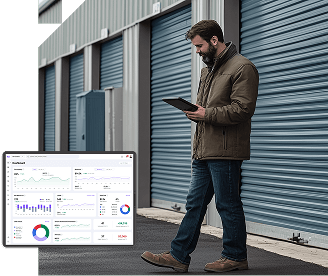
Most multi-facility operations have two distinct users with fundamentally different needs.
Most platforms were designed for one of these users. The facility manager interface has been iterated on extensively because that user touches the software dozens of times a day. The executive layer has been grafted on through aggregated reporting tabs and exported spreadsheets rather than being designed for the way a portfolio leader actually makes decisions.
Ask any Director of Operations at a portfolio-backed operator to describe the 72 hours before a quarterly investor update, and you will hear a consistent story.
This workflow is not a reporting problem. It is a platform architecture problem that creates a reporting problem. Investor dashboards shouldn’t be assembled; they should already exist. Fund-level performance segmented by asset type, geographic region, debt structure, or acquisition vintage should be available on demand, not constructed under deadline pressure by a team that has better things to do with their time.
The right platform eliminates the spreadsheet reconciliation step by treating investor reporting as a first-class feature rather than an afterthought. That means a live dashboard layer that pulls from the same data that drives operations, no exports, no reconciliation, no version-control risk on a spreadsheet that was last modified by three different people.
| Portfolio KPI | What It Signals | Why It Matters to Investors |
| Economic occupancy by asset | Revenue realization vs. physical occupancy | Identifies underpriced or underperforming units masked by high physical fill |
| ECRI revenue lift (trailing 90 days) | Incremental revenue captured from existing customer increases | Demonstrates active revenue management vs. passive lease rollover |
| Delinquency rate by location | Collections health and operational consistency | Flags sites with process gaps before they become write-off problems |
| Autopay penetration rate | Predictability of cash flow | High autopay penetration reduces collections risk and improves reporting reliability |
| Abandoned cart conversion rate | Leasing funnel efficiency | Reveals whether demand is being captured or lost at the final step |
| NOI margin by property cluster | Operational efficiency benchmarking | Enables fund-level comparison across ramp-up vs. stabilized assets |
For operators reporting to private equity sponsors, institutional lenders, or positioning for a capital event, cash-basis accounting is a liability. Not because it’s operationally wrong, but because it produces a financial picture that doesn’t match the standards by which institutional capital evaluates self-storage portfolios.
Native accrual accounting, with automated daily journal entries, lease-level accuracy, and the ability to produce GAAP-compliant statements without a manual reconciliation step, is not a reporting feature. It is a capital infrastructure requirement. Operators who rely on a cash-basis platform and a supplemental accounting system are introducing reconciliation risk, audit complexity, and timeline friction into every capital conversation they have.
The implication for platform selection is direct: if the path your portfolio is on leads toward institutional debt, equity recapitalization, or a portfolio sale event in the next three to five years, the accounting infrastructure your property management platform provides today is already a factor in how that event will proceed. Selecting a platform without native GAAP-compliant accrual accounting at the point when that capability would have been available is a decision that will be re-litigated at closing.
One of the least-discussed capabilities that separates a true portfolio management platform from a facility-level tool with multi-site access is the ability to define custom property sets and act on them simultaneously.
The practical use cases are numerous:
A platform that requires these segments to be approximated through manual filtering, or that doesn’t support segment-level automation rule application at all, forces operational workarounds that consume time and introduce error. Good segmentation means defining the group once, and then having every downstream workflow, automation rules, pricing decisions, reporting, and investor dashboards respect that grouping automatically.
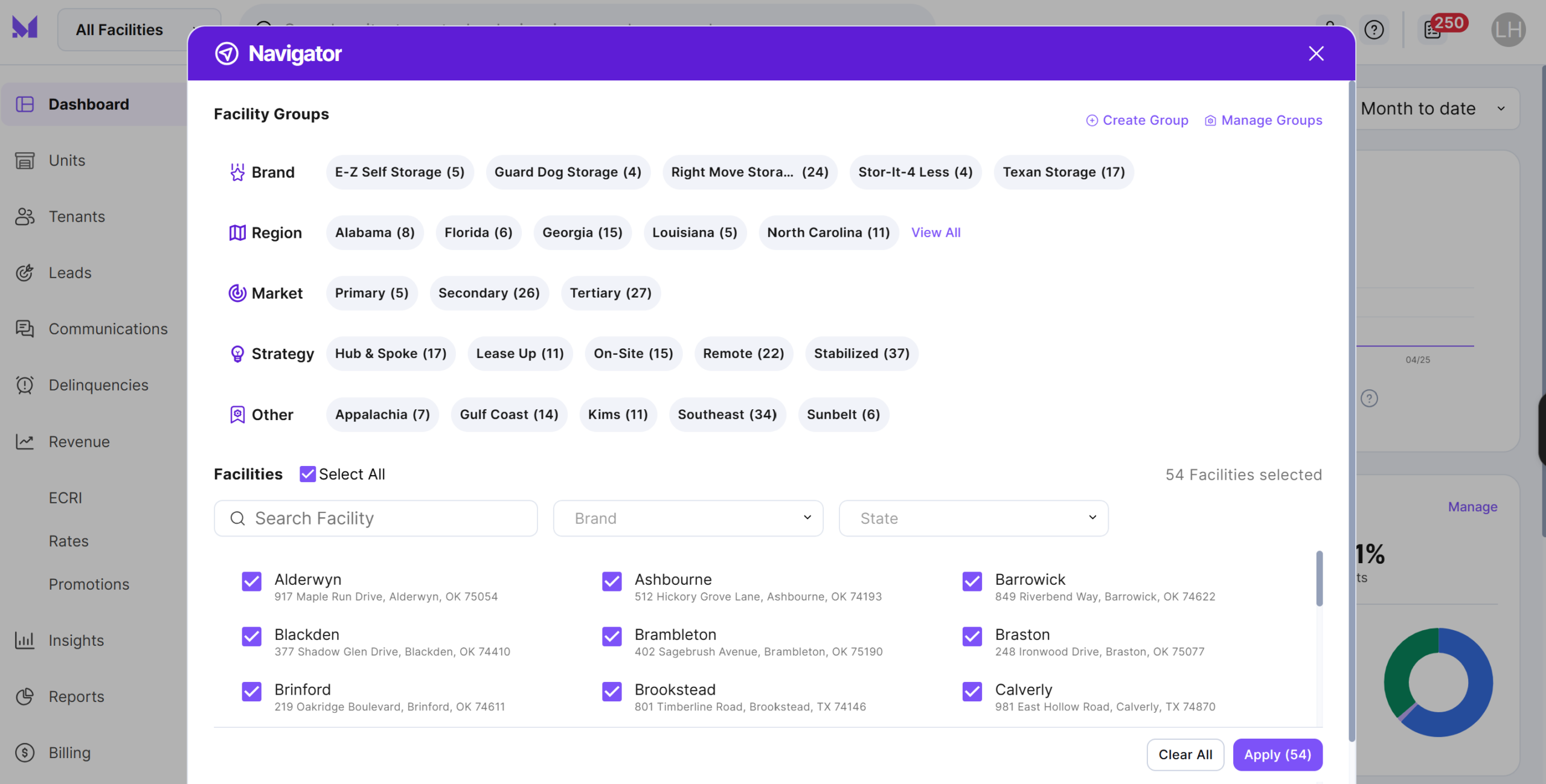
Monument’s Navigator segmentation feature.

The signals that a platform is becoming a growth constraint rarely arrive as a dramatic failure. They arrive as accumulated friction, small inefficiencies that individually seem like operational issues but collectively indicate a structural mismatch between the self storage property management software and the portfolio it is trying to run.
| Warning Signal | What It Indicates | What to Evaluate Next |
| Call center spikes in the first week of the month | Delinquency automation is incomplete; tenants are calling about information the system should have communicated automatically | Notice sequencing, payment retry logic, and overlock trigger timing |
| Investor reporting requires spreadsheet assembly | No native portfolio-level reporting layer | Whether the platform produces GAAP-compliant accrual reports natively and on demand |
| Automation rules are configured per site | Single-facility architecture; no portfolio-level rule inheritance | Whether the architecture supports top-down rule propagation or requires per-site configuration |
| Rate increases applied uniformly across all tenants | ECRI logic is absent or underdeveloped | Whether the platform supports tenure-aware, demand-responsive ECRI recommendations |
| Autopay enrollment is declining without a clear cause | Enrollment workflow is passive or broken | Autopay prompts, in-lease-flow nudges, and automated re-enrollment outreach |
| Adding locations increases per-site administrative workload | No portfolio-level automation; each new site adds overhead rather than reducing it | Whether workflow automation scales at the portfolio level or must be rebuilt per location |
The Complexity Ceiling: When Your Self Storage Property Management Software Stops Scaling With You
Every portfolio reaches an inflection point at which the systems that supported growth begin to constrain it. The timing varies, but the signals are consistent.
Recognizing these signals early is the difference between a managed platform migration and a crisis-driven one.
The decision about which property management platform to run isn’t a software decision, it’s a scalability one. The selection criteria that matter most aren’t features. They’re architectural commitments about what the platform is designed to do at scale.
The operator managing 20 locations today needs to select the platform that will still be the right answer at 60. A platform with proven performance across 90-location portfolios provides more operational confidence than one whose largest reference customer manages 15. Complexity compounds, and the only way to know how a platform performs under portfolio pressure is to have seen it perform there.
Migration risk is real, but it’s not a reason to stay on a platform that’s already costing you NOI. It’s a reason to select a vendor whose implementation methodology is as rigorous as the platform itself, one that treats the transition as a managed operational event, not a technical handoff.
If the signals in this article feel familiar: call center spikes, spreadsheet reconciliation, inconsistent ECRI execution, that recognition is diagnostic. The gap between what your current platform delivers and what a purpose-built portfolio management system provides is already costing you. And it compounds every month you defer the decision.


Explore top self-storage software solutions with key features, comparisons, and tools for facility operations, marketing,...

Explore top facility management software systems for self-storage, including key features, benefits, and how these...

Discover how 3rd party self storage management improves operations, revenue, and NOI—and what to look...