


For operators managing one or five facilities, self-storage remote management is straightforward. You build a process, put the right managers in place, and hold them accountable. But when that number grows to 10, 20, or 50 locations, the model breaks down, particularly when the self-storage software underneath it was never designed for that kind of scale.
That’s where portfolio-level self-storage remote management software stands out. Built to centralize and visualize operational data across a large number of facilities, it gives operators a clear view of performance at every level, from portfolio-wide trends down to a single facility’s unit mix or pricing sensitivity, without logging into multiple systems or cobbling together spreadsheets.
This article breaks down how that works, with practical considerations for operators managing multi-facility portfolios for the first time or looking to improve their current approach.
Key Takeaways
At five facilities, a facility-specific self-storage remote management model works. Regional managers know what’s happening at every site, problems surface through direct observation, and a small team can self-correct. Portfolio growth changes that equation. Diverse locations introduce more variables (e.g., operating hours, competitors, market rates, tenant behavior) and regional managers can’t maintain the same operational visibility they had at a smaller scale. That gap shows up quickly.
What operators often discover at this stage is that their software was chosen when the portfolio was smaller and was never designed for scale. You can keep adding functions, but eventually the platform starts looking like the Winchester House. It’s tempting to attribute execution problems to people, but operational strain from growth is frequently a software problem presenting as a people problem.
The question isn’t whether remote management is necessary. Any operator at this scale already knows it is. The question is whether their tools actually support it, or just create the illusion of remote access while the real work still happens manually, site by site.
You might initially look at each site having their own software to keep things organized by location. But the compounding cost of logging into separate systems for each location is easy to underestimate until it’s consuming a meaningful portion of your team’s week. A Regional Manager overseeing 15 facilities who spends 20 minutes per site just pulling current performance data is losing over five hours before any actual analysis begins. Multiply that across delinquency reviews, rent increase cycles, and lead follow-up, and the time cost becomes significant. It’s not just an inconvenience, it’s a structural drag on NOI.
Beyond time, facility-by-facility oversight produces inconsistency across every core operational function:
The result is that you’re running a collection of independent facilities that happen to share an owner rather than a true portfolio. Inconsistent processes create compliance exposure, unpredictable cash flow, and investor reporting that requires hours of reconciliation. They also make benchmarking impossible. If every site is doing things differently, there’s no clean way to identify which operational model is actually driving better outcomes.
Regional managers stretched across too many facilities without centralized visibility compensate by prioritizing the facilities where problems are loudest, not the ones where proactive intervention would create the most value. That’s a reactive management posture, and at scale, reactive management is expensive.
Legacy self-storage platforms were built when most operators ran one or two facilities. The category evolved to support more locations, but the fundamental architecture didn’t change. What operators experience as a result is software that provides location-level access rather than portfolio-level control, a meaningful distinction that becomes more consequential as the portfolio grows.
The gap between remote access and remote control is where most multi-facility operators are losing NOI. They are not the same thing:
Most platforms deliver the former. The business cost shows up in delayed decisions. When occupancy data for a specific market isn’t visible without three system logins and a spreadsheet, rate adjustments happen late. When delinquency status across a portfolio requires manual compilation, collections cycles slow down. When an ECRI recommendation depends on a regional manager manually reviewing each site’s tenant data, rent increase cycles get delayed or inconsistently applied. At the portfolio level, these delays don’t stay small. They compound.
Remote self-storage management is sometimes defined as the ability to run facilities without a full-time on-site manager at every location. That’s a reasonable operational goal, but it understates what the infrastructure challenge actually is. The real requirement is portfolio-wide control, meaning the ability to see everything, act on anything, and automate the rest, regardless of how many facilities you’re managing or where they are.
Real-time portfolio-wide visibility is the starting point for any meaningful remote management discipline. Occupancy, revenue, delinquency status, and lead conversion all need to be visible across every facility simultaneously, not compiled after the fact.
There’s an important distinction between a fixed KPI dashboard and a full business intelligence layer. A dashboard surfaces key metrics like economic occupancy, net move-ins, past-due balances, and conversion rate. That’s useful for daily monitoring. A business intelligence layer is a collection of analytics that correlates data streams, applies calculations, and surfaces trends. It’s what supports actual decision-making. Knowing your portfolio occupancy is 78% is a data point. Understanding which facilities are trending downward, which tenant segments are churning after ECRI, and where lead conversion is underperforming relative to your best sites is operational intelligence.
The ability to segment and act on specific facility sets is equally important. Not every facility in a portfolio needs the same attention at the same time. Operators managing ramp-up properties need different visibility than those managing stabilized assets. A portfolio with facilities across multiple markets or brands requires the ability to isolate and analyze those groups independently, to run occupancy reports for all Texas properties, or create specific automation rules for facilities branded under a single regional identity. That kind of segmentation needs to be built into the platform architecture, not accomplished through manual filtering.
Self-storage remote management without automation is remote monitoring. You’re watching what’s happening. You’re not systematically intervening before problems compound.
Automation is the operational infrastructure that makes genuine remote self-storage facility management possible. When delinquency workflows run automatically based on invoice age, balance thresholds, and payment status, your collections process is executed at every facility simultaneously without a manager at each site initiating it. When tenant communications are triggered by lease events, autopay failures, or move-in milestones, your tenant relationship management isn’t dependent on whether a specific site manager remembered to follow up. When ECRI recommendations are generated based on churn sensitivity data and tenant behavior, rent increases happen on a disciplined cycle rather than whenever someone has time to review rates.
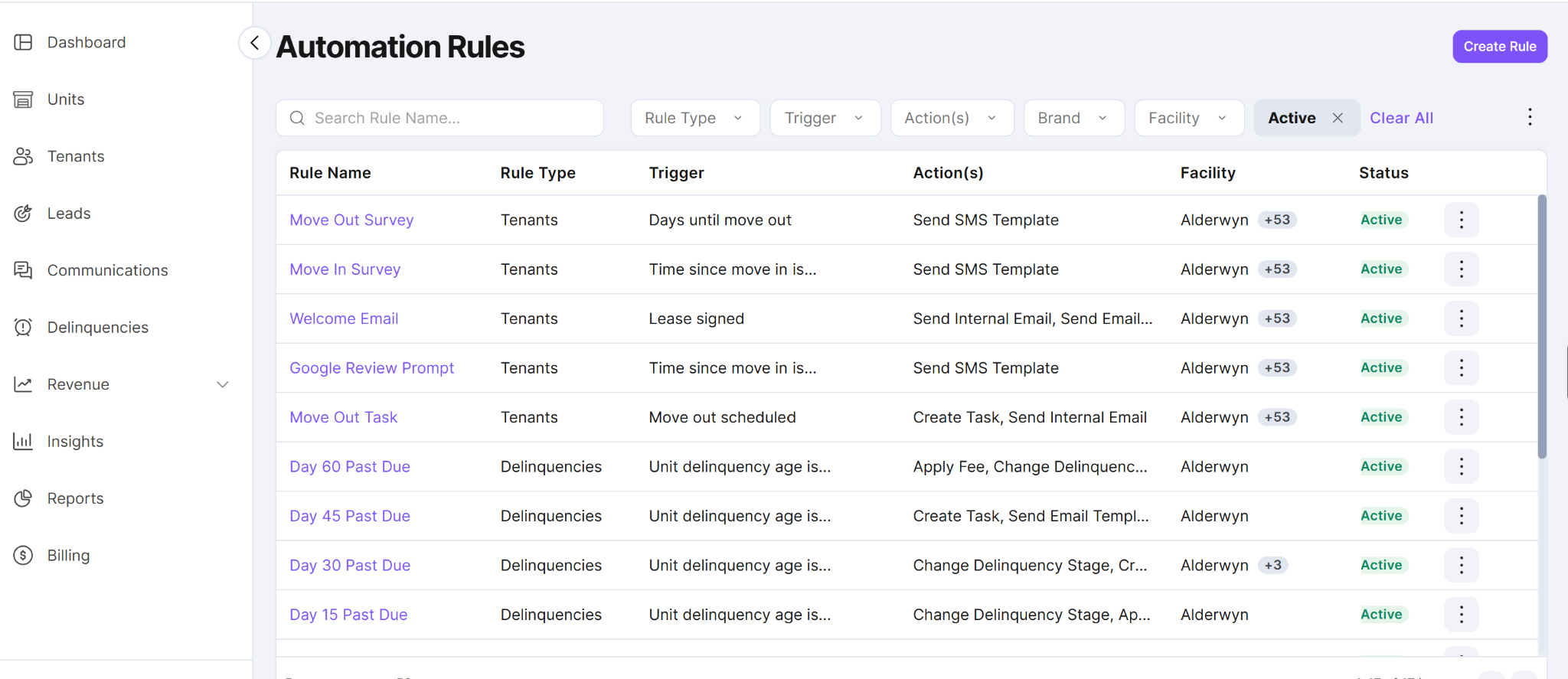
Monument’s delinquency automation rules.
The facilities that execute these workflows consistently, not just most of the time but every time and at every location, collect faster, retain more, and generate more revenue per available unit. The platform has to be capable of defining those rules once and applying them across every facility in the portfolio.
This is where the architecture gap between legacy systems and purpose-built portfolio platforms is most financially significant. Automation rules that fire based on triggers, apply actions across tenant segments, and leverage pre-built communication templates aren’t a feature enhancement. They’re the operational engine that allows a lean regional team to manage a large portfolio without adding headcount proportionally.

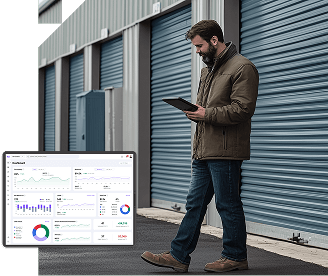
Remote management only works if the people answering phones can do their job regardless of which facility a caller is associated with. A call center agent shouldn’t need to know in advance which location a tenant rents from, or switch between multiple system logins to pull up their record. The software has to make that lookup instant, portfolio-wide.
Beyond tenant lookup, the platform needs to support the full range of tasks a call center handles across every facility in the system.
Leasing:
Tenant Management:
Unit Operations:
When call center operations run through a centralized platform rather than site-by-site logins, response times improve, the tenant experience becomes consistent across every location, and agents can actually do their job at scale.

The relationship between automation and NOI margin is direct. When automation absorbs workload that previously required staff time, the marginal cost of each additional facility decreases. That’s the efficiency gain that makes portfolio scaling financially viable.
Call center volume is the most visible example. When tenants receive automated payment reminders, delinquency notices, and move-in instructions through a systematic communication workflow, they resolve most issues without calling. Operators who have implemented portfolio-wide automation often see call center volume decrease meaningfully in the months following deployment, not because they reduced service quality, but because the automation handled the routine interactions that were consuming staff time.
The same principle applies to regional oversight. A Regional Manager who can see their entire territory’s performance in one view, act on multiple facilities simultaneously, and trust that delinquency and collections processes are running automatically at every location can manage more facilities without the oversight quality deteriorating. That operational leverage is what makes scaling profitable rather than just larger.
Dynamic rate management at portfolio scale requires real-time visibility into occupancy trends, competitive positioning, and tenant behavior across every facility. When pricing decisions depend on manually reviewing each site’s performance, rate adjustments happen slowly and inconsistently. When market benchmarking data is disconnected from the platform’s pricing workflow, operators are making gut-feel decisions with lagging information.
ECRI (Existing Customer Rent Increase) is where the revenue gap between well-managed and poorly managed portfolios widens most significantly. Blanket rent increase policies applied uniformly across a portfolio leave money on the table. Some tenants are far less sensitive to increases than the policy assumes, while others are more likely to vacate. Churn sensitivity analysis at the tenant segment and unit-group level allows operators to calibrate increases precisely, maximizing incremental revenue without driving avoidable vacancy.
At 50 facilities, the difference between an ECRI strategy built on churn data and one built on intuition is not marginal. It’s the difference between a systematic revenue discipline and an annual event that generates mixed results and limited investor confidence.
| NOI Lever | Remote-Optimized Approach | Legacy-Dependent Approach |
|---|---|---|
| ECRI Execution | Automated recommendations by unit group and churn segment; full audit trail | Manual reviews per facility; inconsistent timing and rationale |
| Collections Rate | Automated delinquency workflow across all facilities; systematic card retries | Site-level follow-up; inconsistent process; slower resolution |
| Leads Optimization | Real-time lead capture and automated SMS follow-up; direct booking optimization | Dependent on on-site staff availability; abandoned leads not systematically recovered |
| Direct Booking Rate | SEO-optimized rental website with conversion-optimized checkout | Legacy website or third-party marketplace dependency at higher cost |
| Investor Reporting | Real-time portfolio dashboards; GAAP-compliant accrual financials generated automatically | Manual spreadsheet compilation; cash-basis conversion; reporting lag |
Quarterly investor updates and lender packages represent a recurring overhead cost for most multi-facility operators. The time required to compile performance data across 30 or 50 facilities, reconcile cash and accrual figures, and format results for investor consumption is significant, and it’s time that could otherwise be directed toward operational decisions.
Portfolio-level reporting that pulls real-time data across every facility transforms investor reporting from a manual production effort into a distribution task. When occupancy trends, revenue performance, ECRI impact, and financial summaries are available as interactive dashboards with drill-down capability by facility, fund, or debt structure, investor communication becomes a competitive differentiator rather than a time sink.
For operators pursuing institutional capital relationships or positioning their portfolio for a REIT-level exit, the sophistication of the financial reporting is itself a signal. Investors presented with live, data-rich operational dashboards and GAAP-compliant accrual financials draw different conclusions than investors handed a static spreadsheet compiled from six different sources.
Custom roles and permissions ensure that portfolio-level visibility doesn’t mean undifferentiated access. Regional managers see what they need for their territory. Site managers access the data relevant to their location. Investors and ownership groups get the reporting layer appropriate for their relationship, without requiring your team to manually package information for each audience.
Task management and tenant communication tools keep on-site and remote teams coordinated without email chains or manual handoffs. When a delinquency workflow escalates automatically, the responsible manager receives a task. When a lead converts, the follow-up sequence fires without waiting for someone to notice it. Centralized process standards replace the “each site does it differently” problem that makes quality control across a large portfolio so difficult.

The operational case for a purpose-built portfolio platform is best illustrated at the workflow level, where the difference between centralized automation and site-level manual processes translates directly into financial outcomes.
A centralized call center is only as effective as the software behind it. When an agent receives a call, they need to pull up the right tenant record immediately, regardless of which facility that tenant rents from. Toggling between multiple system logins or asking a caller to confirm their location before you can access their account is friction that erodes both efficiency and the tenant experience.
The platform needs to support the full scope of what a call center handles across the portfolio from a single interface: processing payments, scheduling move-ins and move-outs, applying credits, managing delinquency status, logging maintenance issues, and converting inbound prospects into tenants. When an agent is working a leasing call, available units, current pricing, active promotions, and upsell options all need to be visible in context, without navigating away from the record.
The financial case is straightforward. A call center operating from a unified platform resolves calls faster, converts more inbound leads, and handles more accounts per agent than one working across disconnected site-level systems. At portfolio scale, that efficiency difference compounds across every interaction your team handles.
Consistent delinquency handling across a large portfolio is harder than it looks. On-site managers have competing priorities. Remote teams coordinating across time zones are dependent on site-level data they can’t always access in real time. The result, for most multi-facility operators, is a delinquency process that varies by location. Some sites run a tight, systematic workflow. Others follow up inconsistently. The portfolio-level collections outcome reflects that inconsistency.
Automated delinquency rules that trigger based on invoice age, balance thresholds, and payment status remove that variability. Every facility follows the same process, with automated notices at defined intervals, fee applications at the right trigger points, and escalation workflows that execute regardless of site-level staffing. The process runs uniformly at every location because it’s defined once at the portfolio level, not recreated independently at each site.
The operational outcomes are measurable. Faster collections cycles, reduced call volume, and higher autopay rates are consistent results for operators who implement portfolio-wide delinquency automation. The reduction in manual collections effort is equally significant. Your regional team is reviewing exceptions rather than managing a process that should already be running.
Managing rent increase cycles across 20, 50, or 100 facilities manually is an exercise in risk management disguised as revenue management. The coordination overhead alone is substantial:
The analytical gap is worse. Most manual ECRI processes lack the churn sensitivity data to calibrate increases by tenant segment, which means they’re either too conservative across the board or generating avoidable vacancy.
An automated ECRI workflow built on churn sensitivity analysis changes the nature of the decision. Rather than setting a blanket increase and accepting the resulting churn, operators can identify which tenants at which facilities are likely to retain after a 10%, 15%, or 20% increase and target increases accordingly. That precision, applied across a large portfolio, generates incremental revenue that a blanket policy would leave unrealized.
Automated recommendation, approval, and execution workflows also produce the audit trail that investor reporting requires. When an investor asks why average revenue per unit increased in a specific quarter, the answer is documented:
That level of reporting discipline isn’t possible when ECRI is managed through spreadsheets and email chains.
Tenant acquisition is increasingly a digital-first process. Prospects research facilities online, compare rates, and often complete the entire move-in process from initial inquiry through lease signing without speaking to anyone on-site. For operators managing facilities remotely, this is a structural advantage, provided the digital leasing infrastructure is built to capture and convert leads without human intervention.
Abandoned cart capture is the most common missed opportunity. A prospect who begins the move-in process and doesn’t complete it isn’t necessarily a lost lead. It’s an engagement signal. Automated follow-up via SMS, triggered by the abandonment event, converts a meaningful percentage of those prospects into tenants without requiring any staff action. That conversion happens whether your site manager is available or not.
Automated SMS follow-up for new leads, with conversion rates in the 60-70% range when executed on the right cadence, eliminates the lead response delay that typically occurs when on-site staff are managing competing priorities. SEO-optimized rental websites that surface in organic search and convert visitors through a frictionless checkout process reduce third-party marketplace dependency, capturing direct bookings at a higher margin than marketplace-assisted rentals.
| Leasing Workflow | Remote-Optimized | Legacy-Dependent |
|---|---|---|
| Lead Capture | Automated abandoned cart recovery; all incomplete rentals become tracked leads | Leads lost if prospect exits; no systematic recovery process |
| Follow-Up | Automated SMS drip campaigns; immediate response regardless of staff availability | Dependent on on-site or call center staff availability; inconsistent timing |
| Move-In | Fully digital lease signing; real-time unit inventory and pricing | Manual or partial digital process; potential for inventory discrepancies |
| E-Signature & Payment | Integrated; lease and payment captured in single checkout flow | Separate systems; friction points that reduce conversion |
The operational and financial case for purpose-built remote self-storage management is straightforward. The decision is rarely about whether the platform upgrade makes sense. It’s about managing the transition.
The case for upgrading is rarely the hard part. Managing the transition is.
Start with a discovery call focused on your specific portfolio: current platform, facility count, and where the operational friction is worst. A demo scoped to your delinquency workflow, ECRI cycle, and reporting requirements will tell you more than a general walkthrough. On implementation, the questions that matter most are data migration, autopay token transfer, and go-live timeline. The right platform handles the majority of that complexity for you.
The signals that a portfolio has outgrown its current system are consistent: manual reconciliation to close reporting gaps, delinquency outcomes that vary by facility, ECRI cycles that slip because execution depends on individual managers, and integration constraints that your platform won’t resolve.
Every month on the wrong platform carries a real NOI cost. Slower collections, missed rent increase revenue, occupancy decisions made on lagging data. That gap between what the portfolio is generating and what it should be generating compounds over time.
Operators who have made the move consistently report the transition was faster than expected and the operational improvement larger. The portfolio that looks too complex to migrate is usually exactly what a purpose-built platform was built for.


Explore top self-storage software solutions with key features, comparisons, and tools for facility operations, marketing,...

Explore top facility management software systems for self-storage, including key features, benefits, and how these...

Discover how 3rd party self storage management improves operations, revenue, and NOI—and what to look...