


Operators managing complex portfolios of 20, 50, or 100-plus locations face an entirely different operational reality than single-site owners. At this scale, geographic dispersion, inconsistent site-level execution, and institutional investor reporting requirements create friction in operations management.
This is where legacy architecture starts showing its age, as it often can’t handle the management complexities at this level. The right storage software for an institutional operator will give you the tools you need to manage your growing number of assets effectively. With so many storage software offerings on the market, you’ll need to know what specific features and functions you’re looking for to narrow down your choices to the ones that’ll actually work for your business.
This guide serves as a feature-by-feature evaluation framework for self-storage software rather than a simple platform comparison. It provides a practical, data-driven checklist for any sophisticated executive, regional manager, or operator assessing whether their current storage facility software can genuinely support the next stage of portfolio expansion.
Key Takeaways
Self-storage management software at the enterprise level is an all-in-one operational ecosystem that centralizes portfolio controls, automates revenue optimization, and standardizes facility workflows across multiple locations. Unlike basic tools, this specialized cloud infrastructure integrates real-time business intelligence dashboards, dynamic rate engines, and institutional accounting frameworks, using data from all your facilities to make operations management easier and more effective.
What separates basic storage software from software that can handle portfolio scale is not any specific feature, but its portfolio-level readiness.
When systems keep facility data locked in a silo, executive teams lose visibility, site managers spend hours on manual workarounds, and institutional capital partners are left with disparate, non-standardized reports. True portfolio readiness means every capability, from automated outreach to rate modification, is managed from a single centralized interface that pushes updates downstream seamlessly.
Here are the seven essential features you need to look for in storage software built for multi-facility management.
Monument allows you to run multiple facilities at once, streamlining operations management. You get to treat your portfolio as a single, fluid system, grouped, analyzed, and acted on in the exact way that you think about your business.
Through Navigator, you build custom facility sets along any dimension that matters to you: size, leasing stage, geography, market tier, unit mix, management team, or brand. Once a set is built, you can report on it, analyze it, or push changes across every facility in it at the same time.
This is what portfolio-scale operators get with Monument:
As you acquire new facilities, they slot straight into your existing structures and tagging logic. Whether you run two facilities or two hundred, Monument is self-storage software built for multi-facility management, as it scales with you instead of buckling under the complexity.

Automation represents the biggest capability gap between single-facility tools and genuine enterprise storage business software. For a small portfolio, manual adjustments are a minor inconvenience; for an operator managing dozens of properties, they represent a severe threat to operational efficiency and revenue protection. At scale, the question is not whether automation exists within the platform, but whether those automation rules can be configured, tested, and deployed across every facility simultaneously.
True automation within advanced storage facility management software relies on centralized, trigger-based workflows. These workflows consist of precise conditions, scheduled actions, and automated communication templates that execute without site-manager intervention. In legacy configurations, updates must be manually implemented site by site, leading to fragmented processes, outdated templates, and missed operational milestones.
Centralized deployment allows a regional manager to update an entire workflow, such as modifying a collection sequence or an automated lead follow-up, and push it to a select group or all locations instantly. This enterprise control protects the portfolio’s bottom line.
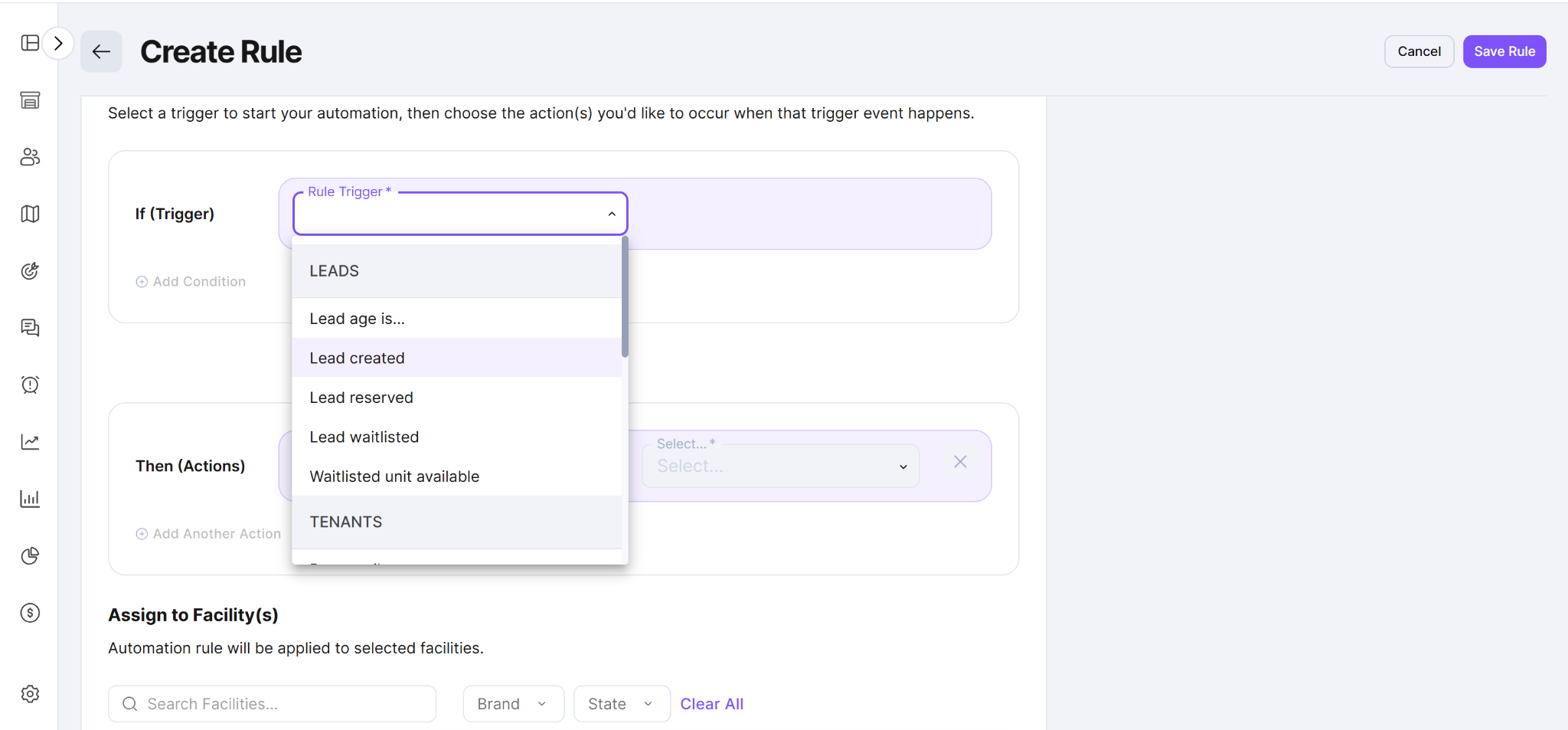
Monument’s lead follow-up automation rules.
Implementing standardized, portfolio-wide automation rules is the single most effective method for quickly addressing delinquent tenants.

Monument’s tenant delinquency automation rule creator.
Manual follow-up on failed credit card transactions or autopay declines represents a hidden labor drain that costs operators thousands in lost efficiency. By leveraging centralized delinquency automations, every location under a specific group operates under identical parameters. Standardizing automated tenant communications across every property ensures that payments are recovered faster, bad debt is minimized, and staff resources remain focused on higher-value leasing activities rather than constant follow-ups.
Generic, static rate tools are fundamentally unsuited for sophisticated operators managing dozens of unit groups across distinct, highly competitive markets. Specialized software for self storage business operations requires a dynamic revenue engine capable of analyzing and executing pricing adjustments across facilities, unit groups, occupancy tiers, and tenant tenures simultaneously.
A portfolio-first self storage management system replaces manual, reactive rate adjustments with algorithmic, demand-based triggers. Instead of a regional manager manually checking occupancy sheets to adjust street rates, the system monitors velocity and occupancy in real time. When a specific unit group (e.g., 10×10 temperature-controlled) crosses a pre-defined occupancy threshold at a specific location, the street rate increases automatically.

Monument’s unit-type rate adjustments.
Alternatively, if velocity slows down, the system can dynamically implement automated move-in promotions to stimulate demand. This portfolio-wide logic allows corporate teams to set global guardrails while letting the localized pricing engine optimize for maximum yields. In addition,
incorporating real-time market benchmarking directly into the platform ensures your street rates automatically respond to competitor shifts without requiring external, disjointed software tools.
Executing Existing Customer Rent Increases (ECRI) manually across thousands of active tenants is a primary driver of revenue leakage. Rather than applying blanket, unoptimized rate increases that trigger unnecessary tenant churn, an enterprise-grade revenue engine should process ECRIs through a systematic, multi-layered filtration sequence:

Monument’s ECRI workflow.
By analyzing indicators like tenant tenure, payment history, and distance from current market rates, the engine optimizes the timing and magnitude of each increase. This maximizes incremental revenue while protecting overall economic occupancy. Corporate executives can track the precise financial impact of these ECRI cycles across the entire portfolio in real time, rather than waiting for month-end reports to compile.
| Revenue Capability | Basic Storage Software | Advanced Revenue Management |
| Pricing Adjustments | Manual, site-by-site updates | Algorithmic, portfolio-wide demand triggers |
| ECRI Execution | Flat percentage across all tenants | Churn-sensitive modeling based on tenure & tenure metrics |
| Market Benchmarking | Manual competitor checks | Real-time automated competitive data integration |
| Revenue Tracking | Delayed, post-facto monthly reporting | Real-time incremental revenue tracking via BI |
For large operations, a single percentage point improvement in digital conversion rates across dozens of web properties yields significant compounding revenue. A self storage website software solution that relies on slow, disconnected third-party iframe plug-ins introduces friction at checkout, dragging down direct booking numbers and increasing customer acquisition costs.
A high-performance platform must include a native, conversion-optimized leasing engine that functions as an organic search asset. Transitioning away from fragmented third-party digital tools eliminates unnecessary licensing fees and provides a cohesive user experience. Traditional iframe integrations obscure critical data from search engines, harming local SEO performance.
A unified, SEO-optimized self storage rental software engine ensures that your real-time inventory, pricing structures, and promotions are indexed directly by search engines. When a prospective customer searches for available units, they receive accurate, immediate data. This seamless synchronization ensures that the unit selected online matches the exact physical vacancy at the facility, eliminating double-bookings and cart abandonment during checkout.
Online transactions are frequently interrupted, but an enterprise-grade storage unit software platform doesn’t treat a dropped checkout as a lost opportunity. Integrated abandoned cart recovery mechanisms capture high-intent tenant details the moment they enter their contact information. If the reservation is not completed within a designated window, the system automatically triggers follow-up sequences.
Deploying targeted, automated SMS and email sequences can significantly boost your conversion rates on abandoned carts at portfolio scale, transforming lost web traffic into reliable rental income. Additionally, built-in good-better-best pricing matrices and tiered protection plan selections act as automated upselling mechanisms during the digital checkout flow, maximizing average revenue per user (ARPU) from day one.
This is the foundational feature most commonly absent from standard storage unit software management programs. While cash-basis reporting may suffice for a single-site owner, it is a non-starter for sophisticated operators aligned with institutional private equity, commercial lenders, or REIT-level stakeholders.
To maintain flawless financial integrity, an enterprise self storage company software platform must execute automated journal entries daily, mapping operational data directly to an institutional chart of accounts. This eliminates the need for manual end-of-month reconciliations across multiple corporate entities.
Every transaction—whether it is a partial rental payment, an advanced multi-month booking, a lien fee, or a protection plan premium—must be accurately tracked at the individual facility level. A sophisticated platform supports both cash and accrual accounting models natively from a single database, allowing on-site managers to work in a simplified workflow while corporate controllers pull pure accrual data for formal financial reporting.

Monument’s revenue insights.
[Operational Transaction Data] ➔ [Native Accrual Ledger] ➔ [Instant Investor-Grade Financials]
Using GAAP-compliant accounting frameworks removes the labor-intensive burden of manually converting books from cash to accrual at the end of every fiscal period. Institutional capital demands rigorous financial documentation, including detailed balance sheets, clear revenue recognition profiles for prepaid rents, and standardized aging schedules.
By using accounting software for self storage business operations that meets GAAP requirements, corporate finance teams can generate fund-level or debt-status reports on demand. This institutional precision accelerates audit cycles, simplifies compliance reporting for lending syndicates, and ultimately protects the portfolio’s capitalization rate during valuation events.
| Accounting Capability | Cash-Basis Legacy Platforms | GAAP-Compliant Enterprise Software |
| Revenue Recognition | Recognized immediately upon receipt | Accrued systematically over the rental period |
| Journal Entries | Manual batch exports or spreadsheet uploads | Automated, daily lease-level general ledger entries |
| Multi-Entity Management | Disconnected databases requiring consolidation | Unified architecture with fund-level sorting |
| Audit Readiness | High manual reconciliation overhead | Clean, verifiable transactional audit trails |
Standard operational dashboards excel at displaying historical data, showing executives what occurred across their properties over the previous month. However, a sophisticated self-storage facility management software platform replaces these rigid layouts with a comprehensive, multi-dimensional business intelligence layer. With nearly 100 deep business graphs correlating marketing, operational, revenue, and tenant behaviors, Monument’s analytics ecosystem shifts your software from a simple reporting tool to an active decision-making asset.
Managing a portfolio of 30 or 80 sites requires the ability to segment asset performance dynamically rather than reviewing a massive, unfilterable list of properties. Monument’s advanced analytics modules offer navigator-style property groupings, allowing corporate executives to filter and isolate performance metrics by specific criteria, such as geographic market, asset age, brand identity, or operational performance tier.
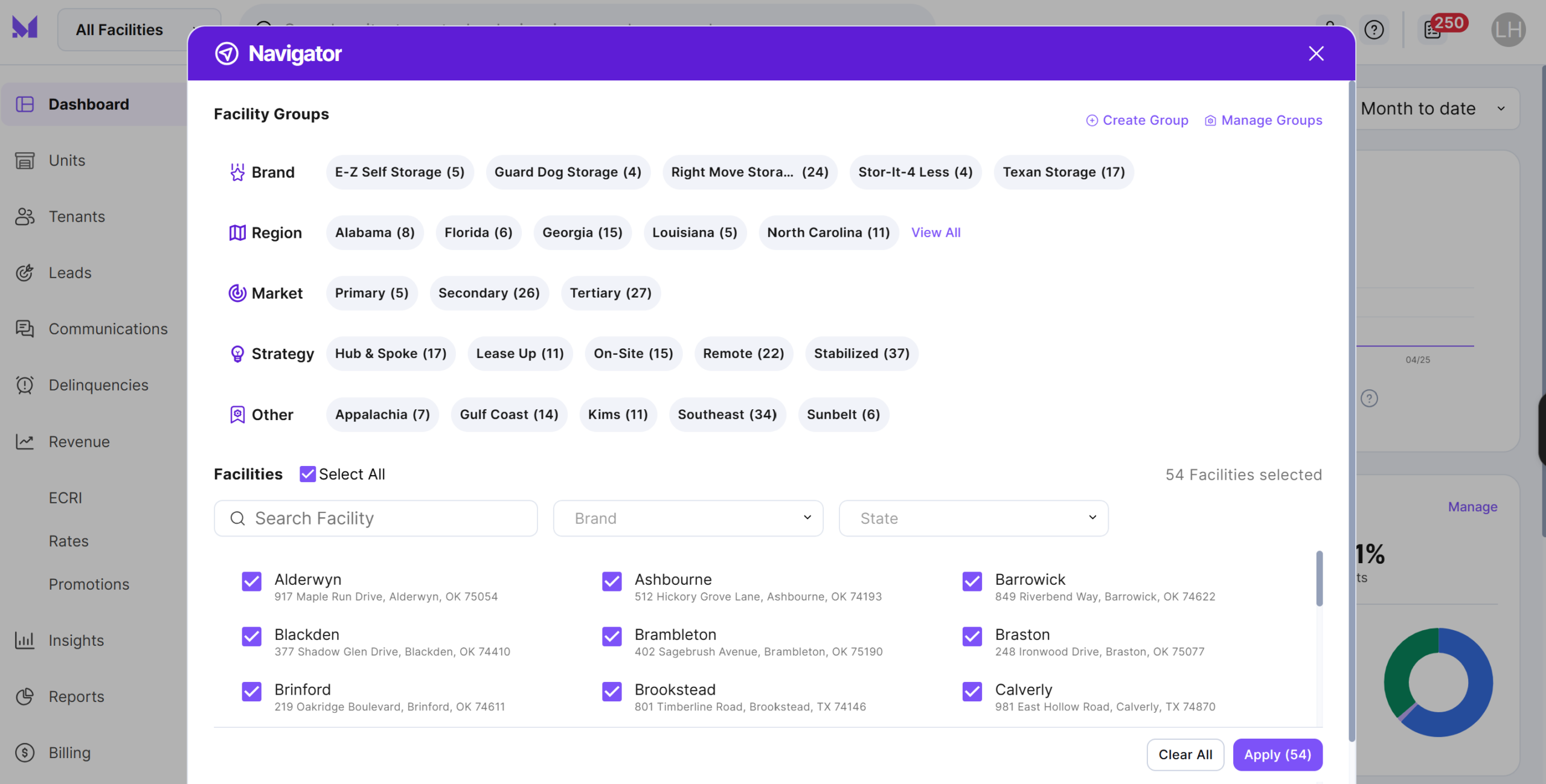
Monument’s Navigator tool.
If a regional director notices a drop in economic occupancy across a specific submarket, they can instantly drill down from the high-level portfolio view into individual facility ledgers. This seamless transition from macro-level trends to microscopic transaction details allows operational leaders to diagnose and correct performance anomalies within minutes.
Understanding the subtle factors that drive portfolio valuation requires access to granular revenue and behavioral analytics. True business intelligence solutions dissect occupancy metrics by cleanly separating physical unit occupancy from true economic occupancy, ensuring discounting practices don’t mask falling net revenues.
Advanced analytics track key metrics across all locations simultaneously, including:
| Dashboard Dimension | Target Metric Views | Strategic Value |
| Operational View | Lead-to-lease velocity, move-out velocity, site manager performance | Optimizes daily site workflows and labor allocation |
| Revenue View | RevPAF trends, street-to-achieved rate deltas, promotion efficiency | Minimizes revenue leakage and maximizes gross yield |
| Investor View | Net Operating Income (NOI), GAAP cash-to-accrual, bad debt write-offs | Delivers rapid, audit-ready updates to equity partners |

Monument’s Insights dashboard.
The most frequent concern voiced by large operators considering a platform migration centers on operational freedom. Companies that have invested significant capital into building custom integrations with specific access control systems, independent pricing engines, specialized marketing partners, or tenant insurance programs are understandably hesitant to tear down their existing software stack. True platform sophistication means prioritizing an open ecosystem that integrates seamlessly with your preferred operational partners.
An API-first architecture means the platform’s core code is built to share data safely and efficiently with external applications. For multi-facility operators, this ensures your online self storage software can connect directly to your existing tech stack rather than forcing a costly replacement of functional infrastructure.
┌─── Access Control Systems
├─── Advanced Pricing Optimizers
[Enterprise API Core] ────┼─── Institutional Tenant Protection
└─── Specialized Marketing Platforms
Whether you want to feed real-time gate activity into your tracking systems, synchronize data with enterprise-grade CRM platforms, or deploy specialized localized marketing campaigns, an open API supports seamless synchronization. This architectural agility protects your historic technology investments while giving your internal IT teams the freedom to build tailored operational tools without vendor interference.
Legacy and challenger software as a service (SaaS) providers often make their software into a “walled garden” by restricting integration access or requiring API fees for third-party vendors. These software companies leverage integration restrictions as a strategic tool to increase customer switching costs to encourage customers to stay within their proprietary ecosystem.
Unfortunately, vendor lock-in restricts your operational flexibility, leaving you more dependent on the included proprietary tools. When evaluating a new self storage software company, it is essential to learn about their third-party integration policies and upcoming development roadmaps. What you want to look for is open, documented API developer environments that support your business growth.
| Platform Strategy | Open API Architecture | Closed Walled Garden Systems |
| Integration Freedom | Connects with any preferred third-party vendor | Often restricts choices to native or partnered vendors |
| Data Accessibility | Real-time, bi-directional data pipelines via API | Flat-file exports or restricted dashboard views |
| Switching Costs | Low; existing hardware and tools remain intact | High; requires transitioning to a new proprietary ecosystem and/or incorporating costs for API tools |
| Innovation Velocity | Leverages the broader technology market | Dependent entirely on a single vendor’s timeline |

The decision to transition a multi-facility portfolio to a new self-storage facility management software platform is fundamentally a risk-management calculation. When an enterprise operates dozens of locations, a poorly executed data migration can disrupt automated payments, corrupt historical transaction data, and halt daily rental operations across the portfolio. The professional implementation capability of a software provider is just as critical as the performance of the platform itself.
The single greatest operational hurdle when migrating portfolios is the secure transfer of credit card and payment tokens. If a software vendor cannot transfer these tokens safely between payment gateways, thousands of tenants will be dropped from automatic payments, causing immediate transaction failures and spikes in delinquency.
A high-performance self storage operating software provider mitigates this risk by delivering a fully managed, white-glove data migration process. By coordinating directly with compliance-certified payment processors, the engineering team manages the token transfer behind the scenes, ensuring continuous payment processing without requiring tenants to re-enter their financial details. At the same time, historical customer ledgers, gate codes, and rental structures are audited, cleaned, and mapped to the new platform database to preserve data continuity from day one.
A successful implementation across a complex portfolio of 20 to 100+ facilities requires a structured rollout schedule designed to minimize operational disruption. Rather than executing a high-risk, single-day transition across all properties, an experienced implementation team uses a phased migration model. This process begins with an in-depth operational audit, moves through extensive testing environments, and launches a single pilot facility before scaling across the remaining locations.
Here’s an example:
Having a dedicated, US-based customer success team that understands the nuances of enterprise operations is invaluable during this transition phase. This support team functions as a direct extension of your corporate staff, conducting comprehensive training sessions for site managers, monitoring data accuracy during the cutover window, and providing instant troubleshooting assistance to keep your portfolio running smoothly.
Enterprise software drives NOI growth by replacing manual site-level tasks with automated, high-yield processes. It implements dynamic, demand-based street rates that maximize unit revenue during peak leasing periods, and utilizes automated, churn-sensitive ECRI to boost retention revenue. Additionally, centralized automation reduces labor overhead and prevents bad debt through systematic, compliant collection sequences.
Cash-basis accounting fails to accurately reflect the financial performance of large portfolios because it records revenue only when cash changes hands. GAAP-compliant accrual accounting matches revenues and expenses to the exact periods in which they are earned or incurred. This institutional precision is required by private equity partners, commercial banks, and institutional buyers, eliminating the need for manual, time-consuming cash-to-accrual adjustments at the end of every fiscal cycle.
Closed platforms restrict your ability to connect with specialized third-party vendors for critical functions like gate access control, advanced pricing optimization, and customized digital marketing. This lack of integration choice creates vendor lock-in, increases your switching costs, and leaves your business dependent on a single vendor’s development capabilities. An open API architecture ensures you can adapt your software stack as your business needs evolve.
A secure, multi-site portfolio migration typically spans 60 to 90 days, depending on the number of locations and the complexity of the underlying historical data. This timeline ensures a meticulous, risk-free transition that covers payment gateway token verification, database cleaning, on-site manager training, and a phased rollout schedule designed to maintain complete operational continuity.
Selecting the right enterprise infrastructure is a critical decision that directly impacts your portfolio’s Net Operating Income, operational efficiency, and long-term valuation. Legacy property management systems that fracture under the weight of scaling portfolios limit your corporate agility and create unnecessary operational hurdles. Monument provides the precise automated rules, institutional revenue engines, and open API architecture required to break through the complexity ceiling and maintain complete control over your growing business.


Explore top self-storage software solutions with key features, comparisons, and tools for facility operations, marketing,...

Explore top facility management software systems for self-storage, including key features, benefits, and how these...

Discover how 3rd party self storage management improves operations, revenue, and NOI—and what to look...