


When you’re running two or three facilities, delinquency management is basically a phone call. A site manager notices an account is past due, picks up the phone, and works it until the tenant pays or the unit gets auctioned. That works because one person can hold the whole picture in their head.
Once a portfolio crosses 20 or 30 facilities, that model breaks down. Delinquency handling stops being a single manager’s job and turns into a systemic risk that touches every site, every regional manager, and every line of the P&L. Inconsistent collections quietly become one of the biggest hidden drains on net operating income (NOI), and most operators don’t notice until the losses are already sitting in the bad debt line.
This guide walks through what delinquency management actually involves, why it gets harder to control as a portfolio grows, and what to look for in a self-storage delinquency management software system built for multi-facility operations.
Key Takeaways
Delinquency management is the process of tracking past-due tenant accounts and moving them through a defined sequence of reminders, late fees, lockouts, and lien action until the balance is paid or the unit is auctioned. It’s less about any single tactic and more about the system that decides what happens next, and when.
Most operators organize past-due accounts into aging buckets that track how long a balance has been outstanding:
Each bucket calls for a different response. A five-day-late account might just need an automated text. A 90-day account is likely headed toward lien and auction. Delinquency management isn’t a single feature. It’s the operating system that decides what happens to every past-due account, at every stage, across every facility in the portfolio.
A single unresolved account at one facility is a minor annoyance. Multiply that account by dozens of facilities and hundreds of units sitting in different aging buckets, and delinquency becomes one of the largest controllable expenses on the P&L.
Three things drive this:
None of these show up as a single dramatic loss. They show up as a slow, steady leak that’s hard to see until someone adds it up across the whole portfolio.
The math gets worse with scale, not better. A single facility with a handful of delinquent units absorbs the loss without much notice. A 50-facility portfolio with the same delinquency rate per site is carrying that loss 50 times over, and if the rate itself creeps up because enforcement has gone inconsistent, the losses compound. Investors and lenders notice this pattern quickly. A portfolio with an unpredictable delinquency rate looks riskier than one with a stable, well-documented one, even if the underlying real estate is identical. Getting delinquency management right isn’t just an operations issue. It’s a factor in how the portfolio gets valued.
For operators who haven’t standardized their approach, manual delinquency management still looks the way it did a decade ago. A site manager pulls a list of past-due tenants, works down it one call at a time, and hopes to catch people before the balance grows. Follow-up depends on whatever that manager remembers to do, and regional leadership has almost no visibility into what’s happening at each site until month-end reports arrive.
The real cost of manual delinquency management isn’t the labor hours. It’s the blind spot it creates for everyone above the facility level.
When delinquency management runs manager by manager, the rules drift. One site sends a reminder on day 3. Another waits until day 10. One consistently applies late fees. Another waives them for regulars. None of these individual choices are unreasonable, but stacked across a portfolio, they mean the delinquency rate, days-to-resolution, and lien timing all vary by site for reasons that have nothing to do with local market conditions.
That drift makes it nearly impossible to answer basic portfolio questions with confidence. Which facilities are underperforming on collections? Is a rising delinquency rate a market problem or a process problem? Without a standardized system, those questions take a spreadsheet and a week to answer instead of a dashboard and a few minutes.
There’s also a people cost to the manual approach that doesn’t show up on a P&L line labeled “delinquency.” Site managers who spend a large share of their week on collections calls have less time for leasing, tenant retention, and the day-to-day upkeep that keeps a facility competitive. Regional managers, meanwhile, end up playing detective, pulling data from multiple site-level systems just to figure out where the portfolio actually stands on collections this month. That’s hours spent reconstructing information a good system should surface automatically.
| Manual Delinquency Management | Automated Delinquency Management | |
|---|---|---|
| Labor hours | High, hours per week per site | Low, system runs rules automatically |
| Consistency | Varies by site manager | Same rules applied at every facility |
| Escalation speed | Depends on when staff follow up | Triggers fire on schedule, every time |
| Visibility | Limited until month-end reports | Real time, portfolio-wide |

Regardless of which vendor an operator chooses, a real delinquency management system needs a handful of non-negotiable building blocks. Effective delinquency management strategies rest on these building blocks working together, not on any single clever feature.
Every past-due account should sit in a bucket that maps to a specific, predefined response. The best delinquency management systems let operators configure escalation tiers by property group rather than forcing one rigid schedule across the whole portfolio. A lease-up property in a competitive secondary market might need a gentler early-stage approach than a stabilized property with a track record of low delinquency. Configurable tiers let regional leadership set the policy once and trust that every site applies it the same way.
Escalation tiers work best when they combine timing with tone. An early reminder should read like a routine nudge, not a threat. By the time an account reaches the overlock stage, the message needs to be direct about what happens next and by when. Getting that progression right, and applying it consistently across every property group, is what separates a delinquency management strategy from a loose set of habits that happen to work most of the time.
Self-storage lien law varies by state, which means the exact day an operator can overlock a unit, send a formal lien notice, or move to auction differs depending on where a facility sits. For a single-state operator, that’s easy to track in one person’s head. For a portfolio spanning multiple states, it’s a compliance risk if left to memory.
A delinquency management system should track lien timelines automatically based on facility location, flag accounts approaching a compliance deadline, and keep a clear audit trail of every notice sent. That protects the operator legally and keeps lien timing consistent, which matters for both compliance and for forecasting how much revenue is actually recoverable in a given month.
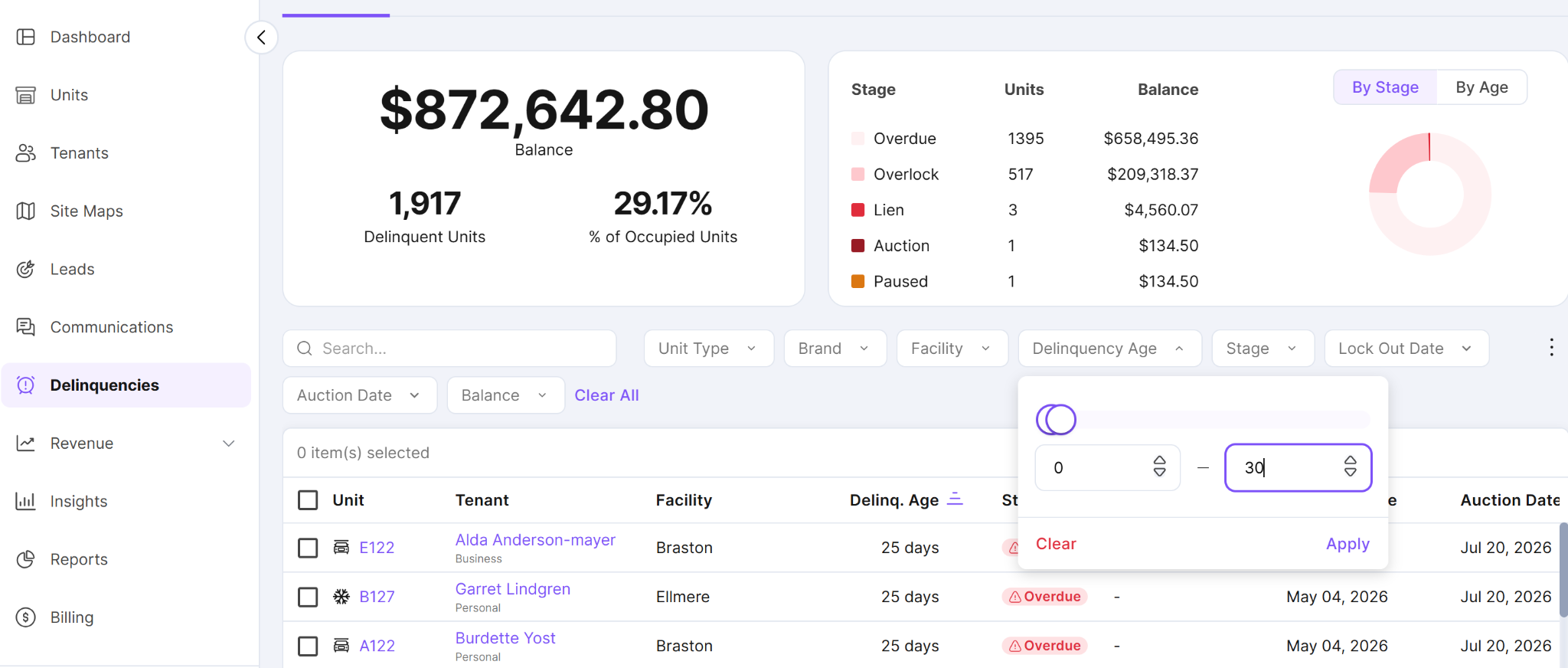
Example of delinquency tracking in Monument.
Overlocking sits in between a late notice and a formal lien. It’s often the point where a tenant who’s been avoiding calls finally reaches out, because losing physical access to their belongings tends to get attention that a text message doesn’t. A system that automates overlock timing based on the rules an operator sets, rather than leaving it to a site manager’s judgment, keeps that step consistent and defensible if a tenant ever disputes the timeline.


A meaningful share of delinquency isn’t a tenant refusing to pay. It’s a card that soft-declined, an expired card on file, or a payment method that simply failed to process. A strong delinquency management system automatically reattempts soft-declined cards over a set window, often two to three days, before applying a late fee or escalating the account.
This matters even more during acquisitions. When a portfolio grows through acquisition, autopay accounts from the acquired facility’s old system need to transfer cleanly into the new one. A failed autopay transfer turns a paying tenant into a delinquent one overnight, through no fault of their own, and creates a wave of avoidable collections work right when a newly acquired portfolio needs the least friction.
Operators who’ve been through a facility management system migration without proper autopay transfer support know how disruptive this can be. Every tenant whose card doesn’t carry over becomes a manual outreach, a payment update request, and often a frustrated phone call, all multiplied across however many units the acquired facility holds. Building autopay transfer into the delinquency management system itself, rather than treating it as a separate onboarding task, keeps a growing portfolio from generating its own delinquency spike every time it adds a property.
Once the strategy is defined, automated self-storage delinquency management software is what actually runs it, consistently, at every facility, without a person deciding case by case what to do next.
Automated delinquency management software turns a defined strategy into a system that runs itself, the same way, at every site.
The mechanism behind most self-storage delinquency management software is a set of triggers, actions, and templates. An account crossing a defined age, say five days past due, triggers an automated action, like an SMS or email built from a pre-approved template. A longer overdue period triggers a late fee. A much longer one triggers an overlock.
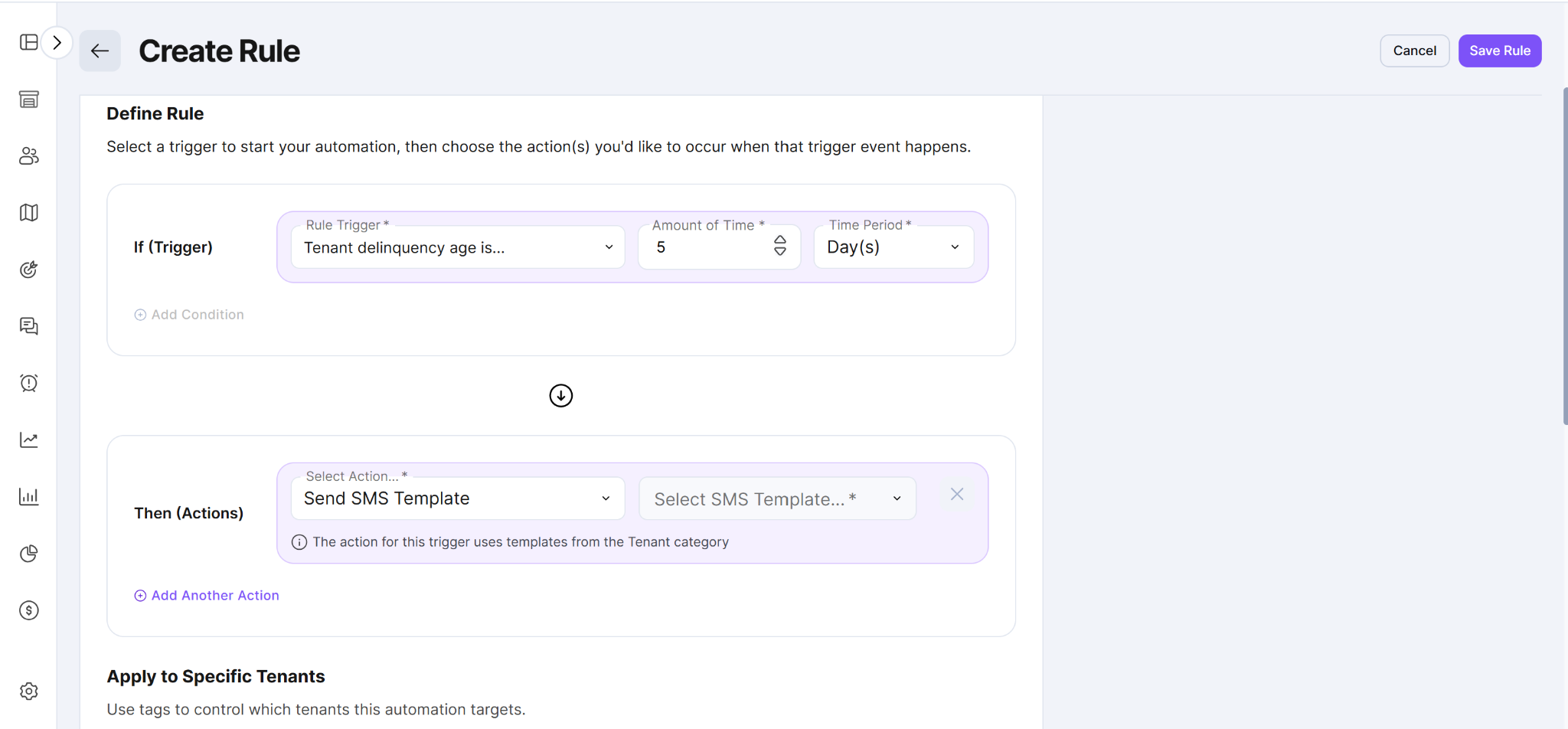
Monument’s delinquency automation rules setup.
Because the rule fires the same way at every facility, regional leadership doesn’t need to check whether a specific site remembered to follow up. The workflow already did it, and the outcome is logged and reportable.
This is also where templates earn their value. A pre-approved reminder, fee notice, or lien warning means every tenant across the portfolio gets consistent, professionally worded communication, instead of language that varies based on whoever typed it that day. For an operator managing dozens of sites, that consistency protects the brand as much as it protects revenue. A tenant who gets a sloppy, inconsistent collections notice forms an opinion about the whole company based on that one interaction.
| Delinquency stage | Trigger | Automated action |
|---|---|---|
| Day 5 | Invoice past due for 5 days | Automated SMS reminder |
| Day 15 | Invoice past due for 15 days | Automated email plus late fee |
| Day 30 | Invoice past due for 30 days | Overlock warning notice |
| Day 60 | Invoice past due for 60 days | Overlock applied, formal notice sent |
| Day 90+ | Invoice past due for 90+ days | Lien notice initiated per state law |
Automation handles the “what happens when” logic. AI in delinquency management adds a layer on top, refining how and when a reminder actually reaches a tenant so it lands with better odds of getting paid.
The most useful AI tools for delinquency management don’t replace the automation rules described above. They sit alongside them, using tenant behavior patterns, like when a tenant typically pays, which channel they respond to, and how they’ve reacted to past reminders, to fine-tune timing and tone. A tenant who usually pays right after a paycheck lands might get a reminder timed to that window instead of a flat “day 5” schedule. This works best as a specialized AI layer that plugs into the core facility management system, giving operators access to live portfolio data through an AI tool rather than depending on AI baked directly into the software.
That distinction matters for operators evaluating vendors. Software that’s AI-ready, meaning it exposes portfolio data securely to whatever AI assistant or tool an operator prefers, tends to age better than self-storage software with one AI feature bolted on. Operator needs and available AI tools are both moving fast right now. A platform built to connect with AI tools, rather than one that tries to be the only AI tool, gives an operator room to adopt whatever works best without waiting on a single vendor’s roadmap.
The goal of AI-assisted timing is shortening the self-storage delinquency management software early resolution window, the gap between when an account goes past due and when it gets paid. A generic reminder sent to every tenant on the same schedule is reactive by design. A reminder timed and worded around how a specific tenant actually behaves is far more likely to get a response before the account moves into a later, costlier aging bucket.
Shaving even a few days off that window across a large portfolio adds up. Fewer accounts reach the overlock and lien stages, fewer hours go into escalated collections work, and NOI holds up better across the board.

With so many delinquency management systems on the market, it helps to evaluate them against a specific, practical checklist rather than a features list from a sales deck. Most vendors will claim they handle collections. Far fewer can show how their system holds up once a portfolio has 40 or 50 facilities running the same rules at once, in different states, with different lien laws, and different property groups needing different treatment.
Choosing a delinquency management solution comes down to whether it can run one consistent policy across every facility in the portfolio at once.
| Feature | Legacy PMS | Purpose-Built Portfolio Software |
|---|---|---|
| Portfolio-wide visibility | Limited, site by site | Yes, single dashboard |
| Custom rule sets by property group | Rare | Yes |
| Autopay token migration support | Often unsupported | Yes |
| Lien compliance tracking | Manual | Automated, by state |
| Reporting by facility and portfolio | Manual compilation | Built in |
Monument was built around the reality that delinquency management for a 60-facility portfolio looks nothing like delinquency management for a single site. Monument treats delinquency management as a portfolio-wide system, not a site-by-site habit.
Monument’s Automation Rules run on a Trigger, Action, Template structure. A trigger, like an invoice reaching a set number of days past due, fires an action, such as sending an SMS or email built from a pre-approved template, applying a late fee, or flagging the unit for overlock. Operators define the rules once, by property group if needed, and Monument applies them the same way across every facility, every time.
Monument’s Navigator lets operators build custom property sets, whether that’s all lease-up assets, a specific region, or every facility over 90% occupied, and see delinquency performance for that exact slice of the portfolio. Paired with Monument’s Insights module, operators can spot a rising delinquency trend in one region weeks before it shows up in a month-end report, and investigate whether it’s a process gap or a genuine market shift.
That combination, standardized automation plus portfolio-wide visibility, is what turns delinquency management from a recurring fire drill into a predictable, measurable part of running the business. It also gives regional and executive leadership a way to answer the questions that used to take a week of spreadsheet work, in minutes, with numbers everyone trusts because they’re pulled from the same source for every facility.
Delinquency management gets harder every time a portfolio adds a facility, but it doesn’t have to get less predictable. Standardizing aging buckets, escalation tiers, and lien compliance across every site, then automating the workflow that enforces them, is what keeps NOI protected as a portfolio scales.


Explore top self-storage software solutions with key features, comparisons, and tools for facility operations, marketing,...

Explore top facility management software systems for self-storage, including key features, benefits, and how these...

Discover how 3rd party self storage management improves operations, revenue, and NOI—and what to look...