


The self-storage industry is entering a technological wave whose implications for multi-facility operators are far more significant than anything that came before it.
Previous technology generations gave operators better information faster. What’s emerging now is software that doesn’t wait for a human to review that information before taking action. It learns, decides, and executes across an entire portfolio simultaneously, at a speed and consistency no regional team can match.
For a Director of Operations managing 40 facilities, this isn’t abstract. Every day that rent increases are delayed pending manual review is NOI left on the table. Every delinquency that goes unaddressed because a site manager’s queue is full is a collections problem compounding in the background. AI self-storage platforms solve this not by making humans faster, but by removing the human bottleneck from decisions that structured, real-time data can make more reliably.
The operator’s role shifts as a result, from executing decisions to defining strategy, reviewing outcomes, and allocating capital. The operators who make that shift early will carry portfolios with stronger NOI profiles, cleaner financials, and a more defensible competitive position. The ones who don’t will find that their legacy tools and the manual workflows built around them are no longer a limitation. They’re a liability.
Key Takeaways

Automation and AI are not synonyms. They are distinct capabilities that solve different problems, and understanding the difference is essential for any multi-facility operator evaluating their technology stack.
Automation in self-storage is the systematic execution of predefined workflows without manual intervention. It is rules-based, trigger-driven, and deterministic: when a specific condition is met, a specific action occurs. When a tenant’s invoice becomes past due, an SMS deploys. When a lease is signed, a welcome email goes out.
The operational value is immediate and substantial. For a portfolio operator managing collections across 30 or 40 facilities, automating delinquency outreach alone reduces call center volume, accelerates payment recovery, and enforces process consistency that a distributed site management team cannot replicate manually. Arborstone, one of Monument’s early customers, watched its highest-volume billing day (historically a call center stress test) pass quietly after going live on the platform. Collections were running. Notices were being deployed. No one had to initiate it.
That is automation’s core promise: eliminate repetitive operational work and enforce consistency across every facility simultaneously.
But automation has a hard ceiling. It executes instructions precisely as written, without observing patterns or recalibrating based on outcomes. It cannot identify that a tenant cohort at your Phoenix facilities is showing elevated churn sensitivity to rent increases above 12%, or that lead-to-lease conversion on 10×15 climate-controlled units has dropped three points over six weeks. A rule fires when its trigger condition is met. Whether that trigger is still the right one given current market conditions is a question automation cannot answer.
AI operates at a different layer entirely. Rather than executing predefined instructions, an AI self-storage decision engine ingests structured operational data:
…and extracts meaning from it. It identifies correlations invisible in any single report and surfaces patterns across thousands of tenant interactions to generate recommendations, predictions, and decisions.
The distinction is both technical and strategic. A rules-based system can execute a rent increase. A self-storage AI system determines which tenants, at which facilities, in which unit groups, at what percentage, and on what timeline are most likely to retain, then instructs the automation layer to act accordingly. The automation handles the execution. The AI does the thinking.
Every lead interaction, payment event, pricing change, and delinquency outcome becomes training data for a system that continuously refines its own recommendations. The more data it processes, the more precise its outputs become, and the wider the performance gap grows between platforms built on this architecture and those that aren’t.
Automation is the operational “muscle”: fast, consistent, scalable, tireless. AI is the strategic “brain”: pattern-aware, adaptive, and focused on a single outcome—maximizing NOI across the entire portfolio. The practical value in facility management software that supports it lies in how they reinforce each other.
Consider revenue management. An operator running dynamic rate plans across 50 facilities cannot manually evaluate ECRI timing and percentage for every tenant cohort at every location. An AI engine processing occupancy levels, tenant tenure, historical churn rates, and competitive market data can, generating increased recommendations calibrated to each unit group’s demand profile and feeding them directly into automated ECRI workflows for execution. The operator defines the strategy and the guardrails. The system handles the analysis and the action.
The same logic applies to delinquency management, lead follow-up, and promotional deployment. Automation removes the manual load. AI ensures it’s directed intelligently, getting the right message to the right tenant at the right moment, not because a rule says so, but because the data says it should.
The following applications represent the highest-value deployment areas for AI in self-storage today, and the clearest indicators of where the performance gap between advanced platforms and legacy systems will widen most rapidly.
Every self-storage platform generates data:
For most operators, the majority of this data is either summarized into static reports or left entirely uninterpreted.
AI changes that value equation fundamentally. By feeding operational data streams into an AI engine, a platform constructs a dynamic knowledge base built from an operator’s own portfolio, including the actual behavioral patterns, revenue profiles, and operational signatures of their specific business. The precision of the intelligence it delivers is a direct function of the depth of data behind it.
For the portfolio executive preparing investor updates or evaluating an acquisition, this translates directly into sharper underwriting, more defensible NOI projections, and a faster path from raw data to actionable decision.
Revenue management has long been an area where institutional operators hold a structural advantage over independent multi-facility operators. AI is closing that gap, and for operators on the right platform, closing it entirely.
The challenge isn’t conceptual. Most operators understand that rent increases should reflect unit demand, tenant tenure, market conditions, and churn sensitivity. The challenge is execution: how do you apply that logic across hundreds of unit groups, thousands of tenants, and dozens of facilities simultaneously, with enough precision to maximize incremental revenue without triggering the occupancy erosion that undermines the NOI gain?
Manual approaches, such as flat percentage increases applied portfolio-wide, gut-feel adjustments made facility by facility, are imprecise and time-intensive. An AI-driven revenue management engine replaces that guesswork with continuous analysis, evaluating each tenant cohort’s sensitivity to prior increases, correlating it with current occupancy and competitive street rates, and generating recommendations calibrated to capture maximum incremental revenue at the lowest churn risk for each unit group at each facility.
The rental website is where demand converts into revenue and where an extraordinary amount of actionable data is generated and, on most platforms, ignored. Every prospect leaves a trail of behavioral signals: which unit sizes they viewed, where they exited the checkout flow, which promotions they engaged with, and whether they completed the transaction.
AI-driven analysis transforms rental website data from a passive record into an active conversion engine. By identifying patterns across the full portfolio, the system surfaces unit recommendations aligned with demonstrated demand, structures Good-Better-Best pricing to consistently move tenants toward higher-margin units, and deploys targeted promotions to address excess inventory before it compounds into an occupancy problem.
Abandoned cart capture illustrates this clearly. A standard platform records the exit. An AI-informed platform analyzes it: at what step the abandonment occurred, what unit type was being considered, and what follow-up offer structure has historically converted best for that unit type at that facility. The outreach that follows is calibrated to that specific prospect and those specific inventory conditions.
For operators under occupancy pressure in a demand-constrained market, the difference between a conversion funnel capturing 48% of qualified leads and one capturing 60% is a direct driver of revenue per available unit and of NOI.

Not all software will benefit equally from the AI shift. For a meaningful segment of the SaaS market, AI isn’t an opportunity, it’s an existential threat. As the technology matures, self-storage platforms are being sorted into three distinct value tiers, each with a fundamentally different trajectory.
Software that exists to organize human work (ticket management, basic scheduling, simple CRM workflows) derives its value from making manual processes marginally more efficient. AI doesn’t optimize these workflows. It eliminates them. When an AI engine can handle the underlying task end-to-end, the software coordinating the human effort around it becomes optional. These businesses may remain profitable for a period, but their addressable market contracts steadily as the workflows they serve disappear.
Platforms holding legal and financial authority (accounting ledgers, billing records, compliance archives) remain essential because the decisions they inform require human judgment and accountability. A CFO signing off on GAAP-compliant financials isn’t a workflow to automate away; it’s a governance function demanding executive ownership. AI improves the quality and efficiency of the information SaaS platforms deliver, freeing finance teams for analysis rather than data assembly. But because the irreplaceable value resides in the human judgment the platform informs—not in its autonomous action—growth multiples stabilize. Foundational infrastructure, not compounding operational leverage.
Automation authority platforms don’t track work or store records, they do the work. They execute rent increases, run delinquency outreach, capture and convert leads, and optimize the checkout flow. Customers pay for outcomes: NOI maximized, occupancy defended, headcount reduced. When a platform demonstrates a direct, measurable relationship between its operation and a customer’s financial performance, the conversation shifts from software licensing to economic leverage.
| Tier 1: Labor-Replacement | Tier 2: System-of-Record | Tier 3: Automation Authority | |
| Primary Function | Organizes human work | Stores legal/financial records | Executes operational outcomes |
| AI Impact | Eliminates the workflow | Enhances human decision-making | Powers autonomous decision engine |
| Customer Value | Efficiency gains | Compliance and governance | NOI growth and scalability |
| Valuation Trajectory | Declining | Stable | Expanding |
| Self-Storage Example | Basic scheduling, ticketing | Accounting ledgers, billing records | Revenue management, portfolio automation |
The case for self-storage AI in multi-facility operations is compelling, but it isn’t unconditional. For operators making platform decisions that will shape their business for the next five to ten years, an honest evaluation requires equal attention to where AI delivers transformative value and where it introduces risks that must be actively managed.
| Dimension | The Opportunity | The Risk |
| Operational Efficiency | Drastic reduction in manual workload and call center volume across the full portfolio | Poorly implemented AI creates new error types that require manual correction |
| Revenue Management | Continuous, data-driven ECRI and rate optimization that compounds NOI gains over time | General AI without domain-specific training produces pricing recommendations that ignore regulatory and market nuance |
| User Experience | Interface recedes; platform delivers proactive outcomes without requiring constant manual oversight | Operators become dependent on systems they don’t fully understand or control |
| Data Requirements | Proprietary structured data becomes a durable competitive moat | Platforms lacking deep historical operational data cannot support reliable AI outputs |
| Compliance & Correctness | Automated enforcement of consistent operational and regulatory standards across every facility | Domain-incorrect AI introduces legal exposure in lien law, lease enforcement, and collections |

If the current wave of AI is already capable of executing rent increases, optimizing conversion funnels, and reducing call center volume, what does the platform look like in five years? In ten?
The answer is not a better dashboard. It’s a fundamentally different operating model.
Today’s best platforms centralize data, automate workflows, and surface insights for human review. The trajectory from here doesn’t lead to more sophisticated versions of that model, it leads to platforms that act on insights autonomously. The distinction between a management platform and an autonomous operating system is architectural, and the platforms being built today are either designed for that future or they aren’t.
For the multi-facility operator, this transition shifts the locus of management from daily operational oversight to strategic governance. The system handles execution. The operator defines parameters, reviews exceptions, and allocates capital. That is a meaningfully different job, and a more valuable one.
The most immediate evolution beyond current AI capabilities is the shift from reporting on what has happened to predicting what will happen and recommending action before the window closes.
Predictive occupancy modeling will allow operators to forecast supply-demand shifts months in advance, enabling proactive rate and promotional adjustments rather than reactive ones. When a competitor facility is projected to come online in a specific submarket, the platform identifies portfolio exposure and recommends a defensive pricing posture before occupancy is affected.
At the portfolio strategy level, AI-driven capital allocation recommendations will provide executives with data-backed guidance on where expansion, renovation, or marketing investment generates the highest risk-adjusted return. Market-entry analysis will identify acquisition opportunities based on real-time demand signals and competitive density, informing decisions that today require weeks of manual underwriting. Regional pricing coordination will ensure rate strategies across nearby facilities remain complementary rather than cannibalizing each other’s demand, a problem that compounds as portfolios scale into dense metropolitan markets.
The most immediate evolution beyond current AI capabilities is the shift from reporting on what has happened to predicting what will happen, and recommending what to do about it before the window closes.
Current AI-assisted revenue management still involves human review at key decision points. The next iteration removes that latency entirely. Street rates will adjust continuously by unit size and availability without waiting for a weekly pricing review. ECRI schedules will generate and execute based on individual tenant sensitivity profiles, updated as new behavioral data accumulates. Promotions will deploy and retire automatically based on inventory thresholds rather than a calendar set weeks in advance.
Pricing differentials between nearby facilities will be managed dynamically, ensuring rate relationships across locations maximize total portfolio revenue rather than optimizing each facility in isolation.
Emerging operational AI capabilities accelerate the shift from reactive to anticipatory. Rather than triggering a delinquency workflow after an invoice goes unpaid, an AI self-storage system identifies elevated-risk tenants before payment fails and deploys proactive outreach calibrated to their behavioral history. Collections performance improves not because follow-up is faster, but because intervention occurs earlier and with greater precision.
Lien timeline management (currently one of the most administratively intensive and legally sensitive workflows in self-storage) will be handled automatically, with the system adjusting process steps and communication cadences based on the jurisdictional rules applicable to each facility. For operators managing locations across multiple states, this eliminates both the compliance risk and the overhead of manually tracking regulatory variation.
Fraud detection, maintenance forecasting, and abnormal tenant behavior identification round out the picture—capabilities that quietly but meaningfully reduce operational risk across a large, geographically dispersed portfolio.
The self-driving storage facility is not a conference keynote concept. It is the logical endpoint of the architectural decisions being made in platform development today.
In this model, leasing occurs entirely online with no human touchpoint required. Street rates and ECRI schedules adjust automatically to live market data. Customer communication is managed by AI-driven agents at a consistency and quality no call center can sustain at scale. Delinquency management runs end-to-end through jurisdictionally accurate automated workflows. Investor reporting generates continuously from live data, available on demand.
For the portfolio executive, this model changes the fundamental economics of scale. Adding the fifteenth facility to a portfolio that operates this way does not require the proportional increase in management infrastructure that a manually operated portfolio demands. The marginal cost of growth compresses. NOI per unit improves. The portfolio becomes a more attractive asset to lenders, equity partners, and the acquisition market.
The framework outlined in this article—the three-tier SaaS split, the structured data imperative, the domain correctness requirement—is a precise description of the competitive landscape Monument was architected to dominate. Every foundational decision made during the platform’s 2.5-year development cycle reflects a deliberate strategy to earn automation authority status in self-storage.
Rather than forcing operators into a proprietary suite of vendor relationships, Monument functions as the central hub of an open ecosystem that integrates seamlessly with preferred access control systems, rental website providers, tenant protection vendors, and third-party pricing tools. This is a strategic prerequisite for AI that actually works. The broader and cleaner the data inputs, the more reliable the intelligence outputs.
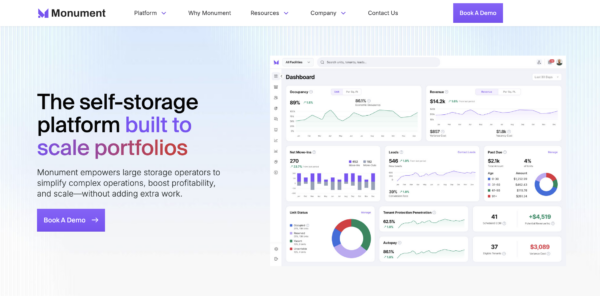
Monument’s Insights module houses nearly 100 business graphs spanning every dimension of self-storage operations, including:
These structured data streams are the foundation for Monument’s AI-assisted engine, targeted for introduction in 2026. Every rent increase outcome, delinquency resolution, and lead conversion event makes the future intelligence layer more accurate and more valuable.
For operators considering a migration, the implication is direct: the data history built on Monument today is the AI advantage accessed tomorrow. Time on the platform compounds intelligence infrastructure.
You cannot build a Tier 3 automation authority platform on weak financial infrastructure. Monument’s accounting architecture was built to private equity-grade standards from the outset—automated daily journal entries, cash and accrual support, GAAP-compliant reporting, and lease-level accuracy across the entire portfolio. For the executive preparing for a capital raise, managing lender covenants, or positioning for a REIT-level exit, this is not a feature. It is a prerequisite.
This is where Monument bridges the gap between Tier 2 and Tier 3. The system-of-record capabilities provide the trusted financial foundation that governance and capital markets demand. Built on top is the automation and intelligence layer that drives operational outcomes. Neither is sufficient without the other. Together, they define what an automation authority platform for self-storage actually looks like.
The self-storage industry is not approaching a technology upgrade cycle. It is approaching a structural reset, one that will separate operators who scale efficiently and profitably from those managing an increasingly complex portfolio with tools that were never built for the demands being placed on them.
Automation authority platforms operate on a different logic. They replace the parts of the workflow that don’t require human judgment, and they continuously improve as the data they operate on deepens. NOI per unit improves. Collections strengthen. Revenue management executes with institutional precision. Investor reporting reflects live performance rather than last month’s manually assembled figures.
The foundational architecture that makes this possible—proprietary structured data, an open ecosystem, enterprise-grade financial infrastructure, and a business intelligence platform built to feed an AI decision engine—exists today in Monument. The platform decision operators make in the next 12 to 24 months will determine whether their portfolio enters the next phase of this industry’s evolution with compounding operational leverage or with a legacy system that treats every new facility as another manual workflow to manage.
Monument was built for what comes next.
Ready to see what automation authority looks like for your portfolio? Book a demo with the Monument team and find out how operators managing 10 to 100-plus facilities are scaling with confidence.


Explore top self-storage software solutions with key features, comparisons, and tools for facility operations, marketing,...

Explore top facility management software systems for self-storage, including key features, benefits, and how these...

Discover how 3rd party self storage management improves operations, revenue, and NOI—and what to look...