


Self-storage technology covers the software, automation, access control, payment systems, and analytics that run a facility day to day. But when you’re choosing different solutions for your business, you need to consider whether these solutions were built to handle one or two facilities or an entire portfolio.
Functionalities that self-storage technology provides have to work the same way across every site in a multi-facility portfolio. For example, a rate change that takes five minutes for one facility needs to apply consistently across fifty without someone manually repeating the process at each location, so that five minutes doesn’t become four hours. Analytics needs to reconcile data from every facility the same way, every time, to give consistent results rather than requiring someone to sanity-check the numbers site by site. And as artificial intelligence (AI) moves from a novelty into daily use, the same standard applies, which is that an AI layer that works for a single facility needs to hold up when it’s scoped across a portfolio, not just answer questions about the one location it was tested on.
Newer technologies like AI, more robust automation, and open API architecture are changing what’s possible at the portfolio level. AI matters because it shifts software from something you check to something that flags issues before they cost you money, like a delinquency pattern building across a region before it shows up in next month’s collections. Open API architecture matters because it decides whether that AI, along with any other tool you want to add, can actually reach your data. A closed platform limits what you can connect and automate, no matter how good the underlying technology gets. Together, these technologies are giving multi-facility operators a level of control and speed that wasn’t realistic a few years ago.
Key Takeaways
The technology trends shaping the self-storage industry right now come down to three things: how much operational load software can absorb, how effectively it helps you increase economic occupancy, and how well it puts analytics and automation to work through AI. For operators managing large portfolios, these shifts are becoming the standard a competitive operation is measured against.
Modern self-storage technology is increasingly defined by how much manual work it removes from a team’s plate. Three shifts stand out:

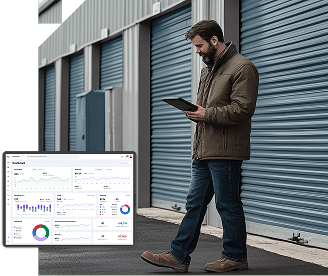
Novel self-storage construction technology is changing what a facility looks like on day one, and that shift puts new demands on the software running it. Climate-controlled units, unmanned or low-staff designs, and modular construction methods are showing up across new developments and renovations. Smart technology rollouts at major REIT operators, including app-based access and keyless entry, signal where the rest of the self-storage industry is headed, and smaller multi-facility operators are also following the same path to stay competitive.
None of these physical upgrades pay off on their own. A facility built for unmanned operation only works if the management software can actually run it that way, handling things like remote access, automated gate control, and tenant communication without someone physically on site.
Construction decisions and software decisions have to move together, or the operator ends up with a modern building running on a system that still assumes a staffed office.
| Legacy Single-Site Tools | Modern Portfolio Technology | |
|---|---|---|
| Leasing | Manual paperwork or a single-site rental page | Real-time inventory and e-signature across every facility |
| Pricing | Flat rates set by facility | Dynamic rate plans applied across custom facility groups |
| Reporting | Spreadsheets stitched together by hand | Real-time, portfolio-wide dashboards |
| Support | Facility-level troubleshooting, inconsistent response | Centralized support built for multi-site operations |
| Integrations | Closed systems, limited third-party options | Open ecosystems connecting preferred vendors |
Technology for self-storage operators breaks down into a handful of functional categories, and each one maps to a specific pain point that gets worse as a portfolio grows.
| Category | Pain Point It Solves | What to Look For |
| End-to-end management | Facilities operating as disconnected islands | One system running every site the same way |
| Websites | Stale inventory, inconsistent branding | Real-time data, SEO-friendly structure |
| Online lease signing | Lost leases from friction in checkout | Leasing, e-signature, and payment in one flow |
| Marketing | Leads falling through the cracks | Automated follow-up, abandoned cart recovery |
| Revenue optimization | Manual, inconsistent rent increases | Dynamic pricing, churn-sensitivity data |
| Analytics | Hours spent reconciling spreadsheets | Real-time, portfolio-wide dashboards |
| Vendor integrations | Being locked into one vendor’s ecosystem | Open API, broad third-party support |
End-to-end self-storage management technology is the system of record for units, occupancy, tenants, and tasks across every facility. The real test at scale is simple. Does one system run all sites, or does each facility live on its own island, forcing staff to learn and maintain separate tools depending on location?
Technology for self-storage websites needs to show real-time inventory and pricing across every facility, not a static site bolted onto the backend. A website that isn’t connected to live unit data creates a gap between what a prospect sees online and what’s actually available, and that gap costs leases. The site also needs an SEO-friendly structure built to scale across markets, since a portfolio spanning multiple states or regions needs pages that can rank locally without duplicating effort for every new facility.
Technology for self-storage online lease signing combines digital leasing, e-signature, and payment into a single flow. Friction at this step, such as an extra form, a slow load time, or a payment page that doesn’t match the rest of the experience, often costs more when it’s multiplied across dozens of locations instead of one.
Technology for self-storage marketing centers on lead capture and automated follow-up, including recovering abandoned carts. A prospect who starts a rental and doesn’t finish shouldn’t just disappear. The bigger win at portfolio scale is consistency, running the same marketing automation across every facility instead of managing campaigns site by site with varying results.
Self-storage revenue optimizer technology replaces manual, gut-feel rent increases with dynamic rate plans and automated Existing Customer Rent Increase (ECRI) workflows. Instead of guessing which tenants can absorb an increase, churn-sensitivity data shows which units and tenant segments can support higher rates without pushing move-outs, and which ones need a lighter touch.
Technology for self-storage analytics replaces facility-by-facility spreadsheets with real-time, portfolio-wide reporting. Beyond day-to-day operations, technology for self-storage analysis also needs to support a separate use case, which is investor and stakeholder reporting that holds up without hours of manual reconciliation.
Technology for self-storage vendor integrations comes down to a choice between an open ecosystem and a closed platform. A closed system locks an operator into one vendor’s tools for access control, payments, and pricing. An open ecosystem protects the tools an operator already relies on instead of forcing a rip-and-replace every time they adopt new technology.

The first step in choosing self-storage technology is figuring out where your current stack breaks or doesn’t serve your needs effectively. Is it reporting that takes too long to compile? Are pricing decisions made on instinct instead of actual data? Is it a leasing process that loses prospects at checkout? Is it support that never seems to understand the scale of the operation? A 5-facility operator and a 75-facility operator are often solving different problems, even when the surface complaint sounds the same. The smaller operator might need better automation. The larger one might need a system that can group and act on facilities as sets rather than one at a time.
It helps to walk through a typical week and note where staff spend time they shouldn’t have to. If a regional manager is pulling numbers from five different logins to build one investor update, that’s a reporting problem. If rent increases only happen when someone remembers to look at a spreadsheet, that’s a revenue management problem. Naming the actual bottleneck before evaluating vendors keeps the search focused on what will move the needle, rather than on whichever demo had the flashiest dashboard.
A short list of questions can separate technology that scales from technology that just claims to. Before signing anything, operators should ask:
Self-storage technology pricing generally falls into a few common structures:
The trap to watch for is a low headline price followed by add-on fees for things like reporting, integrations, or support that raise the real cost well above what the sales conversation implied. Before committing, operators should ask directly about implementation fees, contract length, and exactly what’s included at each tier, not just what the starting price looks like on paper.
| Pricing Model | How It Works | Best For / Watch Out For |
|---|---|---|
| Per-unit | Flat fee per storage unit managed | Predictable at scale; watch for hidden add-ons |
| Per-facility | Base rate per location, often plus extras | Can get expensive with many small facilities |
| Tiered packages | Feature bundles at set price points | Easiest to compare; confirm what’s actually included |
Monument uses a per-unit pricing model. This structure ties cost to what each facility can generate, without taking a cut of income.
Operators choose from tiered plans, each one building on the last with more capability included. A few things set the approach apart:
This structure gives operators a clear, predictable way to budget for growth, without the guesswork of tallying up add-ons after the fact.

The benefits of self-storage technology look different at portfolio scale than they do for a single facility, and they compound as an operator adds locations. A single site might feel the difference in hours saved each week. A 60-facility portfolio feels it in headcount that doesn’t need to grow at the same rate as the business, in rent increases that actually get captured instead of skipped, and in reports that go out to investors without a week of manual cleanup first.
| Benefit | What Breaks Without It at Scale | What to Look For |
|---|---|---|
| Consistency | Compliance risk from site-by-site policy drift | Portfolio-wide rules applied uniformly |
| Revenue capture | Underpriced units go unnoticed | Dynamic pricing with portfolio-wide comparison |
| Lower cost per facility | Manual workload scales with facility count | Automation for collections and communication |
| Problem detection | Issues surface too late to act on | Real-time dashboards and alerts |
| Investor-grade reporting | Manual reconciliation before every report | Accrual accounting, standardized output |
| Scalability | New acquisitions require manual rebuilds | Structures that extend automatically to new facilities |
One set of rules running the same way at every facility replaces each site interpreting policy on its own. That consistency cuts the compliance risk that comes from delinquency and lien processes handled differently from one location to the next.
Dynamic pricing and automated rent increases catch revenue that gut-feel, facility-by-facility adjustments tend to miss. A portfolio-wide view also makes it possible to compare which sites, unit types, or markets are underpriced, instead of guessing based on whichever facility got attention that week.
Automation reduces the manual workload that otherwise scales linearly with facility count under legacy tools. As automated reminders and payment retries take over repetitive collections work, call volume and the hours spent on it drop, even as the portfolio grows.
Real-time dashboards surface issues like falling occupancy, rising delinquency, or conversion drop-off at the facility or portfolio level before they show up in a monthly report. Catching a problem in week two instead of at month-end matters even more when it’s happening across dozens of sites at once.
Accrual accounting and standardized reporting mean the numbers going to ownership or lenders don’t need to be reconciled by hand first. One source of truth replaces the work of stitching together spreadsheets pulled from separate systems.
The real test of self-storage technology isn’t whether it works well for one facility. It’s whether it still works the same way at facility fifty as it did at facility five. New acquisitions should slot directly into existing structures and tagging logic and not require a manual setup process each time a facility joins the portfolio.
Monument was built specifically for the operator managing a large, growing portfolio, not adapted from software designed for a single facility. Where the categories above describe what to look for in self-storage technology, Monument’s platform is built to deliver on each one.
Taken together, these pieces are what an enterprise-grade self-storage technology stack looks like when it’s built for portfolio scale from the start, rather than adapted for it after the fact.
Multi-facility technology only pays off when it’s built to run a portfolio as one system, not dozens of separate ones. The right stack cuts errors, catches revenue that gut-feel decisions miss, and gives operators reporting they can stand behind with investors, all without breaking down as the portfolio grows.


Explore top self-storage software solutions with key features, comparisons, and tools for facility operations, marketing,...

Explore top facility management software systems for self-storage, including key features, benefits, and how these...

Discover how 3rd party self storage management improves operations, revenue, and NOI—and what to look...