

Managing security at a self-storage facility may seem pretty straightforward. Cameras, a gate lock system, perimeter lighting, and security doors are likely among the first things that you’ll think of when asked about the basics of self-storage security.
When you have a single self-storage facility, managing the security effectively translates to visually identifying gaps and taking measures to mitigate them. But when you have 20, 50, or 100 locations, your eyes can’t see everything, everywhere, all at once, so you can’t get away with a manual approach. What you do have to rely on instead is data—unusual patterns with certain vehicles coming and going, the amount a storage unit has been accessed within a period of time, questionable transactions, and more.
Your self-storage software should be able to take all of that information and surface what’s happening in your entire portfolio in real-time, connect those signals to revenue outcomes related to security where it makes sense, and give your team the visibility to act before a security gap becomes a serious business problem.
This guide addresses security self-storage from that portfolio-level perspective, not as a physical infrastructure checklist, but as an operational discipline that, when executed properly, directly protects and enhances NOI.
Key Takeaways
For multi-facility operators, a single security incident can trigger a chain of downstream consequences, occupancy softness, insurance exposure, tenant churn, and brand damage that compounds across a portfolio in ways that are difficult and slow to reverse. Given that there are are more than 50,000 self-storage facilities in the United States with an average of 430 units per facility, it’s easy to see how security becomes a major concern.
| Topic | Core Problem | Portfolio-Level Impact |
| NOI Exposure | A security incident drives occupancy softness that is slow to recover from | A 3–5% occupancy decline at one 500-unit facility costs up to $37,500 annually—multiplied across a portfolio, the NOI impact is high |
| Insurance & Legal Liability | Inconsistent security standards across facilities create compounding legal exposure | A single liability judgment in one jurisdiction can affect insurance terms across the entire portfolio |
| Churn | Tenants who perceive deteriorating security are among the first to churn from a rent increase | Security perception directly affects churn modeling, rent increase sensitivity, and direct booking rates |
| Revenue Upside | Lax security prevents you from monetizing premium access tiers—after-hours entry and business-use tenants both require trackable, credentialed access before you can charge for them. | Across a portfolio, the inability to price for after-hours access and business-use tenants represents a repeatable, facility-level revenue gap that compounds at scale. |
| Brand Integrity | A security failure at one branded location reflects on every location under that name | In a constrained demand environment, local brand reputation is a direct competitive differentiator |
| Inconsistency at Scale | Manual security protocols that work at 3 facilities are unenforceable at 25 or 50 | Without centralized visibility, self-reporting, and enforceable audit cadence, security compliance becomes reactive by design |
When people hear about even a single security incident at a self-storage facility, they’re more likely to move their stuff somewhere else. At a facility with 500 units averaging $150 per month, even a 3–5% occupancy decline means 15 to 25 vacant units—that’s $27,000 to $45,000 in annual revenue loss at one location. Multiply that across a portfolio with any concentration of similar incidents, and the NOI impact becomes important very quickly. Depending on the incident, recovery can look like weeks, months, or even years.
Claim histories and litigation risk scale with the number of facilities in a portfolio and, critically, with the consistency of security standards across them. Operators who can demonstrate standardized, documented self-storage security solutions and audit trails across all facilities are in a stronger position when a claim is filed. Those who cannot demonstrate consistency (where standards vary from site to site based on local manager discretion) face compounding exposure as the portfolio grows. A single liability judgment in one jurisdiction can affect insurance terms across the entire portfolio.
The relationship between perceived security at a self-storage facility and tenant retention is direct and measurable. Tenants who feel their unit is in a safe, well-lit, monitored facility are more likely to stay when rent increases are applied. Conversely, Existing Customer Rent Increase (ECRI) tenants who perceive a deterioration in security standards, like broken lights, malfunctioning gates, or unresolved access complaints, are among the first to move out when facing an increase.
Security perception is not a soft factor. It is a measurable input into churn modeling and rent increase sensitivity. Beyond retention, strong self-storage security drives organic lead acquisition through local search rankings. Facilities with consistently high Google Review scores are more likely to capture a meaningfully higher share of direct bookings, reducing dependence on expensive third-party marketplaces.
Inadequate security also eliminates revenue opportunities that a well-integrated security program makes possible. After-hours access is one example. Without a gate keypad system that tracks and logs tenant entry and exit, you can’t offer after-hours access as a paid tier without exposing the facility to unmonitored risk. Business use is another. Tenants storing business inventory or equipment need confidence that access is tracked and recorded before they’ll commit to that use case, and before you can price for it.
For operators managing multiple locations under a unified brand or multiple brands across a portfolio, a documented security failure at one facility reflects on every location operating under that name. In an environment where demand for storage units is more constrained than it was three years ago, brand reputation at the local level is a competitive differentiator. A well-managed self-security storage portfolio builds compound reputational equity. A poorly managed one dissipates it one incident at a time.
At three facilities, manual walkthrough protocols for lighting checks and camera audits are feasible. A regional manager can personally verify that the self-storage security camera systems are operational, that gate access logs are being reviewed, and that perimeter lighting meets standard. The process is imperfect, but it’s executable.
At 25 or 50 locations, that same approach is structurally unenforceable. The math doesn’t work. A regional team responsible for a geographically dispersed portfolio can’t conduct meaningful manual audits at the frequency required to maintain consistent standards. The result is a security compliance environment that is reactive by design—managers self-report issues, problems surface through tenant complaints or Google Reviews, and corrective action happens after the fact.
The specific failure modes that emerge at scale are consistent across portfolios:
The solution to this problem isn’t more regional managers. It’s a platform architecture that centralizes security monitoring, connects it to operational workflows, and surfaces anomalies before they become incidents. That’s where the conversation shifts from physical infrastructure to operational data.
In well run facilities, a tenant that is up to date on their rent payments can access a facility by entertaining a unique code on the gate keypad. When the tenant enters the code, the gate checks with the FMS and validates that this is a tenant in good standing.
Automated gates with tenant keycode access are the foundation of self-storage security. Every facility should have a gate entry system, and at a minimum one that connects digitally to your FMS, especially for effective security management across every facility in your portfolio. Otherwise, that foundational security isn’t as strong as it could be. Remember, the idea is to have everything integrated so that you can check information at a moment’s notice.
The mechanics of an automated system are straightforward once it’s in place:
Non-tenants, such as landscapers, maintenance crews, district managers, etc. can be assigned their own unique codes as well, keeping access controlled and accountable at every level.
For exit keypads, forward-thinking operators now recommend getting tenants to enter their access keycode a second time to leave.
The benefits of using this method include:
However, there are potential drawbacks to consider as well:
The exit keypad is the stronger choice for operators who want both security and actionable data. Every departure is tied to a specific tenant code, giving you a precise, attributed log of who left, when, and how long they were on-site. That record supports loss prevention, dispute resolution, and more precise facility oversight across a portfolio.
The cons outlined above can be mitigated with careful planning at the install stage:
Operators who prioritize auditability and control tend to find the exit keypad’s tradeoffs worth managing. For portfolio operators in particular, consistent access logging across every facility is the kind of operational data that compounds over time, reducing liability exposure and giving regional managers a cleaner picture of site activity without relying on camera review alone.

Self-storage security is an ongoing operational data problem that requires continuous visibility and analysis to manage effectively.
A self-storage security system that isn’t integrated with your central operations platform (your self-storage software) isn’t a security solution, rather it’s a collection of hardware that generates data no one is systematically reviewing. The facilities that achieve real competitive advantage from their security investments are the ones where security signals flow into a business intelligence platform and are analyzed alongside occupancy, revenue, and tenant behavior data.
When built to capture and correlate operational signals across a portfolio, a self-storage management platform generates a continuous stream of data that reveals exactly where security and operational friction is degrading the tenant experience and, by extension, revenue performance.
The signals that matter in a portfolio-level self-storage security and operations context include:
In isolation, these signals are operationally useless. A single data point from a single facility tells you very little. But surfaced together in a business intelligence platform like Monument—with close to 100 analytical dashboards covering operations, revenue management, tenant acquisition, and investor reporting—they become a precise diagnostic tool that allows portfolio operators to identify, investigate, and resolve security and operational friction before it becomes an incident, a vacancy, or a liability claim.

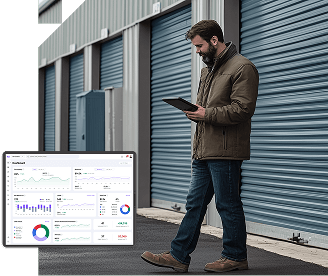
The following two operator examples illustrate what portfolio-level security data makes possible in practice—one focused on diagnosing the chronic operational friction that erodes NOI over months, the other on detecting and responding to an active security threat.
One operator knew two of their locations were underperforming. Call center volume was higher, tenant satisfaction was lower, and something about the on-site experience felt off. But without the data to pinpoint the problem, it stayed a gut feeling. They knew something was wrong, they just couldn’t prove what, or where.
After deploying Monument’s Insights module, that changed. The platform broke down performance data by individual location, and within the first reporting cycles, the problem came into focus. Both underperforming locations showed elevated access-related tenant interactions and indications that poor signage and wayfinding were frustrating tenants enough to drive move-outs above the portfolio average.

A sample of Monument’s Facilities Insights dashboard.
Armed with that data, the operator knew exactly where to act. Updated signage and resolved access friction points improved the on-site experience. And they could now could track the results directly through Google Review scores, occupancy recovery, and NOI improvement.
A second operator used Monument’s gate access reporting to catch something far more serious. During a routine portfolio review, they pulled access data for several properties showing unusual activity. Specifically, one rural facility showed that a recently onboarded tenant had accessed their unit an abnormal number of times compared to everyone else at that location.
The facility was in an area getting hit by a wave of community break-ins, including churches, local businesses, neighboring properties. The operator was already in contact with law enforcement. When they brought Monument’s gate access data to the investigation, police had something they didn’t have before: a specific suspect and a documented access trail to pursue.
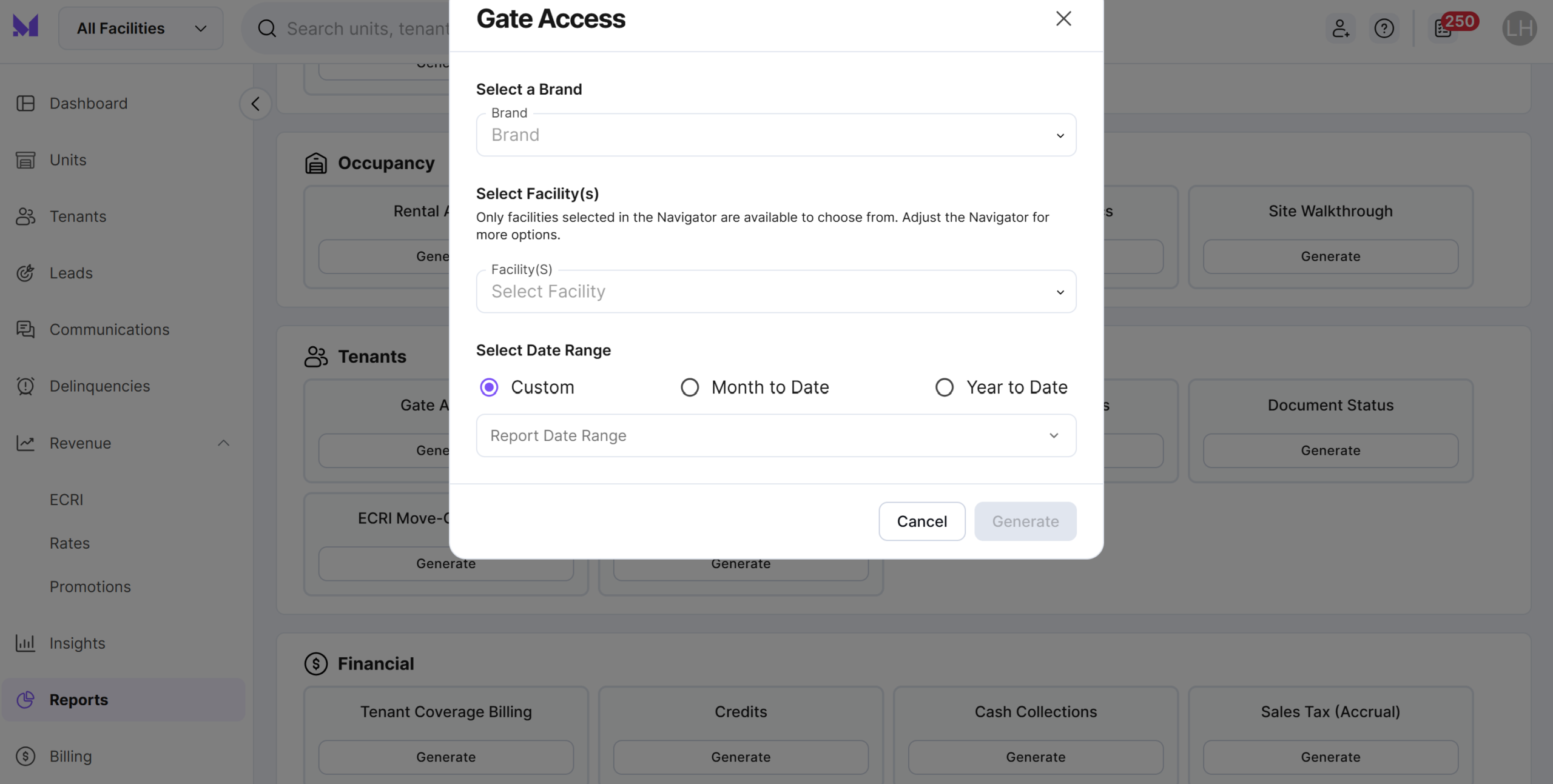
Example of Monument’s Gate Access Reporting Parameters.
As the operator put it: “Most people have cameras that capture crime, but it rarely identifies who the culprit is.”
That’s the distinction. Cameras record what happened. Access pattern data can surface who’s worth looking at before the next incident occurs.
These two stories illustrate that security intelligence at the portfolio level works on two timescales: the slow erosion of NOI through unresolved operational friction, and the acute threat that demands an immediate response. A properly built business intelligence platform surfaces both, which is why connecting security data to your central operations platform isn’t optional. It’s a core requirement for managing a serious portfolio.
The table below maps key operational security signals to their revenue management implications and recommended actions:
| Operational Signal | Data Source | Potential Revenue Impact | Recommended Action |
|---|---|---|---|
| Elevated gate access failure rate | Gate access logs / Ops platform | Tenant churn, negative reviews, occupancy softness | Dispatch maintenance; trigger automated task in platform |
| Access pattern anomaly (per-unit) | Gate access reporting | Security incident risk, liability exposure | Review tenant access history; escalate to management |
| Move-out rate above portfolio baseline | Insights — Operations dashboard | Occupancy decline, NOI erosion | Cross-reference with access complaints and review scores |
| Call center volume spike (access-related) | Call center data / Insights | Operational cost, tenant dissatisfaction | Investigate access control system; update tenant communications |
| Low review score correlated with security | Review monitoring / Insights | Conversion decline, reduced direct bookings | Prioritize site visit and security audit; address root causes |
| ECRI churn rate above benchmark | Revenue Management — ECRI tool | Revenue growth below potential | Segment by security satisfaction; adjust increase cadence |

Investing in security hardware is only half the equation. What determines whether that investment actually protects your portfolio is whether your facility management platform can connect those systems, surface the data they generate, and route it into operational workflows across every location, from a single login.
A common scenario among operators who’ve scaled on legacy software is that they’ve invested in solid security camera systems, deployed modern access control, and installed proper perimeter lighting at every facility. But when it’s time to analyze the data from these systems, they don’t talk to the central platform. The gate system, cameras, and lighting all work, but the data from them is fragmented.
The cost of that disconnect is real and ongoing:
An open API is what allows your gate system, access control vendor, camera solutions, and preferred third-party tools to feed data into a single operational view. Without it, every security technology investment you make operates in a silo.
The gap between an open platform and a closed one also widens over time. Proprietary ecosystems both limit your current choices, and lock you out of future ones. AI-assisted anomaly detection and predictive security analytics are closer than most operators expect. The operators on open, API-first platforms will deploy those capabilities. The ones on closed platforms will watch from the outside.
This is the baseline. If your team has to log into multiple systems to check gate access status, camera health, or access control events across the portfolio, the platform isn’t built for multi-facility management. Any operator running more than ten locations needs centralized visibility as a non-negotiable.
Visibility without action is incomplete. A platform that surfaces a gate failure anomaly but doesn’t route it to the right site manager is giving you information without operational leverage. Security signals need to live inside your automation layer, not alongside it.
Ask for a documented list of current integrations and the process for building new ones before go-live. An enterprise-grade platform should connect to the vendors already in your stack. If the answer is that you’ll need to switch to their proprietary hardware partners, that’s a red flag worth taking seriously.
This matters more than most operators initially appreciate. You need to know how long access log data is retained, how it’s exported, and whether it can be filtered by facility, tenant, time window, and access frequency. As the operator examples earlier in this article show, this data can carry direct legal and investigative weight. It needs to be accessible and reportable, not buried in a system that makes meaningful analysis difficult.
Security in self storage, approached properly at the portfolio level, is an ongoing operational discipline, not a one-time infrastructure decision. Cameras, security doors, perimeter lighting, and access control systems are necessary baseline investments, but they are inputs to a larger operational system, not the system itself.
The operators who build durable competitive advantage from their security investments are those who treat security as a data problem as much as a physical infrastructure problem. In practice, that means being able to:
Delivering that capability requires a platform built for scale, with an open ecosystem that connects your preferred security vendors, a business intelligence layer that surfaces security signals alongside operational and revenue data, and the analytical depth to turn those signals into actionable decisions.
The competitive advantage doesn’t belong to the portfolio with the most cameras. It belongs to the operator who can see, diagnose, and act on security and operational signals across every facility from a single platform.
As AI-assisted analytics continue to mature, the next frontier for portfolio-level security management is predicting the conditions that precede incidents before they occur. Monument’s Insights platform is being built with exactly that in mind. And for operators managing complex, multi-facility portfolios, that capability will define the next generation of competitive differentiation.
Book a Demo with Monument today, and see how our portfolio-level insights can surface operational faps your current platform isn’t showing you, and connect security signals directly to revenue outcomes across your entire portfolio.


Explore top self-storage software solutions with key features, comparisons, and tools for facility operations, marketing,...

Explore top facility management software systems for self-storage, including key features, benefits, and how these...

Discover how 3rd party self storage management improves operations, revenue, and NOI—and what to look...