


Managing a portfolio of self-storage facilities at scale is a fundamentally different operational challenge than managing one. The systems, workflows, and reporting structures that served you well at five locations will fracture at fifteen—and by the time you reach thirty or fifty, the cost of that fragmentation shows up directly in your NOI, your investor relationships, and your team’s capacity to execute.
The problem isn’t growth. Growth is the goal. The problem is that most facility management platforms were architected for a single site and later adapted by shoehorning support for third-party apps, or trying to build internal tools to support multiple facilities that don’t jive well with the single-facility software foundation.
This article examines what a purpose-built portfolio management platform must actually deliver for operators running ten or more facilities, and where legacy systems consistently fall short.
The analysis is organized around five strategic pillars that define enterprise-grade storage unit solutions:
Each pillar represents a distinct dimension of portfolio performance. Taken together, they form the framework serious operators use to evaluate whether their current platform can scale with them or is quietly becoming the ceiling on their growth.
Key takeaways
Self-storage unit solutions is a broad term, but what it means in practice depends entirely on the complexity of what you’re managing. For an operator with a handful of locations, a basic facility management system typically handles the fundamentals well enough with built-in tools: unit tracking, billing, tenant communication, and a simple reporting view. That’s workable when your portfolio is small and your team is centralized.
The problem is that software designed for single-site management doesn’t scale. The moment an operator crosses roughly ten locations, the architecture of most legacy platforms begins to work against them. Data lives in separate silos for each property. Delinquency processes that worked at one location need to be manually replicated at every new site you add. There’s no unified view of portfolio performance without exporting data, building spreadsheets, and cobbling together a picture from twelve different sources. Teams at individual facilities operate inconsistently because there’s no centralized way to enforce standard workflows. Every new acquisition adds not just a property, but another layer of manual effort.
This is the complexity ceiling, and it’s the reason operators of 20, 50, or 100 locations are evaluating the market for a fundamentally different class of self-storage unit solutions.
Most operators think of fragmentation as just an operational headache, when it’’s actually also a revenue problem.
Take rent increases. When Existing Customer Rent Increase (ECRI) workflows aren’t centralized, facility managers handle them differently—some execute on schedule, some run late, some skip the process altogether. Across 30 facilities, even a one-month delay across a portion of your portfolio means real money left uncollected against what you projected.
Financial reporting creates a similar drag. When each facility runs on its own isolated self-storage unit solutions, your finance team has to manually pull and reconcile data from multiple sources before you have numbers accurate enough to share with investors. That can take days, and the chances of errors is higher than if it was able to be done automatically. Also, when your investors are waiting on financials, every delay chips away at the confident relationship you’ve worked to build with them.
The point is this: the right self-storage unit solutions for a scaling portfolio are less about adding features and more about how the data from them can be centralized and be actionable at one source that every stakeholder can access.
The five pillars map directly to the operational progression of a well-run storage business: operate efficiently, fill units, optimize revenue, analyze performance, and do all of that with the right tools that can connect to a centralized platform.
Self-storage management solutions at the portfolio level have to solve two connected problems:
The answer to both questions lies in automation architecture. When processes depend on manual execution, outcomes vary by facility, by manager, and by day. A well-designed automation layer eliminates that variability: every tenant gets the same collections sequence, every payment failure triggers the same retry logic, every delinquency escalates on the same schedule.
Faster collections and higher recovery rates on delinquent balances flow directly to NOI. In addition, because automated workflows run without staff intervention, they also directly reduce operating costs. Fewer manual touchpoints means less call center volume, less administrative overhead, and less time spent by regional managers chasing down site-level inconsistencies.
Best-in-class platforms allow operators to define Automation Rules that execute consistently across every facility in the portfolio.
These rules operate on triggers, such as a payment failure, a lease signing, an invoice becoming past due, or a unit reaching a certain delinquency age, and respond with actions like sending an SMS or email from a pre-built template, assessing a fee, creating a task for a team member, or initiating a collections sequence. The rule is set once and runs everywhere, without requiring anyone to monitor or manually execute it. If you do need manual oversight at some point in the process for more complex triggered events, you can incorporate that in your Automation Rules, too. That consistency also accelerates time-to-value for new acquisitions, since a facility brought onto the platform inherits your existing rule set from day one rather than requiring months of manual process-building. And because automated workflows replace tasks that would otherwise require staff time, the cost savings compound as your portfolio grows.
To sum it up, operators who deploy comprehensive automation rules often report significant reductions in call center volume, faster collections resolution, and better efficiency with administrative tasks overall.
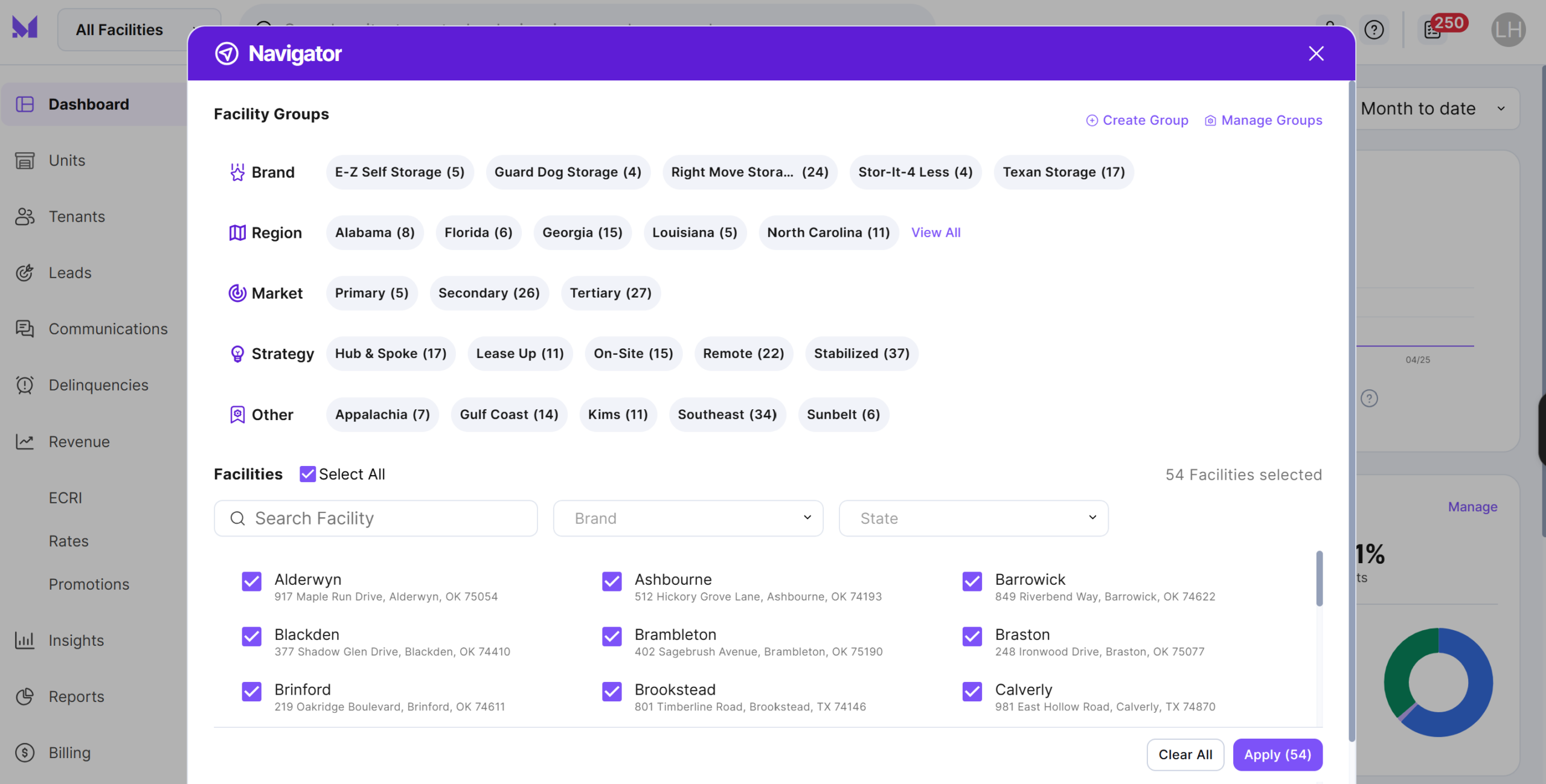
When you pair automations with Monument’s Navigator, a portfolio-management interface that lets operators define custom property sets, it allows you to manage, report on, and automate across those sets simultaneously, giving you true centralized control. Property sets can be defined by virtually any operational dimension: geography (Greater Dallas, Southwest), brand (Lake Self-Storage, RV & Boat Self-Storage), leasing stage (lease-up, stabilized), market size, facility size, amenity type, or storage use, among others.
The power is in combining a set with a targeted action. An operator can apply aggressive promotional pricing to all lease-up facilities in tertiary markets, push ECRI cycles to stabilized properties in an underperforming district, or send a specific delinquency sequence to all non-gated locations with a higher rate of access issues, each as a single operation rather than a facility-by-facility exercise. An operator overseeing 40 facilities can run a portfolio-wide delinquency campaign in minutes, not days.
The Dashboard layer then provides an at-a-glance KPI view filtered by whatever property set is active: occupancy, revenue, net move-ins, lead conversion, past due balances, and autopay penetration, all in one view, without logging into individual systems.
Sample of Monument’s Navigator dashboard.

Every lease that comes in through a direct online rental is more profitable than one that comes through a third-party marketplace. Of course, the reason why marketplaces are successful is because of exposure—listing your facility on one gives you the visibility to drive bookings, but the marketplace charges a commission for every booking, because that’s how they make money.
There’s a way around it though. A well-built rental website should be your foundation, while a third-party marketplace should be viewed as your advertising.
So how does that work? Well, the billboard effect is a common term in the hospitality industry, and it means that when someone views your listing on a third-party marketplace, they remember it and visit your website directly later. However, if your website isn’t user-friendly, they’ll bounce back to the marketplace to book with you.
Converting more prospects at a higher margin requires getting several things right at once:
Monument gives you the option to build a conversion-optimized rental website that’s already connected to the rest of the platform. This makes it much easier to ensure every integration will always work correctly, helping you set up easier automations and unlock new revenue opportunities.
The majority of operators at portfolio scale are leaving revenue on the table. Not because they’re inattentive, but because the tools they’re using don’t give them the analytical foundation required to price with the discipline of a public REIT.
REIT-level revenue management means applying data-driven, dynamic pricing strategies at scale:
The ECRI workflow is where the NOI impact is most direct. When rent increase recommendations are automated and calibrated to tenant behavior (not applied as a flat-rate increase across the board) operators retain more tenants post-increase while capturing more incremental revenue per unit.
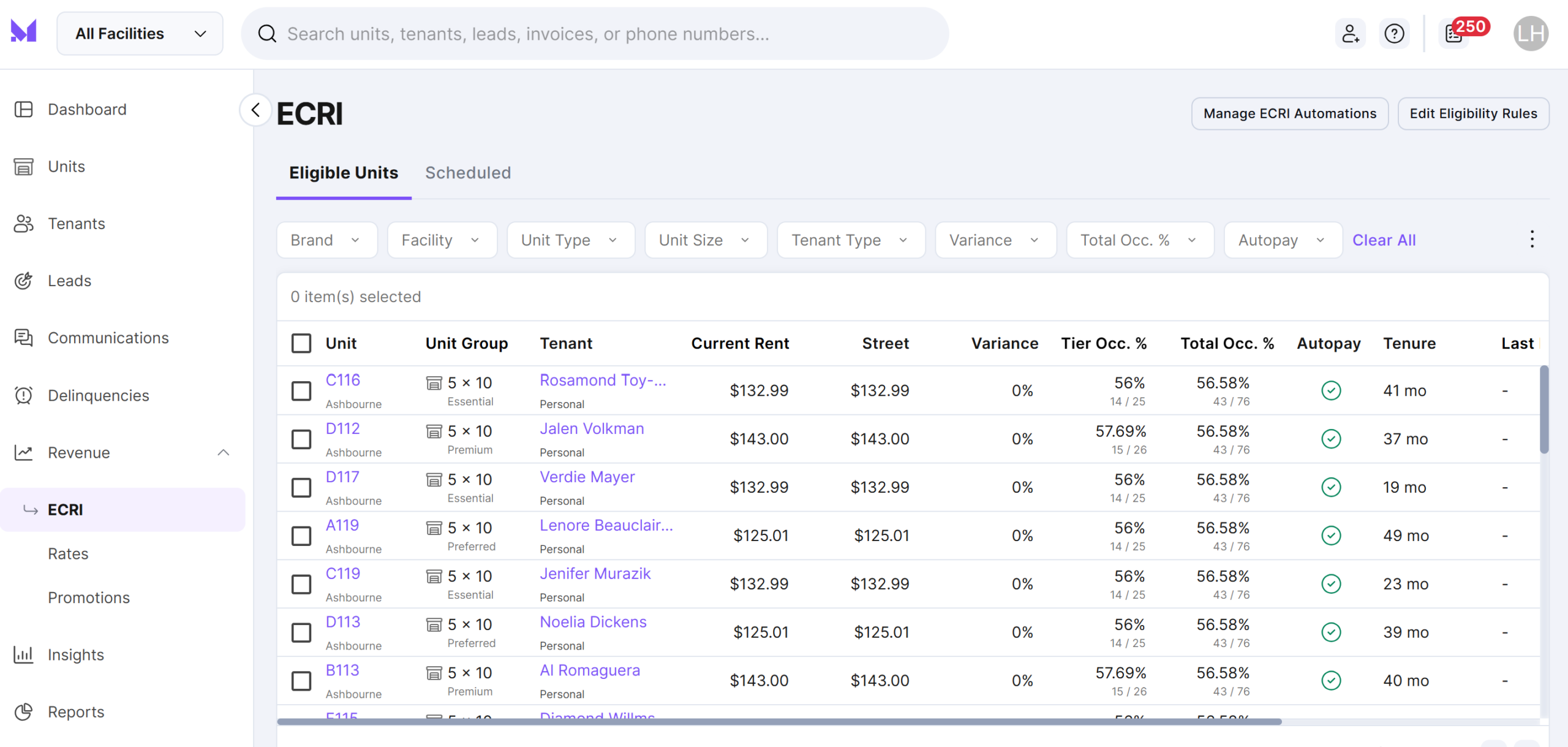
Sample of Monument’s ECRI Workflow dashboard.
Dynamic rate plans extend the same logic to new-tenant pricing. Setting pricing rules that respond to occupancy by reducing friction and offering promotions when occupancy drops below a threshold, tightening rates as units fill, removes the manual judgment calls that lead to revenue leakage at individual facilities.
The Revenue Management Insights layer closes the loop. Operators can measure the actual incremental revenue generated by each rent increase campaign, track tenant churn against predictions, and compare their rates to competitors using integrated market benchmarking. That evidence base is what transforms revenue management from a departmental function into a credible, investor-grade narrative about the performance of the portfolio.
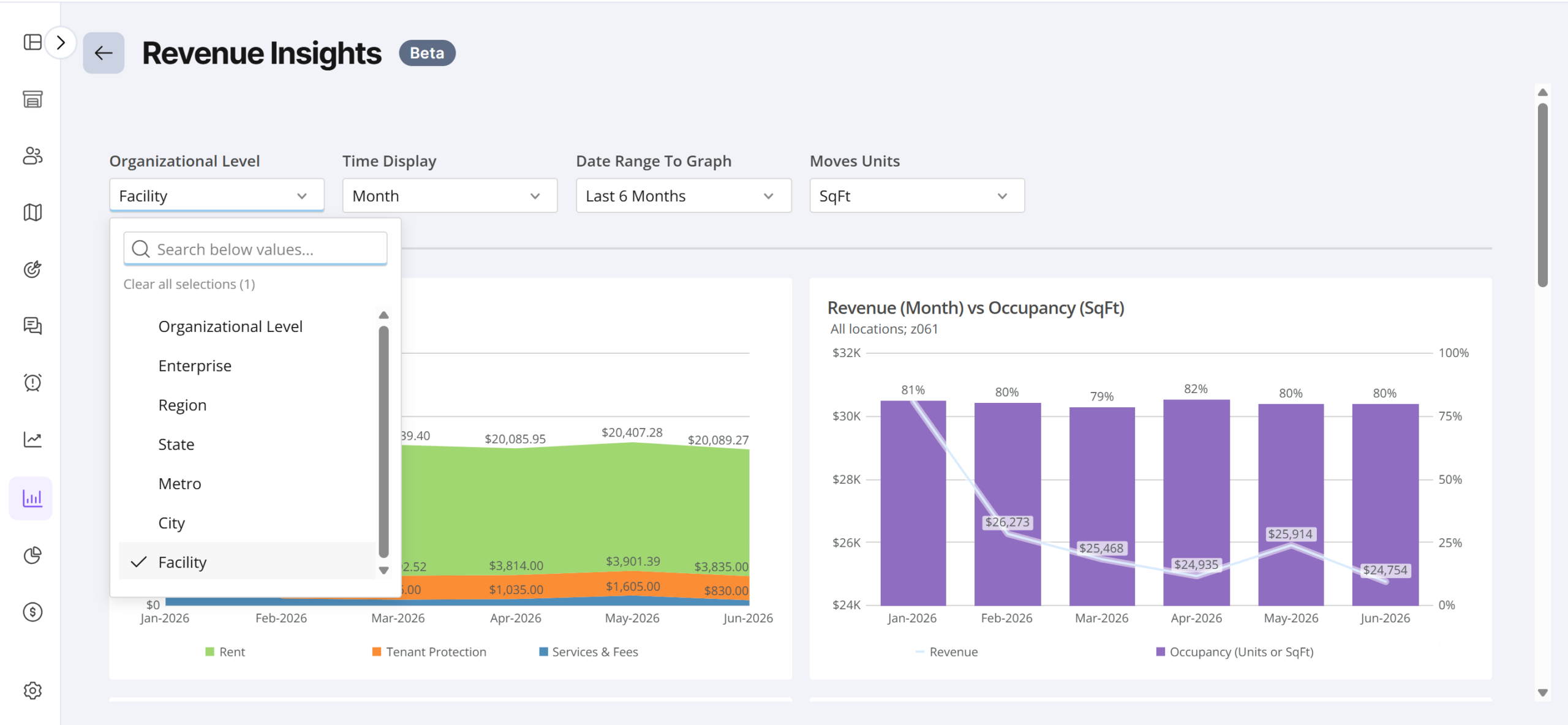
Sample of Monument’s Revenue Insights dashboard.
For executives running a multi-facility portfolio, analytics is how you demonstrate to investors that you know exactly what’s happening in your business and why.
Basic KPI dashboards don’t cut it at this level. Monument’s Insights module can analyze any set of facilities with over 100 business graphs organized across focused dashboards covering marketing, customer acquisition, operations, revenue management, and investor reporting. The goal is to connect the dots between different parts of your operation so you can make faster, better-informed decisions without spending hours pulling reports manually.
The Investor Insights dashboard is where this pays off most directly for executives managing institutional capital. Instead of spending days assembling a performance update from multiple systems, you get a consolidated, presentation-ready view of your portfolio that’s ready to share with capital partners when you need it.
The accounting layer is what makes all of this credible. Most legacy facility management systems only produce cash-basis financials. If you’re reporting to investors, lenders, or private equity partners, that means your team is manually converting cash records to accrual—a time-consuming process that introduces risk every time it’s done. Monument automates daily journal entries, supports both cash and accrual reporting, and delivers lease-level accuracy across every property in your portfolio. The result is financials you can stand behind.
Of all the objections that sophisticated operators raise when evaluating a new platform, the most emotionally charged is the one about lock-in. Operators who’ve spent years on legacy platforms know what it feels like to be trapped in a vendor’s preferred ecosystem that doesn’t integrate with the hardware (such as gate controls, cameras, and unit access tracking) they’ve already deployed at 40 facilities.
The right self-storage solutions are built on an open, API-first architecture that treats the platform as a hub, not a walled garden.
For self-storage gate security solutions and access control, this especially matters. An operator managing dozens of facilities may have existing relationships with Open Tech, Swivel, or other access control providers. Switching platforms shouldn’t mean losing those relationships or renegotiating hardware contracts. An open ecosystem integrates with the vendors the operator has already chosen, adding intelligence and automation on top of an existing tech stack rather than requiring its wholesale replacement.
The same logic applies to pricing optimization tools, third-party rental websites (for operators who have heavily customized their existing site), reputation management systems, tenant protection providers, and chatbot integrations. An open API means operators can connect best-in-class tools for each function rather than accepting the lowest-common-denominator offering bundled into a closed platform.
This is a direct competitive advantage relative to legacy incumbents. Closed ecosystems restrict operator choice and consistently fail to deliver best-in-class capability at every integration point. Operators managing complex, multi-facility portfolios, where the technology stack has been built and refined over the years, need the freedom to retain what’s working and replace what isn’t.
| Pillar | Core Pain Point | Key Capability | Primary Metric |
|---|---|---|---|
| Operations | Manual effort across disparate systems | Automation Rules, Navigator, Dashboard | Headcount, call center volume |
| Leasing | Low direct booking conversion | SEO rental website, abandoned cart capture | Cost per acquisition, occupancy |
| Revenue Management | Flat-rate, gut-feel pricing | Dynamic ECRI, rate plans, churn analysis | NOI, revenue per occupied unit |
| Analytics & Insights | Investor reporting delays, cash-only financials | 100 business graphs, GAAP accrual accounting | Reporting time, investor confidence |
| Integrations | Vendor lock-in, closed ecosystem | Open API, third-party connectivity | Tech stack flexibility |

For an operator who has reached the complexity ceiling, the question is which platform can actually handle what you’re managing, and how to evaluate that platform without being misled by marketing that sounds compelling but doesn’t survive real operational scrutiny.
The first thing that breaks when you scale is the ratio between your facility count and the effort required to manage it. If you added 20% more facilities and your operational workload grew by 20% or more, that’s the signal. Growth should not be a 1:1 relationship between new locations and new effort, but without the right platform, it almost always is.
Operators running the right FMS report a different experience. A 20% increase in facility count doesn’t require a 20% increase in headcount or hours. The platform absorbs the additional complexity. Automations that already run across your portfolio extend to new facilities without rebuilding from scratch. Reporting that covers 30 locations covers 36 just as easily. The FMS scales with your portfolio, but your operational burden doesn’t.
There’s a pattern to how successful operators reach the decision to change platforms. They’ve built something real—a portfolio of 20, 40, or 80 locations, years in the making. And then the tools that supported that growth stop being assets and become friction points instead.
The systems that worked at three facilities aren’t designed for fifty. Reporting that satisfied early investors doesn’t hold up when capital partners expect GAAP-compliant accrual statements. Manual delinquency workflows create compliance gaps at scale. The bundled rental website costs you direct bookings against competitors with better SEO and a frictionless tenant experience.
The complexity ceiling isn’t a failure, it’s a symptom of success that your current platform was never engineered to handle.
Self-storage unit management solutions built for this stage of growth are architected around the portfolio, not the single facility. They centralize operations, automation, and reporting so that adding a new acquisition is additive rather than burdensome. They apply the same pricing discipline to your private portfolio that public REITs apply to theirs. They provide the investor-grade analytics and GAAP-compliant accounting your capital relationships require. And they integrate with the vendors you’ve already chosen rather than forcing you to rebuild your tech stack around a closed ecosystem.
The right platform doesn’t just solve today’s problems. It positions your portfolio for the next stage of growth with the data, automation, and operational clarity that scale demands.
Ready to see how Monument addresses your portfolio’s specific challenges? Book a personalized demo today.


Explore top self-storage software solutions with key features, comparisons, and tools for facility operations, marketing,...

Explore top facility management software systems for self-storage, including key features, benefits, and how these...

Discover how 3rd party self storage management improves operations, revenue, and NOI—and what to look...