


The self-storage landscape has undergone a radical structural transformation. What was once a fragmented industry defined by local single-facility operations has been reclaimed by institutional-grade players managing massive, geographically dispersed portfolios.
However, as these portfolios expand from a handful of sites to dozens or even hundreds, operators invariably hit a “complexity ceiling.” Legacy management tools—designed for the era of on-site managers and paper ledgers—begin to fracture under the weight of high-volume operational demands. For the scaling operator managing diverse portfolios, the path forward requires a shift from localized oversight to total portfolio control. The goal isn’t just managing a facility like it was before. Instead, it’s the strategic optimization of a high-performance asset class.
This transition demands automated storage systems: enterprise-grade platforms purpose-built to centralize command, eliminate manual friction, and drive Net Operating Income (NOI) through software-defined precision.
In this guide, we explore how automation serves as the definitive architecture for the next stage of institutional growth.
Key Takeaways
Automated storage systems are enterprise-level management platforms that integrate software and hardware to perform core facility tasks without manual intervention. By centralizing portfolio data, these systems replace fragmented legacy workflows with streamlined, rule-based logic to increase operational velocity and ensure consistent, portfolio-wide execution.
These systems effectively automate critical, high-frequency tasks such as:
Automation helps turn a self-storage facility from a local small business into a high-yield, precision-engineered financial instrument as the business scales. At the same time, it moves the operator from the chaos of growth into a position of total portfolio control.
The specific benefits of automated self-storage include:
The most immediate operational impact of portfolio-wide workflow automation is a measurable reduction in payroll, call center volume, and regional overhead. Legacy systems often require managers to manually work delinquencies, chase collections, and follow up on leads facility by facility. Monument’s automation engine handles these workflows continuously and consistently across every location. This represents a genuine shift from a labor-intensive, site-by-site model toward centralized regional oversight. Furthermore, every dollar saved in the expense ratio flows directly to your NOI, hardening the asset against market softness and increasing its valuation.

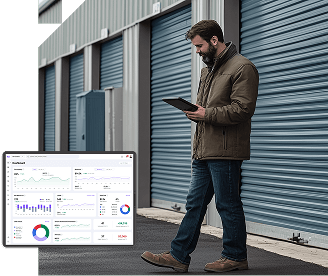
In an era defined by instant gratification, modern tenants expect a “buy-now” experience. If a prospect is forced to wait for traditional office hours to sign a lease or gain access, they will move to a competitor who offers an immediate digital solution. Automated systems provide a 24/7, frictionless leasing engine. Through integrated, optimized rental websites, tenants can select a unit, sign a GAAP-compliant lease, and receive their access codes at 2:00 AM without a single interaction with your staff. This ensures you never miss a lead, even if a tenant requires facility access outside of standard business hours.
As a portfolio expands from 10 to 100+ facilities, the complexity ceiling typically forces operators to hire massive corporate teams to manage the administrative chaos. Automation solves this by creating a repeatable, software-defined operating model. Whether you are adding one facility or twenty, our portfolio-first architecture ensures that your delinquency rules, communication triggers, and accounting standards remain uniform across the entire map. In other words, you gain the ability to scale your unit count exponentially while keeping your corporate headcount linear.
Net Operating Income is the ultimate metric of success, and automation is its most powerful lever. By simultaneously lowering operating expenses (OpEx) and capturing more revenue through lead recovery and 24/7 availability, automated systems widen the margin of every square foot you own. Additionally, by removing human error from the billing and collection cycle, you ensure that every dollar of potential revenue is tracked and captured, rather than lost to the administrative oversights common in legacy management.
In a high-stakes market, “set-it-and-forget-it” pricing is a recipe for stagnation and leaves you vulnerable to more agile competitors. Automated storage systems enable sophisticated, data-driven revenue management that outpaces any manual effort. These tools analyze real-time demand, occupancy levels, and historical trends to execute precise pricing adjustments. By automating ECRI and dynamic street rates, you can maximize revenue per square foot across your entire portfolio, ensuring your assets are always performing at their peak.

Another important part of managing a high number of facilities that an operator needs to consider is implementing a system that creates a unified, centralized ecosystem where the automations can work seamlessly between different pieces of software. This is because a truly automated storage solution isn’t just a single piece of software, it’s a whole synchronized, enterprise-grade tech stack that assists your management team.
Below are the critical components that define a high-performance, automated infrastructure:
At the center of the ecosystem sits the facility management software (FMS). While legacy systems often function more like digital ledgers, a modern FMS serves as the intelligent command center for the entire portfolio.
This platform is responsible for the logic behind operations, automating:
An automated facility is only as secure as its integration. Modern access technologies have evolved beyond the simple keypad and are now deeply embedded into the management software to ensure that access is a real-time reflection of a tenant’s standing.
Operators with leading portfolios integrate access through:
A truly frictionless rental experience is powered by an integrated web engine that serves as a 24/7 virtual leasing agent. For the elite operator, this means capturing the “buy-now” customer who expects to move in immediately without issue.
The system automatically handles the high-stakes steps of the leasing process:
Revenue leakage is the silent killer of NOI. Automated billing systems replace the chase of manual collections with an efficient, rule-based engine designed to maximize cash flow.
These systems handle:
| Technology Layer | Core Function | Example Automation Capability | Operational Benefit |
| Facility Management (FMS) | Portfolio Command & Control | Automated ECRI (Rent Increase) Execution | Maximized NOI & GAAP-Compliant Accounting |
| Access Control | Perimeter & Unit Security | Instant Revocation upon Delinquency | Reduced Liability & Eliminated Manual Overlocks |
| Self-Service Web Engine | Digital Leasing & Onboarding | 24/7 “Buy-Now” Tenant Conversions | Lower Customer Acquisition Cost (CAC) |
| Payment Automation | Revenue Cycle Management | Automated Lien Notice Scheduling | Improved Cash Flow & Reduced Staff Labor |
An automated self-storage kiosk is a ruggedized, self-service terminal located on-site that serves as a 24/7 digital leasing office. While much of the tenant journey has migrated to mobile devices, the physical facility still remains as a critical touchpoint for drive-by leads and customers who prefer a tangible interface.
Functioning with the same reliability and intuitive logic as an airport check-in terminal or a high-end bank ATM, these kiosks allow customers to execute complex transactions—from unit selection to move-in—without the need for an on-site manager. For the operator, the kiosk acts as a permanent, non-salaried employee that never misses a shift and executes every workflow with GAAP-compliant precision.
A sophisticated kiosk system functions as a payment portal, but also as a fully integrated extension of your management platform. By connecting directly to your “single source of truth,” (i.e., your FMS) the kiosk ensures that the data seen by the customer on-site matches the data in your corporate dashboard.
Modern self-storage kiosk systems empower customers to:
By integrating kiosks into an automated storage system, operators ensure they capture 100% of the foot traffic at their facilities, regardless of the hour or the availability of regional staff.
In the pursuit of maximizing NOI, scaling operators are moving beyond the binary choice of fully staffed or unstaffed facilities. Instead, they’re going for a hybrid model, which combines on-site staff during peak hours with automated kiosks and centralized remote support during off-hours. This allows high-performance portfolios to maintain a consistent brand presence and high-quality tenant experience across every location, regardless of time of day.
This operational flexibility is only achievable when the underlying platform can support it. Monument’s automation engine ensures that the workflows running in the background— collections, tenant communications, delinquency management and more—are executing consistently whether a manager is on site or not.
Specifically, the deployment of kiosks allows operators to:
While both online rental platforms and on-site kiosks serve the same ultimate goal—frictionless, 24/7 tenant onboarding—they address different stages of the customer journey. For the high-performance operator, these are not redundant tools; they are complementary layers of a sophisticated digital leasing strategy.
In a hybrid facility model, the management system serves as the central brain, while these channels act as the “limbs” that interact with the market. Whether a tenant is searching for a unit from their living room or standing at the gate of a satellite facility, the transition from prospect to paying tenant is handled with the same REIT-level precision.
The following table summarizes how these two components of an automated storage system function as distinct, high-impact levers for your portfolio:
| Leasing Channel | Customer Experience | Operational Role | Use Case |
| Online Rentals | Mobile-first, “buy-now” convenience from any location. | Primary digital acquisition engine; minimizes CAC through web conversions. | Capturing researched leads and “book-ahead” tenants. |
| Self-Storage Kiosks | Tactile, on-site presence with a physical interface. | Bridges the gap for physical foot traffic; enables unmanned satellite sites. | Capturing “drive-by” leads and providing on-site support. |
For the sophisticated operator, the transition to automated storage systems is not merely a technical upgrade—it is a strategic mandate. As portfolios scale toward the institutional level, the manual workflows and rigid architectures of legacy products like SiteLink and storEDGE become liabilities that stifle growth and erode Net Operating Income.
By embracing an automated ecosystem, high-performance operators reclaim their most valuable asset: control. Whether through the implementation of 24/7 digital leasing engines, the deployment of on-site kiosks for hybrid facility models, or the execution of data-driven revenue management strategies, automation provides the REIT-level sophistication required to lead the market.
At Monument, we believe that growth should not come at the cost of operational chaos. By partnering with a platform built for the elite, operators can move beyond the complexity ceiling, driving NOI and maximizing asset value through a seamless blend of technology and professional intuition. The future of self-storage is automated, open, and relentlessly efficient.
Book a demo today and learn more about how our software supports your scaling efforts.


Explore top self-storage software solutions with key features, comparisons, and tools for facility operations, marketing,...

Explore top facility management software systems for self-storage, including key features, benefits, and how these...

Discover how 3rd party self storage management improves operations, revenue, and NOI—and what to look...